





Thank you dear subscribers, we are overwhelmed with your response.
Your Turn is a unique section from ThePrint featuring points of view from its subscribers. If you are a subscriber, have a point of view, please send it to us. If not, do subscribe here: https://theprint.in/subscribe/
Every year brings its share of crises—grey skies that choke our cities, rivers that overflow and then run dry, landslides that erase homes, and buildings that collapse from neglect. Numbers flash across our screens: AQI levels, rainfall totals, contamination rates, casualty counts. Yet few stop to ask: Do these numbers make sense? Who collected them, and what do they reveal about our choices? We rarely demand data (pramāṇa), and when we do get it, we seldom interpret it (anumāna).
India has not conducted a full census since 2011. Public datasets on pollution, health, and education are often outdated or opaque. We speak endlessly about development, but seldom with evidence. In a nation that prides itself on its engineers and scientists, why has the habit of asking for data—and reasoning with it—become so rare?
If this gap in evidence-based thinking begins anywhere, it begins in how we teach. The classroom is often where curiosity first meets authority—and too often, authority wins.
What our policies say—but classrooms don’t practice
The OECD’s PISA 2025 Science Framework defines the purpose of science education as “preparedness for life,” emphasizing explaining phenomena, evaluating scientific enquiry, and interpreting evidence for decision-making. Importantly, it includes science identity—valuing inquiry, evidence, and environmental agency as part of being an educated citizen.
India’s National Education Policy 2020 echoes this vision. It calls for “conceptual understanding rather than rote learning,” and encourages creativity and critical thinking to support logical decision-making and innovation.
Both frameworks agree: classrooms must help students reason with evidence. Yet our schools still reward recall far more than curiosity.
Answers are everywhere—but inquiry is disappearing
In an age where students can retrieve any fact in seconds—through Google, YouTube, and AI—our role is no longer to supply answers but to strengthen the ability to question. Many students can find information instantly but struggle to interpret it, verify it, or use it to solve a problem. They are surrounded by answers, yet starved of inquiry.
This tension is not new. For decades, science teaching in India has leaned toward memorization. Schools invest in smart boards and lab kits, yet the curiosity deficit persists. The NEP acknowledges this gap and calls for pedagogies that emphasize reasoning, creativity, and respect for local context.
The challenge is not only to upgrade facilities—it is to give teachers the time, trust, and training to cultivate better questions.
Inquiry is inexpensive—but transformative
Imagine a classroom where students explore gravity not by reciting g = 9.8 m/s², but by timing falling objects and calculating it themselves. Or where they test the water quality of local ponds to understand contamination and public health. These are not expensive experiments; they are acts of empowerment.
Inquiry makes learning active. It turns science from a textbook chapter into a way of seeing. Students begin to understand how evidence is gathered, how it is filtered, and how decisions rely on it. This prepares them not just for exams but for citizenship in a world where misinformation spreads faster than facts.
Inquiry is Indian—our own traditions prove it
India’s intellectual traditions show that inquiry is not foreign to our culture. For centuries, this has been called a land of seekers—a civilization where questioning was not rebellion but reverence.
Ancient thinkers formalized these instincts in the concept of pramāṇa—valid means of knowing—such as:
- pratyakṣa (knowledge through direct perception)
- anumāna (knowledge through reasoning)
Developed in the Nyāya school, these ideas resemble what we now call evidence-based thinking. Rather than invoking them only as cultural pride, we could bring them into classrooms to rediscover what they teach us about learning.
A nation of problem-solvers, not passive learners
Curiosity is not an accessory to learning—it is its foundation. A questioning classroom fosters confidence, problem-solving, and civic awareness. It prepares students not just for careers but for democratic life.
India stands at a critical juncture. With its rich knowledge traditions and a young population, it can model an education system that is both rooted and forward-looking. But to do so, we must stop treating curiosity as a luxury and inquiry as optional.
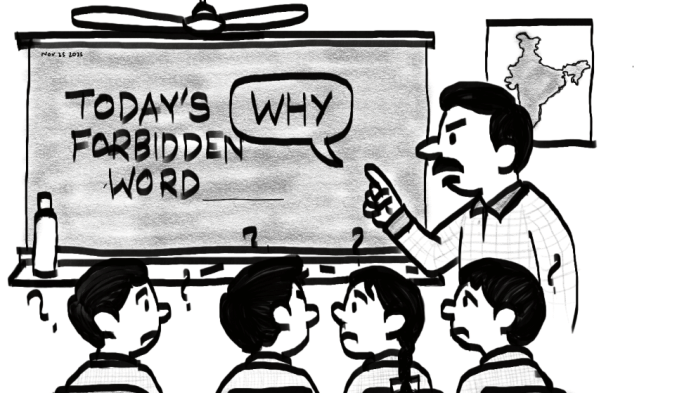
Building labs and installing smart boards will not suffice if students still hesitate to ask “why.” We must invest as much in teachers’ freedom to nurture curiosity as we do in technology to display information.
In the end, science education is not about producing better infrastructure—it is about producing better questions. When classrooms become spaces where evidence is explored, not memorized, we move closer to a vision shared by both ancient wisdom and modern policy:
Vidya dadāti vinayam—knowledge imparts humility.
Sa Vidyā Yā Vimuktaye—that is knowledge which liberates.
These pieces are being published as they have been received – they have not been edited/fact-checked by ThePrint.