





Thank you dear subscribers, we are overwhelmed with your response.
Your Turn is a unique section from ThePrint featuring points of view from its subscribers. If you are a subscriber, have a point of view, please send it to us. If not, do subscribe here: https://theprint.in/subscribe/
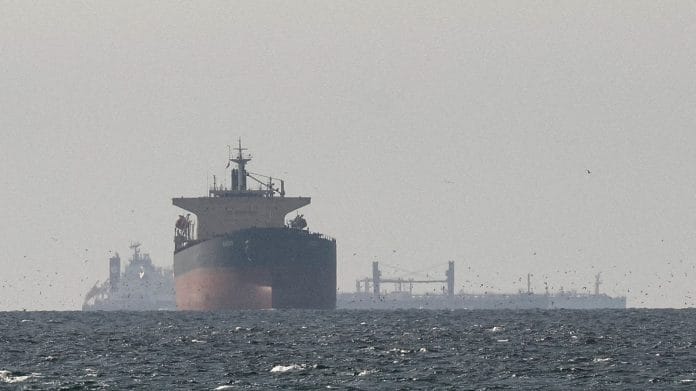
On Monday evening, the Indian LPG tanker Shivalik docked at Gujarat’s Mundra Port after a nine-day voyage from Qatar’s Ras Laffan terminal. On Tuesday morning, her sister vessel Nanda Devi arrived at Vadinar. Both had crossed the Strait of Hormuz under escort from the Indian Navy’s stealth frigate INS Trikand and Coast Guard Ship Valiant — India’s first military escort of a commercial vessel through a war zone since 2019. A third vessel, the crude oil tanker Jag Ladki, carrying 81,000 tonnes of Murban crude from the UAE, is safely en route.
Together, the two LPG carriers delivered 92,700 metric tonnes of cooking gas — enough to fill 6.8 million domestic cylinders. India consumes over 80,000 tonnes of LPG a day. The maths is sobering: two weeks of war, four rounds of ministerial phone calls, a naval escort through mined waters — for barely more than one day’s national supply.
That single convoy tells the story of India’s war — a conflict being fought not with missiles on distant battlefields, but with gas cylinders in millions of Indian kitchens.
Two and a half weeks into the most intense military campaign in the Middle East since 2003, a striking asymmetry has emerged. The US-Israel coalition has struck over 15,000 targets in Iran. In response, Tehran has fired over 700 missiles and 3,600 drones. Yet outside the carnage in Iran and Lebanon — where over 2,200 have died — the human toll of Iran’s retaliation has been remarkably contained: under 60 dead across all other countries combined.
This is not a failure of Iranian ballistics; it is a calculated strategy of “economic kineticism.” By targeting airports, desalination plants, and financial districts rather than residential centres, Iran is maximising global economic pain while minimising the kind of mass casualties that would invite a Western ground invasion. A single drone strike on a Dubai counting house generates more global leverage than a thousand casualties in the hinterlands. Iran needs the Gulf states as neighbours after this war; it does not need them as blood enemies.
India, 4,000 kilometres from the nearest airstrike, is absorbing the heaviest collateral blow.
India imports 67 per cent of its LPG, with nearly 90 per cent transiting Hormuz. When the IRGC mined the strait in early March, the domestic supply chain buckled within 72 hours. The government invoked the Essential Commodities Act. Refineries increased LPG production by 31 per cent. Panic bookings surged past 88 lakh. Joint inspection teams conducted over 1,000 raids in a single day. Pollution control boards directed commercial kitchens to burn kerosene and biomass — rolling back two decades of clean-energy progress. Gujarat Gas has invoked force majeure, cascading the crisis from kitchens into manufacturing.
With 333 million households on the LPG grid and five states heading to polls — Kerala, Assam, and Puducherry on April 9, West Bengal and Tamil Nadu on April 23 — the price of cooking gas is the most politically sensitive metric in the country.
In response, New Delhi executed what may be the most consequential act of “strategic autonomy” in recent history. Prime Minister Modi spoke directly to President Pezeshkian. External Affairs Minister Jaishankar confirmed four calls with Iran’s Foreign Minister Araghchi, telling the Financial Times that India has offered no concessions — each passage is negotiated individually. Iran’s Supreme Leader’s representative in India said Tehran is “mindful of India’s energy needs.” The Nanda Devi’s Chief Officer publicly thanked both the Indian Navy and the Islamic Republic of Iran Navy for assistance.
The result is a “blue corridor” — a bilaterally negotiated safe passage through a strait the rest of the world considers closed. While Washington’s naval coalition request has drawn no firm commitments from any country, India secured three vessels through Hormuz via diplomacy. The country that picked up the phone to Tehran got its ships through. The country that asked the world to send warships is still waiting.
But this is managed dependence, not victory. Each passage remains a high-stakes negotiation. Twenty-two Indian-flagged vessels carrying 611 seafarers remain in the Persian Gulf. Each approval rests on the goodwill of a regime under siege by India’s strategic partners.
The deeper lesson is structural. India possesses a military capable of defending its land borders, but it lacks the LPG reserves to outlast even a thirty-day disruption of the Strait of Hormuz. We have the diplomatic weight to negotiate temporary passage, but not yet the energy architecture to bypass the choke point entirely.
The Shivalik at Mundra and the Nanda Devi at Vadinar will bring relief to millions. But the war that empties kitchens from Bengaluru to Varanasi will only truly end when India builds a strategic energy reserve for gas as robust as its ambition. Until then, the front line of India’s national security is not just in the Gulf; it is at the stove.
(Shreshth Dugar is the founder of The Kochi Compass, a geopolitics briefing focused on energy security and conflict economics. A graduate of New York University’s Arthur L. Carter Journalism Institute, he is based in Kochi, India, where he heads a century-old publicly listed plantation company.)
These pieces are being published as they have been received – they have not been edited/fact-checked by ThePrint.