




Thank you dear subscribers, we are overwhelmed with your response.
Your Turn is a unique section from ThePrint featuring points of view from its subscribers. If you are a subscriber, have a point of view, please send it to us. If not, do subscribe here: https://theprint.in/subscribe/
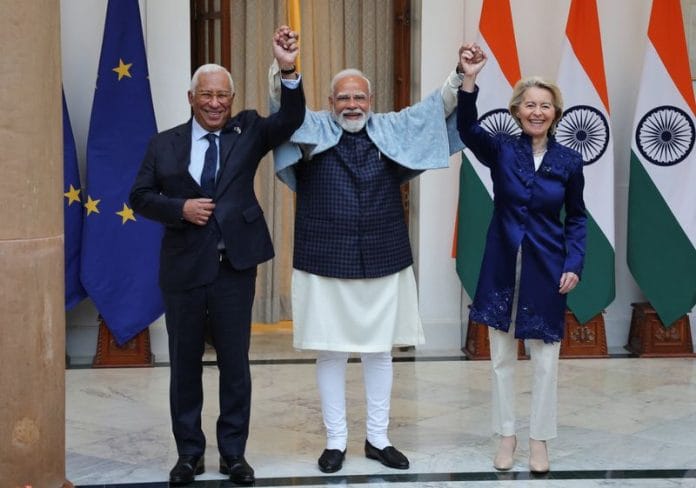
The much-anticipated India–EU Free Trade Agreement, expected to be politically sealed around late January, is being hailed as a watershed — a $136.5-billion trading relationship turbocharged, supply chains re-drawn, India finally stepping into China’s shoes in Europe. The rhetoric is intoxicating. The reality is more disciplined — and more demanding.
This deal is not a jackpot.
It is a walk on red-hot coal.
The real question is not whether the India–EU FTA is good for India. In the abstract, it clearly is.
Let us be honest about the context. Europe is not embracing India out of romantic multilateralism. It is acting out of strategic unease.
China has become too large, too coercive, and too politically radioactive to remain Europe’s factory of last resort. The United States, meanwhile, has rediscovered tariffs, industrial subsidies, and transactional diplomacy. Europe finds itself squeezed between a mercantilist ally and a systemic rival.
India appears, therefore, as the least risky alternative: large enough to matter, stable enough to trust, independent enough not to be a proxy. The FTA is Europe’s hedge.
That alone should temper India’s triumphalism. Hedge capital is cautious capital.
India–EU goods trade already stands at roughly $136.5 billion annually. This matters because it reduces downside risk. The relationship exists, the channels are tested, and the commercial familiarity is real. Any agreement that reduces tariffs, improves market access, and brings predictability will generate incremental gains.
But incremental is the operative word.
This is not the kind of FTA that will flood Europe with Indian exports overnight. Europe is a mature, saturated market with exacting standards, entrenched suppliers, and a regulatory architecture that often functions as an economic moat. Tariffs are not the real gatekeepers anymore. Rules are.
And Europe is becoming the world’s most rule-dense trading bloc.
The new protectionism wears green clothes
The most misunderstood aspect of the India–EU FTA is what it does not do. It does not neutralise Europe’s non-tariff barriers. It does not dilute climate regulations, due-diligence obligations, or product liability regimes. In fact, it may sharpen them.
Carbon Border Adjustment Mechanisms, deforestation-free supply chains, ESG disclosures, traceability norms — these are not moral gestures. They are industrial policy by other means. They raise entry costs, reward compliance capacity, and penalize casual exporters.
In this environment, price is no longer king. Process is.
China understands this well. When it cannot win on rules, it wins on scale and subsidy. India has neither luxury. Which means the Indian exporter’s battlefield is different.
India will not displace China in Europe by being cheaper. That contest is already lost.
India’s opportunity lies elsewhere: trust, transparency, and enforceability. European buyers increasingly price geopolitical risk, legal uncertainty, and reputational exposure into their sourcing decisions. India, with all its flaws, offers something China does not — contractual comfort and political legibility.
But this advantage is fragile. It exists only if Indian exporters behave like institutional suppliers, not opportunistic traders.
This agreement will quietly divide Indian exporters into two camps.
On one side will be firms that invest in documentation, origin compliance, emissions data, supply-chain visibility, and post-sale accountability. They will win slowly, steadily, and durably.
On the other side will be exporters who believe an FTA is a passport, not a probation. They will struggle — not because Europe is hostile, but because Europe is exacting.
The danger for India is not that the FTA fails. The danger is that India mistakes access for acceptance.
What India must do differently
First, exporters must internalise compliance as cost, not inconvenience. If carbon data or traceability is required, it must sit in the balance sheet, not the apology letter.
Second, rules of origin must be treated as strategic assets. Europe will not tolerate China-origin goods wearing Indian labels. Any hint of circumvention will invite scrutiny that harms the entire ecosystem.
Third, India must stop under-pricing itself. Europe does not want the cheapest supplier. It wants the least troublesome one. India should sell stability, not desperation.
Finally, policymakers must resist the temptation to declare victory too early. FTAs are not endpoints. They are frameworks. The real work begins after the signing ceremony.
The India–EU FTA will not remake India’s export economy overnight. But it can do something more valuable: force Indian industry to grow up.
If India uses this agreement to professionalise, standardise, and institutionalise its export base, the gains will compound. If it treats the deal as a political trophy, the benefits will evaporate.
Europe is opening a door.
It is narrow.
It is conditional.
India can walk through it — but only if it travels light on slogans and heavy on substance.
These pieces are being published as they have been received – they have not been edited/fact-checked by ThePrint.