





Thank you dear subscribers, we are overwhelmed with your response.
Your Turn is a unique section from ThePrint featuring points of view from its subscribers. If you are a subscriber, have a point of view, please send it to us. If not, do subscribe here: https://theprint.in/
Before “IKS” Became a Policy Term
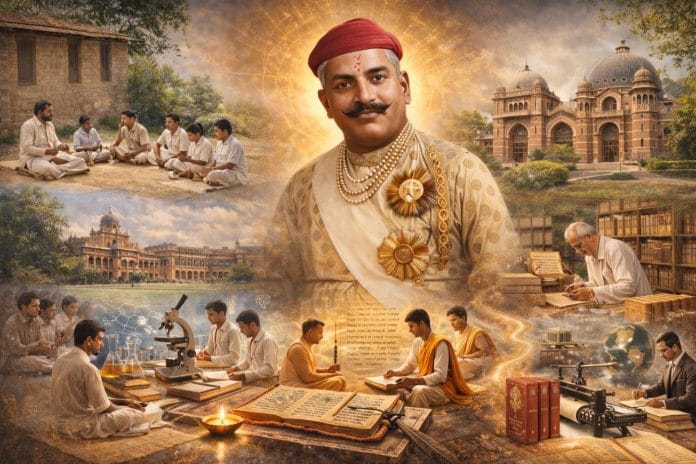
In recent years, Indian Knowledge Systems (IKS) has emerged as a central theme in academic and policy debates. Universities are being encouraged to revisit classical traditions, redesign curricula, and integrate indigenous epistemologies into modern frameworks. Yet long before IKS entered official vocabulary, Maharaja Sayajirao Gaekwad III (1863-1939) of Baroda had already implemented a working model of knowledge integration in colonial India.
His approach was not rhetorical. It was institutional.
Education as Statecraft
In the late nineteenth century, colonial universities reorganised knowledge along European lines. English gained dominance. Classical traditions, especially Sanskrit-based Shastric disciplines, were pushed to the margins of institutional legitimacy.
Sayajirao did not treat education as ceremonial reform. He treated it as governance. For him, education was not a cultural ornament but a structural responsibility of the state. This difference shaped Baroda’s educational trajectory.
Compulsory Primary Education: Laying the Foundation
Baroda introduced free and compulsory primary education, formally consolidating it by 1906. At a time when most of British India had not adopted universal schooling, this was a pioneering move.
Education was positioned as civic infrastructure rather than privilege. Literacy became the foundation upon which higher learning and specialised knowledge systems could be built. Without this base, knowledge reform would have remained elitist.
Modern Higher Education Without Civilisational Displacement
Baroda College was strengthened under Sayajirao’s patronage. Science laboratories were introduced. Agricultural education was aligned with regional economic needs. Law classes trained students for administrative service. In 1915, a Chair for the Comparative Study of Religions signalled openness to plural intellectual traditions.
Baroda embraced modern disciplines, but it did not frame modernity as a rejection of tradition. This refusal of binary thinking became the core of Sayajirao’s educational design.
Rajakiya Sanskrit Mahavidyalaya: Preserving Knowledge Systems
In 1915, Rajakiya Sanskrit Mahavidyalaya was established as a structured institution dedicated to Shastric disciplines such as Dharmashastra, Vyakarana, Vedanta, Jyotisha, Sahitya and Vedic studies.
Across colonial India, Sanskrit often survived merely as philology or language study. In Baroda, it was preserved as a living knowledge system. The traditional taxonomy of Shastras was retained rather than replaced by Western academic categories.
The significance lies in institutionalisation. Courses were structured. Degrees were formalised. Administrative mechanisms were introduced. Yet the epistemic integrity of the disciplines remained intact.
Integration into the University Framework
After Independence, the Sanskrit Mahavidyalaya became part of The Maharaja Sayajirao University of Baroda. It adopted semester systems and regulatory frameworks while maintaining its classical disciplinary organisation.
This integration demonstrated that traditional knowledge could inhabit modern academic architecture without surrendering its intellectual coherence.
The Oriental Institute: Securing Archival Foundations
Knowledge continuity requires preservation. The Oriental Institute, formally established in 1927, became a major centre for manuscript collection and research.
Thousands of manuscripts were catalogued and preserved. This initiative ensured that classical knowledge was not lost to neglect or dispersed without institutional care.
But preservation alone was not enough.
The Gaekwad’s Oriental Series: Scholarship as Infrastructure
The Gaekwad’s Oriental Series (GOS), initiated in 1915, undertook critical editing and publication of classical texts. Through rigorous philological methods—collating manuscripts and producing reliable editions—the Series stabilised textual traditions within modern scholarly standards.
At a time when European institutions dominated Sanskrit critical editions, Baroda asserted intellectual agency. The GOS transformed preservation into dissemination.
It was not nostalgia. It was research infrastructure.
An Integrated Knowledge Ecosystem
What distinguished Maharaja Sayajirao Gaekwad III’s educational model was its structural coherence. Primary education expanded literacy and created a broad civic foundation. Baroda College cultivated scientific, legal and administrative competence suited to a modernising state. The Sanskrit Mahavidyalaya institutionalised Shastric knowledge within a regulated academic framework. The Oriental Institute ensured systematic manuscript preservation and research continuity. The Gaekwad’s Oriental Series transformed preservation into dissemination through critical scholarly publication. Each institution reinforced the others, creating not a series of isolated reforms but an integrated and durable ecosystem of knowledge.
Beyond Colonial Binaries
Colonial discourse often framed education as a choice between Western modernity and indigenous tradition. Sayajirao rejected this binary. He aligned scientific education with Shastric scholarship. He embedded classical knowledge within modern governance structures.
Under colonial rule, political sovereignty was limited. Educational architecture, however, remained negotiable. Sayajirao used that space strategically.
Lessons for Contemporary IKS
Today, debates around Indian Knowledge Systems focus on curriculum reform and symbolic inclusion. The deeper challenge is infrastructural. Can classical knowledge be sustained through degree programmes, research centres, publication series and academic governance? Can it function as living scholarship rather than heritage display?
More than a century ago, Maharaja Sayajirao Gaekwad III of Baroda answered these questions through institutional design.
The continued functioning of Baroda Sanskrit Mahavidyalaya, the Oriental Institute and the Gaekwad’s Oriental Series demonstrates that knowledge architecture built with structural clarity can survive political transitions—from princely state to postcolonial university.
Before IKS became policy language, it was already institutional reality in Baroda.
Sayajirao did not merely celebrate India’s intellectual traditions. He organised them, structured them and embedded them within modern academic life.
The enduring lesson is clear: knowledge survives not through slogans, but through institutions. And institutions endure when education is treated not as administrative convenience, but as civilisational responsibility.
These pieces are being published as they have been received – they have not been edited/fact-checked by ThePrint.