




Thank you dear subscribers, we are overwhelmed with your response.
Your Turn is a unique section from ThePrint featuring points of view from its subscribers. If you are a subscriber, have a point of view, please send it to us. If not, do subscribe here: https://theprint.in/subscribe/
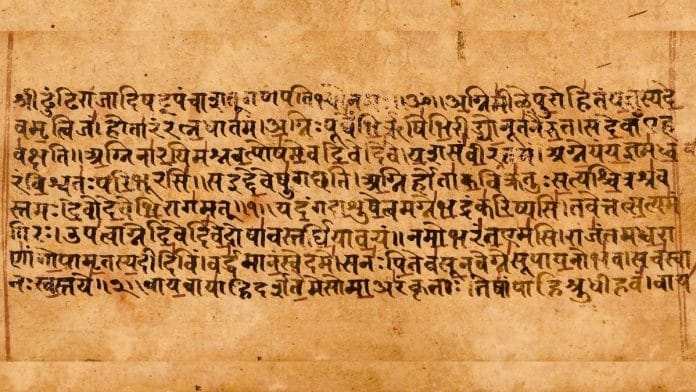
The Smṛti literature is a vast corpus of derivative work, but every Smṛti ultimately traces its roots to Śruti. What was first heard was later remembered. That sequence matters.
Long before paper or palm-leaf manuscripts, India’s intellectual and spiritual traditions flowed through memory, carried by sound, rhythm, and disciplined repetition. Even when finally written, the form reveals its origin: knowledge was recited, not narrated. Much of it is poetry (kavya), not prose, because it was first spoken and heard, and only later recorded as Smṛti from the earlier Śruti.
In this civilizational landscape, words were not merely tools of communication; they were power. The spoken word- śabda – was treated as sacred and transformative, a force capable of shaping thought, action, and even creation. Each tradition developed its own precise system of intonation and recitation, preserved with remarkable fidelity across generations. India’s foundational knowledge systems, the Vedas, the Mahabharata, the Ramayana, and a wide range of philosophical and ritual traditions, were transmitted orally for centuries before being committed to writing.
At the core of this system lay intricate poetic meters, exacting phonetics, and rigorous memorization techniques. This was not rote learning. It was deep internalisation, knowledge absorbed, lived, and transmitted with discipline and continuity.
Importantly, India’s knowledge traditions were never uniform. Alongside the Sanskritic world of the Vedic seers existed equally rich tribal and indigenous cosmologies. Their wisdom found expression through stories, songs, rituals, and lived practices—each reflecting a nuanced understanding of nature, community, and the divine. Over time, the confluence of Vedic thought and indigenous insight did not clash; it blended, evolved, and adapted, creating a uniquely plural and layered civilizational fabric.
Recent archaeological work adds another dimension to this continuity. A study by the Tamil Nadu State Department of Archaeology, based on the digitisation of over 15,000 potsherds, has identified striking similarities between graffiti marks found in Tamil Nadu and symbols from the Indus Valley Civilisation. Their comparative analysis suggests that nearly 60% of the symbols and up to 90% of the graffiti marks correspond in form and pattern. While this does not establish direct equivalence, it strongly points towards cultural continuity, shared motifs, or long-standing interactions across regions of the subcontinent.
Excavations across multiple sites in Tamil Nadu further reinforce this sense of depth and continuity. At Chennanur, a cultural sequence from microlithic to Neolithic phases has been identified, with optical dating suggesting antiquity going back nearly 10,000 years. At Tirumalapuram, urn burials within structured enclosures indicate the emergence of organised, possibly clan-based societies during the Iron Age. Sites like Kilnamandi reveal stages of Neolithic tool production and evolving burial practices, including sarcophagus interments. At Marungur, inscribed potsherds in early Tamili script and associated burial remains strengthen earlier findings of cultural continuity.
The urban site of Keeladi provides further evidence of an organised settlement with indications of trade, craft, and possibly literate activity, while Kongalnagram, located along an ancient trade route, reflects continuity in material culture and burial traditions. At Porpanaikottai, fortifications reveal a long-standing tradition of defensive architecture, some elements of which find echoes even today.
Taken together, these findings do not seek to displace the significance of the Indus Valley Civilisation. Rather, they expand the frame. They suggest that the story of the Indian subcontinent is not one of isolated civilizational silos, but of overlapping cultures, shared symbols, and enduring continuities, stretching further back in time than we may have previously acknowledged.
There is clearly more to the Indian past than we have been told, and perhaps more than we have yet understood. The evidence, both textual and archaeological, points not to a beginning at a fixed point, but to a continuum, one that flows, adapts, and persists.
In that sense, Indian civilisation may not merely be ancient; it may be among the oldest continuous civilizational traditions in the world, where memory preceded script, and knowledge lived long before it was written.
Perhaps the question is not how old Indian civilisation is, but how continuous it has been. From sound to script, from memory to material, the thread has rarely broken. What we call beginnings may only be points where we started noticing.
The past, in India, does not lie behind us, it flows alongside.
And we are, whether we realise it or not, part of that unbroken current.
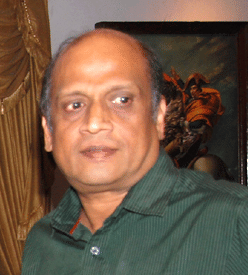
Col KL Viswanathan
(The author is an Indian Army veteran and a contemporary affairs commentator. The views are personal. He can be reached at kl.viswanathan@gmail.com )
These pieces are being published as they have been received – they have not been edited/fact-checked by ThePrint.