




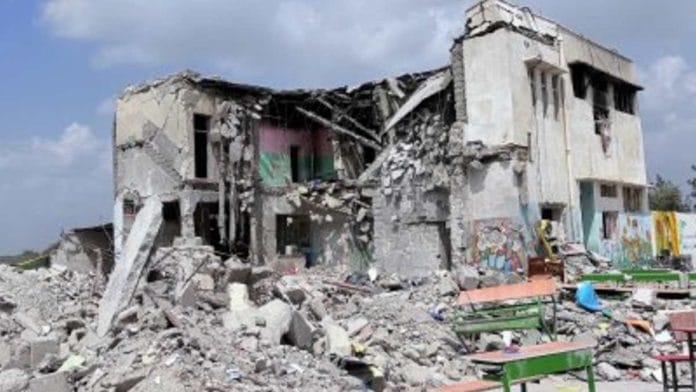

Empires do not admit defeat. They rename it, reframe it, and bury it under the language of strategy. The United States and Israel are doing precisely that today as their war on Iran fails to deliver the decisive victory, they promised the world.
From the outset, this war was framed as a demonstration of overwhelming power. Washington spoke with the arrogance of an empire convinced of its own permanence. Tel Aviv, emboldened by its devastation of Gaza, imagined it could replicate the same script—bomb, isolate, and reduce a nation to rubble. Iran, they believed, would “eat humble pie.”
But Iran did not kneel.
Instead, it absorbed the first blows and rewrote the terms of engagement. What was expected to be a short, punishing campaign has evolved into a prolonged confrontation in which the very assumptions of Western dominance are collapsing in real time.
This is not an accident. It is the consequence of imperial overreach meeting prepared resistance.
For decades, the United States has relied on a doctrine of shock and awe—overwhelming force designed to paralyze opponents before they can respond. It worked, temporarily, in places like Iraq and Libya, though even there the illusion of victory quickly dissolved into chaos and failure. But Iran is not Iraq. It is not Libya. It is a state that has spent years anticipating precisely this moment.
And it has responded accordingly.
Iran’s strategy is not built on matching American or Israeli firepower. It is built on endurance, asymmetry, and disruption. By striking across multiple fronts—militarily, economically, and psychologically—it has transformed what was meant to be a unilateral demonstration of power into a contested battlefield where no side can claim easy victory.
Israel, long accustomed to projecting force outward, now finds that force returning home. The mythology of invulnerability has been punctured. Sirens, strikes, and uncertainty have replaced the carefully cultivated image of total control. This is not merely a military development; it is a psychological rupture. A state that defined itself through dominance is now confronting exposure.
To say Israel “stands destroyed” is to speak politically rather than literally—but the political truth carries weight. The aura of invincibility is gone. And in geopolitics, perception is power.
The United States fares no better.
Despite its vast military machine, Washington has been unable to impose a decisive outcome. Instead, it has resorted to threats, ultimatums, and coercive rhetoric—tools of intimidation that reveal anxiety more than authority. Its allies are uneasy, its strategy unclear, and its endgame uncertain.
This is what imperial decline looks like—not a dramatic collapse, but a slow erosion of credibility.
More importantly, the war has exposed the fragility of the American security architecture in West Asia. The Gulf states, long treated as subordinate partners, now find themselves on the frontlines of a conflict they did not choose but are expected to sustain. Their infrastructure is vulnerable, their economies exposed, and their sovereignty compromised by the continued presence of foreign military bases.
These bases are not instruments of protection. They are instruments of control.
For decades, the United States has maintained its dominance in the region through a network of military installations that project power while extracting compliance. This is colonialism in contemporary form—not through direct rule, but through strategic dependency. The current war has laid bare the cost of this arrangement. By hosting American forces, Gulf countries have effectively made themselves targets in a conflict driven by Washington’s priorities, not their own.
It is a dangerous bargain—and one that is increasingly untenable.
Iran understands this dynamic and has leveraged it with precision. Its ability to threaten critical chokepoints such as the Strait of Hormuz is not merely a military tactic; it is a geopolitical statement. It reminds the world that control over resources and routes cannot be monopolized indefinitely by external powers.
This is where Iran’s real strength lies—not in the absence of damage, but in its capacity to impose costs.
Wars are not decided solely by who destroys more. They are decided by who can endure longer, who can reshape the battlefield, and who can force their adversary into strategic exhaustion. By that measure, Iran is not losing. It is dictating the tempo of a war that was supposed to break it.
The broader implications are profound.
Across the Global South, this conflict is being watched closely. For nations long subjected to Western intervention, sanctions, and coercion, Iran’s resistance carries symbolic weight. It challenges the notion that defiance is futile. It suggests that even in the face of overwhelming force, sovereignty can be asserted and defended.
This does not romanticize war. The human cost is immense, and Iran itself has suffered significant losses. But resistance has never been about avoiding pain; it has been about refusing submission.
The West’s fundamental miscalculation lies in its inability to grasp this.
It continues to operate within an outdated framework in which power is absolute and opposition is temporary. But the world has changed. Power is now contested, fragmented, and increasingly resisted. The age of unchallenged Western dominance is not ending with a single event—it is eroding through a series of confrontations in which the limits of that dominance are exposed.
This war is one such moment.
Iran will not emerge unscathed. But neither will the United States or Israel emerge victorious in the way they had envisioned. The promise of a swift, decisive triumph has already been broken. What remains is a grinding conflict that exposes vulnerabilities, drains resources, and reshapes perceptions.
And perception, in geopolitics, is everything.
To call Iran the “tactical winner” is not to suggest final victory. It is to recognize a shift in momentum—a disruption of the old order in which outcomes were predetermined by Western power.
That order is no longer intact.
What we are witnessing is not simply a war between states. It is a confrontation between an empire struggling to retain control and a resistance determined to redefine the terms of engagement.
Empires rarely recognize the moment they begin to lose.
But the world does.
And today, the signs are unmistakable.