





Thank you dear subscribers, we are overwhelmed with your response.
Your Turn is a unique section from ThePrint featuring points of view from its subscribers. If you are a subscriber, have a point of view, please send it to us. If not, do subscribe here: https://theprint.in/subscribe/
In an interview with the IndiaTV , a senior D.R.D.L official discreetly alluded to range enhancement of the home grown Astra B.V.R missile family in light of recent advancement in missile propulsion domain. This capability enhancement marks a significant shift in the Bharat’s air combat doctrine, one that is profound enough to send jitters down the spine of our adversarial neighbours sharing “Iron Clad” bonhomie.
The Beyond Visual conundrum
Modern aerial combat has underwent remarkable metamorphosis. Gone are the days where close-in dogfights used to decide the outcomes of aerial warfare. At the centre of this shift lies the beyond visual range air-to-air missiles . The modern air supremacy is the function of early detection and first strike capability from the far horizon and the BVR missiles ensure just that. Using advanced radar seekers and propulsion systems, these missiles can engage aerial targets well beyond pilot’s view [ 40 km and beyond] reaching extreme range of a whopping 300+ km!!.
Such extreme ranges not only expands engagement envelope of any air power but also disrupts tactical formations and denies airspace to the adversary’s airforce.
IAF’s B.V.R arsenal
The Indian Air Force fields diverse BVR missiles across multiple platforms, including Russian R-27, R-77, KS-172; French Super 530, MICA, Meteor; Israeli Derby, Python-5; and British ASRAAM. These missiles saw operationalisation during operation sindoor and performed with remarkable precision but still the inventory lacked that indigenous “X” factor.
The ASTRA Family
The concept of an indigenous BVR air-to-air combat missile was conceived in the 1990s, with the first trial of Astra Mk-1 conducted in 2003. Like most advanced weapons programs, Astra’s development was fraught with challenges in aerodynamic control, software, weapons integration, and technical snags. After years of refinement, the first production batch of Astra Mk-1 was flagged off from DRDO’s Kanchanbagh facility in January 2024.
Astra Mk-1
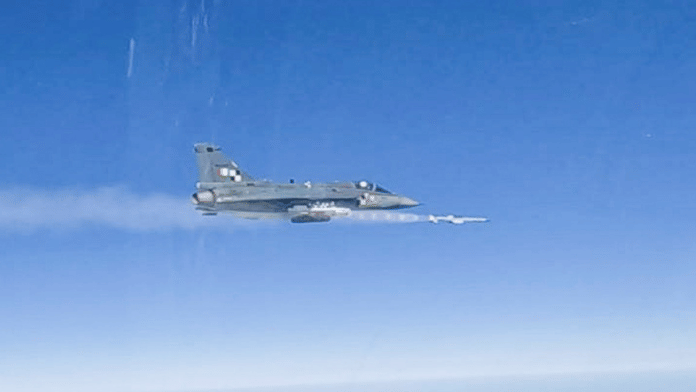
Astra Mk-1 is the first indigenous BVRAAM developed for the Indian Air Force and Navy. It uses a smokeless solid-fuel motor and has an effective range of about 110 km. The missile features ECCM capability and Radio-frequency homing in the terminal phase. Initially fitted with a Russian R.F seeker, it now employs an improved indigenous Ku-band seeker. Astra Mk-1 was operationally deployed on Su-30 MKI aircraft during Operation Sindoor, though it was not reportedly used.
Astra Mk-2
The range of Astra Mk-1 was limited by its single-pulse motor, leading to the development of it’s spinoff with a dual-pulse rocket motor. This significantly enhances its reach to nearly 200 km. The missile incorporates an A.E.S.A radar and network-centric warfare capability. It is expected to enter service between late 2026 and early 2027.
GANDIVA (Astra Mk-3)
The “GANDIVA,” the formidable scion of the Astra family, draws it’s inspiration from the legendary bow of Arjuna in the Mahabharata. It employs a solid fuel ducted ramjet (SFDR) propulsion system. Retaining most Mk-2 features while accommodating a new propulsion design, Gandiva is expected to achieve an effective range beyond 300 km and is optimized for engaging high-value targets such as tankers, AEW&C aircraft, and strategic bombers. Service entry is projected by 2029.
VLRSAM
VLRSAM is the surface-to-air variant of the Astra family, intended to replace aging Barak SAM systems. Essentially an Astra Mk-1 adapted for vertical launch, it is tailor-made for naval air-defence roles.
The “Aatmanirbharta doctrine”in the layered BVRAAM domain on a common technology platform not only ensures cost effectiveness but also provides for insulation against supply chain vagaries emerging in the wake of geopolitical hectoring to maintain strategic autonomy.
What changed now??
DRDO senior officials confirmed that after incorporating the inputs from the I.A.F post operation sindoor and recent breakthroughs in motor propulsion systems has resulted in range enhancement from 110km to 160km (Mark1) , 200km to 240 km ( Mark 2) and the GANDIVA’s range is expected to reach 340km .The range enhancement was not at all serendipitous. D.R.D.O was deft in it’s approach and ruthless in their execution. A combination of AI-augmented flight optimisation, improved grain geometry, nozzle flow adjustments for higher mass flow, and the use of a new propellant are considered key factors. Bharat’s solid propellant uses HMX, aluminium powder, and HTPB, unlike Russia’s ADN or the USA’s CL-20. DRDO’s progress in advanced propellants aligns with minimal airframe changes which is outright astounding.
To put it into perspective, given the limited “ Strategic depth” of Pakistan, coming a tad closer to the Indian border for PAF’s platforms will become a costly gamble . This will not only impede Pakistan’s strike capability drastically but also enhance flexibility for the IAF assets to dominate the contested skies while the P.A.F scrambles for safe zones to even stage an act of defiance.
Complimented by network centricity, an aircraft like a LCA Tejas with its low radar cross section can further breach PAF’s engagement envelope expanding the no escape zone of the astra missiles manifolds.
As the astra family exhibits broader fleet adoption it will be prudent to presume that the long claws of the I.A.F are in the making , dangerously unrelenting and strikingly menacing.
These pieces are being published as they have been received – they have not been edited/fact-checked by ThePrint.
Excellent analysis,this rightly highlights how propulsion breakthroughs at under are reshaping ’s air combat capability. The extended reach of the Astra family is not just a technical milestone but a strategic signal of growing self-reliance and deterrence strength. Articles like this help readers understand how indigenous innovation directly impacts national security and future warfare doctrine. Well written and insightful looking forward to more such analyses🫡🫡🙏