




Thank you dear subscribers, we are overwhelmed with your response.Your Turn is a unique section from ThePrint featuring points of view from its subscribers. If you are a subscriber, have a point of view, please send it to us. If not, do subscribe here: https://theprint.in/subscribe/
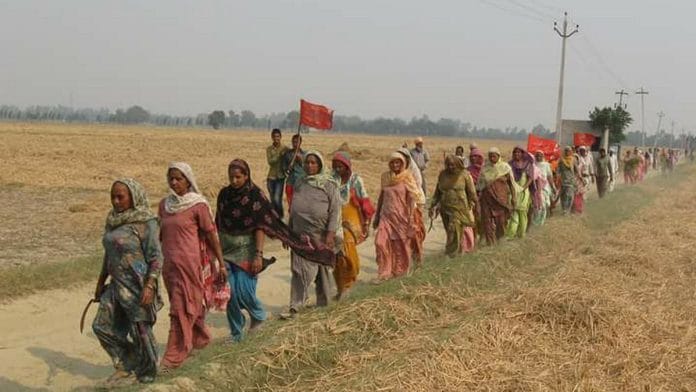
Punjab Chief Minister Bhagwant Mann’s government has finally delivered on one of its oldest promises: a monthly cash transfer for women. Marketed as a landmark step in women’s empowerment, the scheme offers Rs 1,000 per month to most adult women and Rs 1,500 to Scheduled Caste women. But that claim is precisely the problem. A cash transfer may offer relief. Calling it empowerment reveals how small the political imagination around women in Punjab has become.
A monthly cash transfer may help women meet routine personal expenses without having to ask male family members for money. In poorer households, it may ease immediate pressure. As short-term assistance, it can be defended. But relief is not empowerment, and a transfer payment is not social transformation. To describe Rs 1,000 a month as women’s empowerment is to reduce a serious social, economic and political idea into a token allowance.
Empowerment is not about making women recipients of state generosity. It is about making them agents of their own advancement. It means education, skills, jobs, enterprise, safety, mobility, access to credit, representation in decision-making, and the freedom to shape one’s own future. It means creating the conditions in which women can earn, lead, own, decide and rise. A recurring payment may support consumption. It does not, by itself, alter the structure of women’s opportunity.
That is why the gap between the claim and the policy is so large. Punjab’s women have been offered a politically marketable measure and told to treat it as a milestone in gender justice.
Serious examples of women’s empowerment elsewhere follow a very different logic. Rwanda expanded women’s power through political representation and institutional inclusion. Bangladesh’s better-known gains came through programmes that linked support to girls’ schooling and long-term social outcomes. In both cases, the aim was to expand capability, agency and participation, not merely create beneficiaries of a recurring payment.
Punjab, too, could have imagined something more serious. It could have designed a large-scale mission for women’s entrepreneurship. It could have created subsidised credit lines for women-led businesses, coaching support for competitive exams, digital skill-building, safer transport, market linkages for women entrepreneurs, and measurable targets for women’s employment and leadership. It could have chosen to build women as wealth-creators, employers, decision-makers and public actors. Instead, it chose the easiest and most electorally legible route: distribute cash widely, package it emotionally, and call it empowerment.
The timing is not incidental. This was a major promise made before the 2022 Assembly election. Its rollout now, after years of criticism over delayed implementation and as Punjab moves closer to the 2027 election cycle, makes its political purpose difficult to ignore. This is not just social policy. It is electoral messaging.
That, however, is only part of the problem. Every party seeks electoral gain. Democracies work through competition for votes. The deeper issue is not that parties want to win elections. It is the quality of politics through which they seek to win them.
Electoral success can also be built through better governance, stronger institutions, credible reforms and real development. Governments can earn durable support by improving schools, hospitals, public safety, urban services, job creation and investment conditions. Women voters can be mobilised through policies that increase their income, security, autonomy and representation. That path is harder. It takes administrative seriousness, long-term thinking and a real understanding of the society being governed. But it is possible, and it is healthier than reducing public life to calibrated dependence.
What makes this trajectory worrying is that too much policymaking now appears shaped by managerial electoralism — by consultants, strategists and poll-focused operators whose expertise lies in voter aggregation, not social transformation. Their method is simple: identify a target constituency, design an easily communicable benefit, maximise coverage, and convert welfare into loyalty. This is not governance in any meaningful developmental sense. It is campaign logic extended into public policy.
That is how unsuitable and economically burdensome schemes get packaged as empowerment. That is how a debt-stressed state begins to substitute structural reform with recurring handouts. In that context, a major recurring commitment of this kind is not a symbolic gesture. It is a serious expenditure choice.
A government can always argue that welfare spending is justified. That argument is legitimate. But once it invokes empowerment as the rationale, it must answer a harder question: is this really the most effective and dignified way to empower women in a financially stressed state?
If the answer is political rather than developmental, Punjab should at least say so honestly.
The larger damage is not only fiscal. It is political and cultural. Over time, such schemes lower the quality of democratic aspiration. They train citizens to think in terms of monthly support rather than structural opportunity, recurring allowances rather than long-term reform. In a state with Punjab’s history of enterprise, migration, resilience and self-respect, that is an especially poor message to send.
Most troubling of all is the symbolism. Punjab’s women are not weak social subjects waiting to be uplifted by a modest state allowance. They are among the strongest forces in the state’s social and economic life — workers, professionals, farmers, entrepreneurs, teachers, caregivers and community anchors. The land of Mai Bhago should be speaking to its women in the language of power, opportunity and leadership, not paternalism and managed dependency.
That is the real failure of calling this empowerment. It asks women to accept a modest transfer as dignity, and the political class’s limited imagination as progress.
A monthly allowance may bring relief. It may even bring votes. But empowerment requires something much bigger: capability, opportunity, representation and power. Women in Punjab deserve that politics, not this substitute for it.
About the Author -Dr. Kanwar Deep Singh is a political analyst, researcher and commentator on Punjab’s social and political issues. He holds a PhD in Political Science from Panjab University.
These pieces are being published as they have been received – they have not been edited/fact-checked by ThePrint.