





Thank you dear subscribers, we are overwhelmed with your response.
Your Turn is a unique section from ThePrint featuring points of view from its subscribers. If you are a subscriber, have a point of view, please send it to us. If not, do subscribe here: https://theprint.in/subscribe/
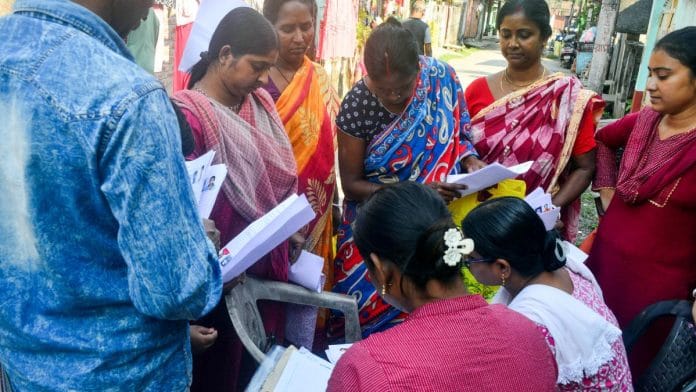
Democracy fails not just when votes are stolen, but also when voters silently vanish. The right to vote is considered as the most powerful tool to bring a meaningful change in a democratic society. However, the Special Intensive Revision (SIR) of electoral rolls, underway in various parts of the country, potentially strikes at the very foundation of democracy, that is, enfranchisement.
SIR refers to the exercise undertaken by the ECI to ensure inclusion of all eligible voters and purify the electoral rolls by removing dead, migrated or otherwise ineligible voters. The need for SIR arises as last such exercise was undertaken between 2002 and 2005, post which many changes occurred in electoral rolls due to frequent migration, non-removal of dead voters and wrongful inclusion of ineligible voters.
The power to order revision can be traced to Article 324 of the Constitution of India which vests the power of superintendence, direction and control of preparation of electoral rolls in the Election Commission of India (ECI). The electoral rolls are prepared by the ECI in accordance with the provisions of the Representation of People Act, 1950 (RPA,1950). Section 21 of the RPA, 1950 states that the ECI may direct revision of the electoral rolls, and further provides that ECI has also the power to direct special revision of the electoral roll for any constituency or a part of it. Rule 25 of the Registration of Electors Rules, 1960 further provides for the intensive revision of electoral rolls.
While the aim behind this exercise is benign, yet the process is questionable as it risks disenfranchisement by excluding eligible voters.
REVERSE BURDEN OF PROOF
In the present exercise, the elector is mandated to fill the enumeration form and to also establish a link with past the SIR. This essentially shifts the burden of proof of legitimacy on the voter, which is essentially a reverse burden. In the case of Inderjit Barua v ECI, the Supreme Court held that in case of objection to inclusion of names in electoral roll, the burden is on the objector to prove that the person is invalidly included. This essentially shows that once a name is included in the electoral roll, prima facie legitimacy is accorded to it unless proven otherwise. Later, in ECI v Dr. Manmohan Singh, the Supreme Court held that the presumption lies in favour of the person being an ordinary resident and it is the duty of the ECI to prove the contrary. Building on this overarching principle, it can be reasonably stated that in the SIR process as well, the burden must be on the ECI to prove that the voter is not a legitimate one rather than on the voter to prove legitimacy.
This process is criticized for being a citizenship determining exercise than just being an electoral roll purification exercise, making it a potential backdoor NRC. Against this backdrop, the shifting burden of proof implies doubting citizenship of voters unless they prove legitimacy. This is again contrary to the decision in the case of Lal Babu Hussein v Electoral Registration Officer, which held that where a name is already added in the electoral roll, “it must be presumed that before entering his name, the concerned officer must have gone through the procedural requirement under the statute.” This establishes the argument of presumed legitimacy of voter inclusion in electoral rolls.
Therefore, the procedure of SIR clearly violates the established principles on evidentiary burden and thereby deviates from landmark judicial precedents. This shifting burden, coupled with heavy documentary requirements and procedural technicalities, also disproportionately impacts women and socio-economically marginalized voters, who often lack sophisticated and stable documentation. Unlike previous exercises, where the presumption of validity ensured ECI had to justify removal of a person’s name, the present exercise, thus, carries high risk of disenfranchisement by placing burden on proof the voters.
CONCLUSION
Electoral rolls are not simply administrative records; they are the doorway to democratic participation. However, when the process of maintaining them becomes exclusionary, the cost is borne by legitimate citizens who lose their voice. The Special Intensive Revision, in its current form, risks the constitutional right to vote into a conditional privilege – available only to those who prove their legitimacy constantly.
While ensuring electoral integrity is a legitimate state aim, it must not be achieved by formalizing bureaucratic processes which looks upon people with suspicion, shifting burdens onto voters and subtly deviates from the constitutional mandate. Democracy is judged not by purified rolls but by protecting rights of the citizens. SIR, if continued as it stands today, may achieve administrative accuracy, but at the expense of constitutional fidelity – a result too costly to afford.
Kanishka Chaudhary is pursuing her B.A., LL.B. (Hons.) from the National Law University, Jodhpur.
These pieces are being published as they have been received – they have not been edited/fact-checked by ThePrint.