








New Delhi: Israel has announced that its military would take control of southern Lebanon up to the Litani river to create a “security zone”, a move that marks a major escalation in Israel’s campaign against Hezbollah, the Iran-supported Lebanese paramilitary group.
Israeli leaders argue that pushing Hezbollah north of the Litani is essential to securing Israelis along the country’s northern border who were evacuated in the aftermath of Hezbollah’s retaliation against initial US-Israeli strikes in Iran on 28 February.
Litani is the longest river entirely within Lebanon, originating in the Beqaa Valley before turning westward into the Mediterranean Sea.
Roughly 30 km north of the internationally recognised border between Israel and Lebanon, the river has historically served as a natural boundary between the two countries. Now, Israeli officials are signaling that Litani, once a natural feature, could become a “red line”.
The current phase of fighting saw major escalation earlier this month, when a Hezbollah attack on 2 March prompted a large-scale Israeli response involving sustained airstrikes and ground operations. According to Lebanese Ministry of Public Health, Israeli strikes have killed more than 1,000 people in Lebanon since 2 March 2026.
Israeli media reports suggest that this is not a temporary campaign but part of a longer-term effort to fundamentally reshape the security landscape of the region.
Israeli Defence Minister Israel Katz said Tuesday that Israelis evacuated from the area south of the Litani river would not be allowed to return until their security is “guaranteed”.
Katz said the military was operating “following the model of Rafah and Beit Hanoun,” referring to areas in Gaza that were subjected to relentless Israeli strikes and remain under Israeli control. In southern Lebanon, he said, this would include destruction of Hezbollah infrastructure and homes in border villages that Israel considers militant outposts.
On the same day, the country’s Finance minister Bezalel Smotrich said Israel should extend its border with Lebanon up to the Litani river deep inside the country’s south.
His comments were the most explicit admission yet by an Israeli official of plans to expand into Lebanese territory. According to The Times of Israel, Smotrich told an Israeli radio programme that the military campaign in Lebanon “needs to end with a different reality entirely, both with the Hezbollah decision but also with the change of Israel’s borders”.
Lebanese president Joseph Aoun has labelled the Israeli action as a violation of sovereignty, adding that it would change the borders of the country entirely.
Geography & strategy
Historically, the area south of Litani river has served as a defensive barrier and primary area for Hezbollah’s military operations. If Israel gains control of the river, it can effectively isolate the southern tip of Lebanon from the rest of the country, turning it into a natural buffer zone.
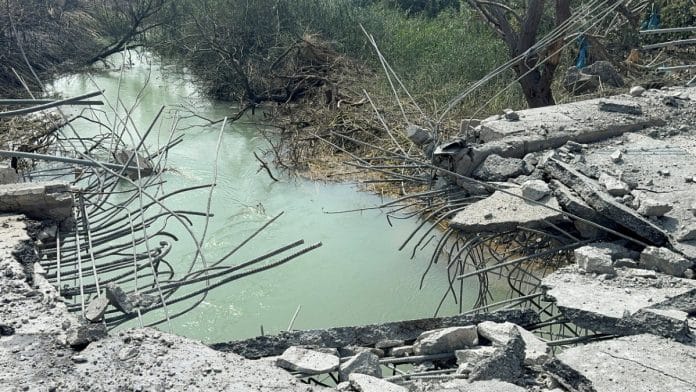
According to reports from The New York Times and Reuters, the Israeli military has lately shifted from localised raids to a broader effort to disable crossings over the Litani. Bridges have been destroyed or seized, with the aim of disrupting the flow of weapons and fighters from Hezbollah’s northern strongholds into the south.
At the same time, the IDF is seeking to establish what it describes as a “sterile zone”, which would effectively isolate Hezbollah units and block any additional forces from reaching them in this part of the country.
Smotrich went further, suggesting the river should become Israel’s de facto border—an idea he compared to the “Yellow Line” established in Gaza in 2025.
Escalation into territorial conflict
The struggle over the Litani is rooted in decades of conflict.
From 1982 to 2000, Israel maintained a ‘security zone’ in southern Lebanon to counter Hezbollah and militant Palestinian groups.
After the 34-day war between Israel and Hezbollah in 2006, the United Nations adopted Resolution 1701, which mandated that the area between the internationally recognised border—known as the Blue Line—and the Litani river remain free of armed groups, other than the Lebanese army and the United Nations Interim Force in Lebanon.
However, the arrangement never materialised. Hezbollah set up military infrastructure alongside the river which Israel cited to target sites in the region. Lebanon, meanwhile, maintained that repeated Israeli attacks undermined the agreement from the beginning.
(Edited by Amrtansh Arora)