








New Delhi: Post-Venezuela, US President Donald Trump has doubled down on his claim to the semi-autonomous Danish territory of Greenland.
From his first term onwards, Trump has been threatening a takeover of the Arctic Island, citing America’s “national security”, as well as “Arctic security”.
Taking his line, the United States administration, currently in place under Trump, has refused to rule out the possibility of using military force in Greenland. US statements around this topic, however, have left Denmark and the NATO member countries deeply unsettled.
Trump’s attempts to acquire Greenland, which he considers a strategic piece of real estate, are not the first by the US, though. On at least three previous occasions, Washington, DC, has attempted to strike a deal with Denmark to acquire the Arctic Island. The last one was in 1946 under President Harry Truman.
What’s interesting to note is that Trump’s renewed push to acquire Greenland comes as the US competes with China for rare earth materials.
Critical minerals are the “bedrock” on which nations hope to climb the technological pyramid to emerge at the top.
The pertinent question that merits attention in this scenario of heightened geopolitical competition is, “Why does Greenland allure the US and Trump so much?” In this report, ThePrint attempts to find the answers.
Geostrategic location
Proximity to Russia, combined with its location in the middle of the Arctic, which straddles the newly opening sea routes becoming more navigable due to global warming, has enhanced Greenland’s geopolitical salience for Washington.
Much of Russia’s nuclear submarine fleet is based in the Kola Peninsula, which Moscow considers strategically key to maintaining its nuclear deterrence.
With Finland and Sweden joining NATO, Russia’s space for maneuverability in the Baltic Sea has been significantly curtailed, enhancing the power of its Northern Fleet.
Moscow is strengthening its Northern Fleet by commissioning new nuclear submarines, as well as modernising its Arctic military bases and upgrading air bases such as Nagurskoye. Chinese icebreakers are meanwhile opening new routes, ringing alarm bells in the US administration.
But for the Northern Fleet to reach the Atlantic easily, it has to go past a gap, known as the GIUK (Greenland-Iceland-United Kingdom) gap, a narrower body of water running between Greenland and the UK, with Iceland in the middle. The strategic significance of this maritime chokepoint provides a fillip to the island territory’s acquisition as a professed foreign policy goal of the Trump administration.
Global warming and the increased rate of ice sheet melting are making alternative sea routes through the Arctic more desirable, with Greenland’s location providing it proximity to such routes as the Northwest Passage along Canada’s northern coast, the Northern Sea Route that runs along Russia’s Arctic shoreline, and the future Trans-Arctic or Transpolar Route across the central Arctic Ocean. This makes the island territory seductive to US economic designs.
Also Read: America gifted China its rare-earth monopoly — and India helped too
Minerals galore
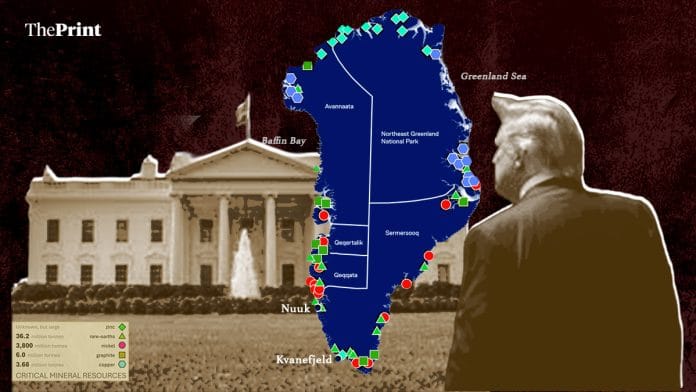
A 2023 survey by the Geological Survey of Denmark and Greenland (GEUS) found that 25 out of the 34 minerals that the European Commission has deemed “critical raw materials” are found in Greenland.
The region is specifically rich in “heavy” REEs like dysprosium and terbium, which are extremely scarce outside China. China currently controls 80-90 percent of the global rare earth element (REE) production, and the global demand is heavily dependent on Chinese exports.
On the other hand, Greenland is considered to hold up to 30-40 percent of the global reserves. Its Kvanefjeld project is one of the largest and richest deposits of ‘heavy’ REEs. Additionally, high-grade natural graphite, used in EV battery anodes, is found in large formations in Greenland, for instance, at the Amitsoq project.
China and Trump’s Monroe Doctrine 2.0
“Right now, Greenland is attracting increased attention from foreign powers, particularly China and Russia,” President Trump said when asked about the region’s future following the US military operation in Venezuela, during which President Nicolás Maduro and his wife Cilia Flores were “captured”.
China has significantly expanded its Arctic presence, with investments in Greenland’s infrastructure, mineral resources, and scientific research. Russia has also bolstered its military capabilities in the region. These developments concern Trump’s foreign policy outlook.
The US President’s stated stance is a “modern take” on the Monroe Doctrine, which, in 1823, declared the Americas off-limits to European interference, establishing separate spheres for Europe and the Western Hemisphere. Trump, instead, is focusing on countering Chinese influence in the Western Hemisphere, including Greenland—an area of growing strategic importance both militarily and economically.
Under Xi Jinping’s leadership, China has positioned itself as a ‘Near Arctic State’ in its 2018 Arctic Policy and views Greenland as key to its Polar Silk Road strategy. It aims to secure new Arctic shipping routes in the region. Shenghe Resources, a Chinese rare earth company, is the largest shareholder in Greenland’s Kvanefjeld mine, holding a 12.5 percent stake through a 2018 MoU. However, the project has been stalled since Greenland’s 2021 ban on uranium mining.
To counter Chinese influence, the US also acquired the Tanbreez rare earth deposit in South Greenland. As a NATO ally, Denmark has blocked Chinese attempts to build critical infrastructure, citing security concerns.
In light of these developments, US rhetoric about China’s presence in Greenland often appears exaggerated, reflecting Trump’s reimagined Monroe Doctrine.
In short, the increasing militarisation of the Arctic, the opening up of sea routes in the region, and Greenland’s 8th-largest rare earth reserves in the world, at 1.5 million tons—all made more attractive by global warming—make the autonomous territory of the Kingdom of Denmark a coveted strategic prize for the US President.
(Edited by Madhurita Goswami)
Also Read: India is a rich source of rare earths, but still imports. US collaboration can help change