








In this Episode 1814 of Cut The Clutter, ThePrint Editor-in-Chief Shekhar Gupta examines the growing tension in the Persian Gulf, where the Strait of Hormuz has become the focal point of a potential confrontation between the U.S. and Iran. He explains why Kharg Island, a tiny 20-sq-km island in the middle of the Gulf, has emerged as a strategic and geopolitical flashpoint, its history dating back to Alexander the Great and the Zoroastrian Empire, and why control over it could give the U.S. leverage over Iran’s oil exports and the flow of global energy.
Here’s the full transcript.
The war in the Gulf or Middle East or West Asia is not thawing. If anything, it’s getting more intense and also more violent. It’s also spreading out. Now the one locus of that war is the Strait of Hormuz. That is a part of the geography of Persian Gulf that we had spoken about just a couple of episodes earlier. I will again share a link with you.
That’s a narrow strait which at its narrowest is 31 km. And that’s the one that the Iranians are able to block or they are threatening to block. And they say that they have the wherewithal to attack any ship that goes there, if they don’t want that ship to pass through that strait. They’ve blocked this in the past as well and they can do it now. They can fire missiles from the ground. They can fire torpedoes from the tiny submarines they might have.
Although US Defense Secretary Pete Hegseth said that all 11 of the Iranian submarines have been sunk. However, Iranians have many midget submarines and some also unmanned submersibles which can go and slam into a ship. A big tanker has no defense. Also a big tanker can burn very easily. The other weapon that the Iranians have are the mines. And these mines, they can spread there and then comparing them with searching needle in a haystack is actually an understatement.
In a wide deep sea to find mines which are not that big, but which can be very damaging, very destructive for a ship, particularly because some of these are magnetic. They will go, they’ll be attracted by the ship’s hull and some of these are limpet mines. They’ll go and stick to the ship’s hull and at some point will detonate.
All of that is very difficult to sort out. And US President Donald Trump has been trying to get other allies, NATO allies to join in, bring in their ships along with American ships to escort tankers going through the strait. That hasn’t happened as yet, although late Thursday night our time, the British Embassy in Washington tweeted with a statement saying the following countries, most key European or NATO allies of the US and also Japan, were willing to join in an operation to keep the Strait of Hormuz open. But it was a step forward from the bland denials that Trump has been getting so far.
Now in the middle of this, Donald Trump is looking for leverage. And as he searches for that leverage, be prepared to hear the name Kharg Island often enough that we are anticipating that story and talking about that today.
Kharg Island, it’s also called Kharag Island, Kharaj Island, Kharej Island, where the name comes from is very complicated because the history of the island goes back to 300-350 century BC. It also goes in Alexander’s time—as we know Alexander had invaded, conquered Persia, destroyed the Zoroastrian Empire, driven many of the Zoroastrians out, and had destroyed the beautiful city of Persepolis.
You should go and check out those ruins whenever you get a chance to go to Iran. That is something to see before anybody dies. So it’s difficult to say how the name came in. However, the name right now is Kharg Island.
Kharg Island is very tiny. It is just about 20 sq km, say 5 km of length, 4 kM of width. It’s nothing. Even if you look at Delhi, it’s a fraction of the size of Delhi. If you look at international publications, they’ll tell you it’s about one third the size of Manhattan. If I look at all the islands that constitute original Mumbai, then it’s about one fourth or little less than one fourth the size of all of Mumbai islands or what we might see as Mumbai today.
And what is Trump talking about? Trump has now ordered a whole bunch of more Marines to go to the Persian Gulf. Another 2,500 Marines, he’s already got some on the way. A ship has been on the way already. This ship has come from USS Boxer, which is an amphibious support group. So, these are Marines whose training and job is actually to establish footholds on beaches or beach holds and take islands and territories.
This goes right back to Second World War, the warfare for beaches and islands in the Pacific against the Japanese. These Marine units are on their way and the intention seems to be to seize Kharg Island. How strong is this intention? Nobody knows. Trump has been talking about it. In fact, Trump talked about this even in 1988, way before there was any thought of Trump becoming the US President or even contesting as President of America.
That is when the Iranians were involved in tanker warfare with the Iraqis. And Iraqis were transferring their crew to Kuwaiti ships and Iranians were also attacking the Kuwaiti ships, which then began to be escorted by US Navy after they started flying the American flag. So, Iranian attacks on those ships was seen as attack on American ships.
Donald Trump had then said in an interview that if Iranians keep on attacking the American Navy or the ships American Navy is protecting, then I might go and take Kharg Island. He said, ‘if Iran attacked American forces, I would do a number on Kharg Island. I would go and take it.’ So, this is something that he’s been thinking about, that he talked about even in 1988.
Also, I can take you further back. In 1979-80, when the Iranians, just after the revolution, had taken American diplomats and other hostages in the American embassy and Jimmy Carter’s administration was trying to figure out what to do. So, one of the options they had thought of was to take this tiny Kharg Island and then tell the Iranians that ‘you want your island back, give us our hostages back’. That plan, however, was given up. That’s a story that was broken by the storied, syndicated columnist and reporter who broke many, many, many scoops, Jack Anderson. I have a screenshot for you from Baltimore News American of a Jack Anderson article in 1980.
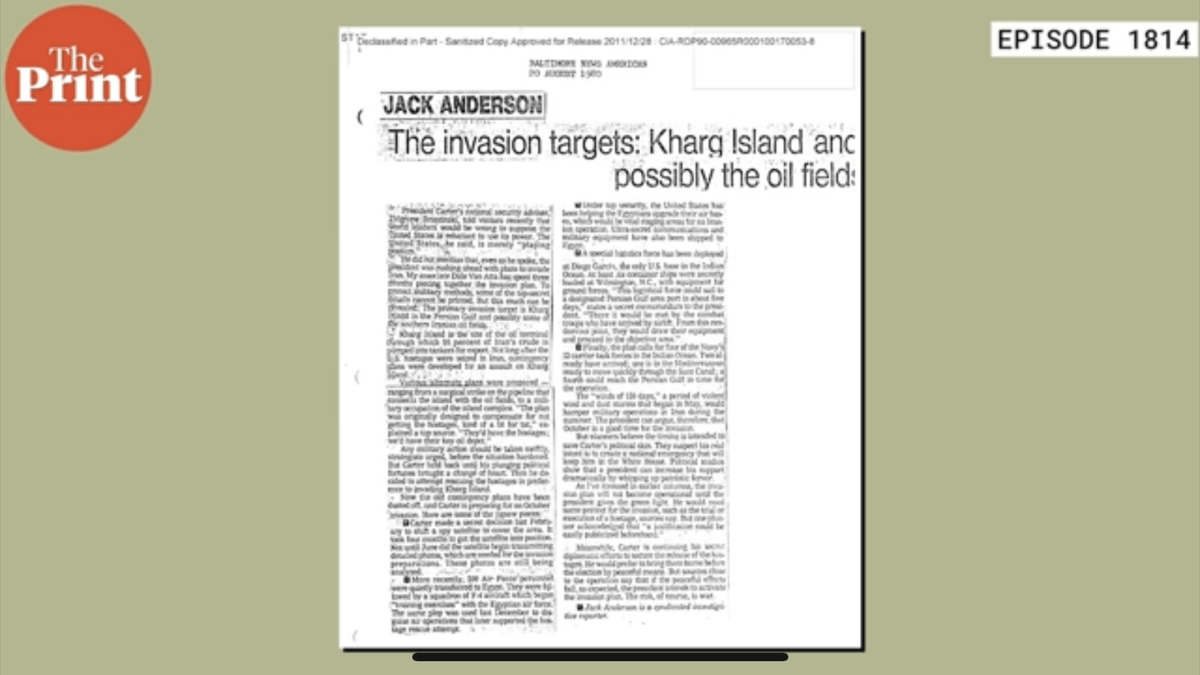
So, US President Jimmy Carter had also thought about it, but not done it. Now, why is it that from Jimmy Carter in 1979-80 to Donald Trump now, almost 46 years later, the talk is of taking Kharg Island. Why is Kharg Island so important? Kharg Island was also bombarded very heavily by the Iraqi Air Force in 1984-85 during the Iran-Iraq war. That war went on for 8 years.
And in many ways, that war became about oil between two huge oil-bearing countries because each one knew that the other’s economic power or the ability to sustain the war came from oil sales. So, each was trying to stop the other’s oil sales or the other’s oil production. That’s why a lot of the fighting took place across this waterway called Shatt al-Arab.
Shatt al-Arab means literally river of the Arabs that arises after the confluence of the great Arabian rivers, the Tigris and Euphrates, along which many civilizations rose, Babylonian one in particular. And these two great rivers meet, just as Ganga and Brahmaputra meet in Bangladesh and become one huge river, that becomes Padma. In this case, this becomes Shatt al-Arab or river of the Arabs. This runs for about 200 km.
On the other side of the river is Iran. And that’s where the Iranians and the Iraqis fought a lot of their battles. The town of Khurramshahr is somewhere there. If you have any recollection of that war, that name Khurramshahr will keep on featuring again and again. And Khurramshahr is the name that the Iranians have now given to one of their biggest missiles. That said, the reason the Iraqis bombed this island also was part of their oil warfare against Iran.
Also Read: Why Strait of Hormuz is critical oil chokepoint & how Iran is weaponising it | Cut The Clutter
Importance of Kharg
So, what is it that is so significant about this merely 20 sq km island in the middle of the wider part of the Persian Gulf? You might also think, as I did, when I initially heard that Kharg Island was so important and Trump wanted to take it now as leverage against Iran, I thought maybe this is very close to Strait of Hormuz. And Trump thinks that it is from here that Iranians get their ability to block the Strait of Hormuz. So, let me go and take it.
No, it’s actually 483 km away from the Strait of Hormuz towards the end of the Persian Gulf, that is say until Shatt al-Arab. Strait of Hormuz itself is 167 km. And then from this island to the other end of the Persian Gulf is another almost around 300 to 350 km. So, it’s in the middle of nowhere.
It’s also about 150 to 200 km from the South Pars gas field that we spoke about just the other day. That is what the Israelis bombed in retaliation for which the Iranians attacked oil facilities in many Gulf Arab countries. So, about 150 to 200 km depending on how you are sailing. So, once again in the middle of nowhere.
However, it has a couple of important points. One, it is only about 25 km from the coast of Iran. Second, this island doesn’t have oil of its own. This island has fresh water of its own so people can live there. So, about 10,000 people live there. Islamic Revolutionary Guard Corps (IRGC) has a lot of facilities there. It also has an airstrip. IRGC also controls who can enter the island. So, it’s also been called the forbidden island. All of this, however, does not explain the importance of the island.
What makes the island important is the fact that around the island, water is very deep. This is contrary to the situation along most of Iran’s coastline where the water is shallow. And because the water is shallow, super tankers, the big oil bearing ships, cannot go there. So, they cannot load these big ships from their coastal ports. They simply don’t have the port depth to load those ships there.
However, the waters around this tiny island have that depth. So, this island becomes a kind of stationary jetty in the middle of the sea, in the middle of the Persian Gulf. What happens then? Iran has a series of offshore oil fields, big offshore oil fields, and also oil fields elsewhere because all of Iran’s oil has to be emptied out. Some of Iran’s oil Iran uses itself. Some might be going through Iraq, maybe to Syria. I don’t know that, but that can be only very little or maybe to Turkey.
That can be very little, only bulk of Iran’s exported oil—because at this point the only export they can carry out is to China—that has to go by sea. This island is where all the super tankers come and dock between the island and the Iranian oil fields, the big Iranian oil fields which interestingly are all still named by old Zoroastrian figures. Darius, Ardeshir, Cyrus, Faridun like that. So, again reminds us of the Persian ancestry of Iran. From these big oil fields, crude is pumped into the island through pipelines that have been built from 1960 onwards.
These are now sizable pipelines that can carry a lot of oil at any point of time at the island there are facilities to store 30 million barrels of oil and that oil is then filled into the super tankers which keep going out. At any point of time up to a dozen super tankers can be docked there and as they fill out more oil comes in from these offshore oil fields through the pipelines.
That is why Kharg is so important. Almost all of Iran’s significant oil exports have to take place through Kharg island. This is Iran’s big deep sea port in the middle of the Persian Gulf. This is a geographical marvel in that sense. It’s also become a geopolitical prize now. So, what is Trump trying to do? Trump is trying to take this over or at least threatening to take this over only 5 km by 4 km or something like that.
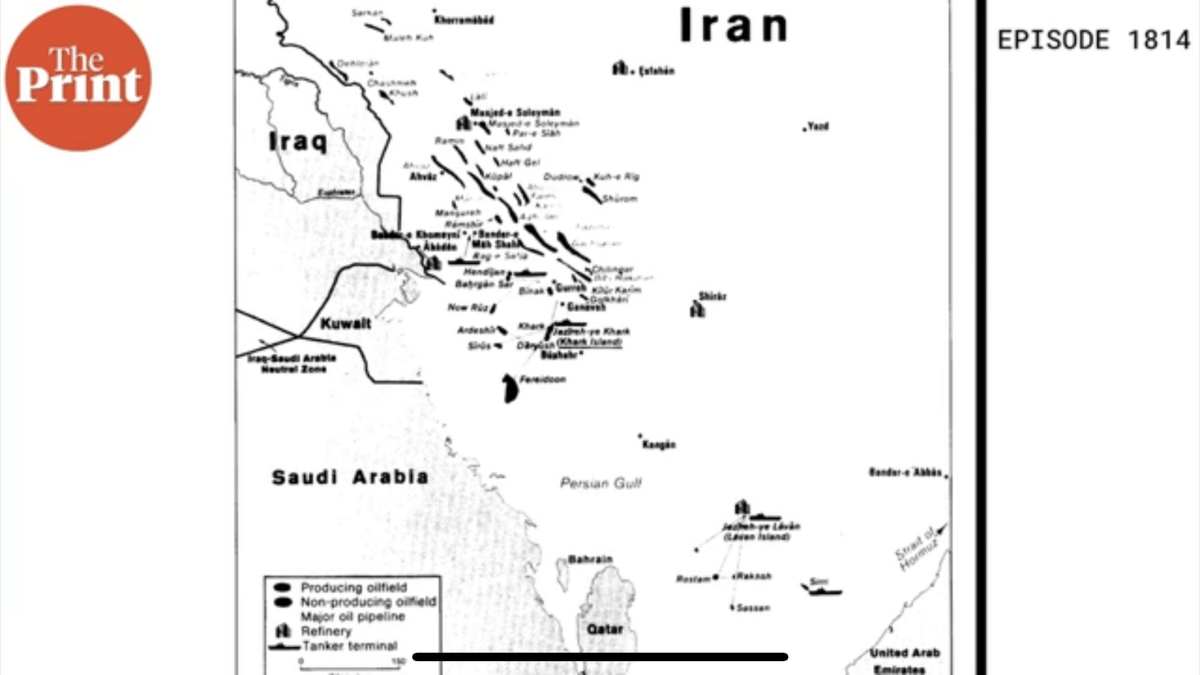
See the picture. See also the picture of the entire Gulf and then you will also see the distances that I mentioned to you. All of the Persian Gulf right up to the Gulf of Oman where Strait of Hormuz opens out is about 989 km. See where this island sits there. So, militarily you might say it’s not such a difficult job to take this island. There might be casualties because people there will fight.
The IRGC contingent there may not give in so easily. Also, there will be missiles and drones fired from the Iranian mainland. There will be risks. There will be casualties. But for a big power, helped by total air superiority, missiles, and other capabilities, it may be possible to take this island.
And then Trump would say, “Look, I have your island. I am not destroying your oil or your oil facilities, but I have your island. Because I have your island, you can keep your oil in your wells — you cannot export it. If you cannot export it, your economy comes to a standstill.’
‘I don’t want to destroy your oil fields or your oil stocks. All I am telling you is let’s make a deal. And the deal is: you guarantee that the Strait of Hormuz will remain open and all convoys and tanker traffic will go unmolested by you or your people. I will make sure that you can use your Kharg Island, or maybe I will turn over the Kharg Island.’
That seems to be the bargain that he is heading for. Now Kharg island can store up to 30 million barrels of crude oil. Iranians have been anticipating American interest in this island. Maybe they were also worried that the island might get bombed. So lately they have been emptying out these tanks. And right now the tanks have much less oil, much less crude that they can hold. In fact, at this point the tanks only hold about 9 million barrels of oil. The rest Iranians have sent out. Some of that is still sitting on Iranian ships.
And Scott Bessent, the US Treasury Secretary, had said the other day that the Iranian oil which is sitting on water, which is sitting on tankers and seas, we may unsanction it to stabilize global oil prices. So it’s possible that Iranians have moved this already into those tankers.
So analyst Natasha Kaneva, for example, of JP Morgan, says of last week that at that point 18 million barrels were stored at Kharg island, which was equal to about 10 to 12 days of exports for the Iranians. Iranians have very limited market for their oil, mostly it’s China. So Iran’s total exports these days of crude oil are just about 2 million barrels per day. Almost all of that is done from this terminal. Their total production is three and a half million. They must be using the rest for themselves. They are a large, urbanised population with significant needs for electricity and energy.
The gas comes from South Pars. That’s a different story. Bulk of that gas is also consumed within Iran because it depends on gas for its electricity needs. That’s far away—that is about 150 km sort of upstream from Kharg island.
This island is also an archaeological wonder. We talk about geology and also about geopolitics. It’s been inhabited by the Zoroastrian Empire by Alexander. After that many other powers came in. The Islamic power came in. There are mosques. There is a church. This island has changed hands all the time—Zoroastrians, Muslims, the French, the Portuguese, the Dutch and for heaven’s sake also the British.
Then at some point in 1960s there were negotiations between Saudi Arabia and Iran on their rights over the continental shift under the waters between them. Waters of the Persian Gulf. In that negotiation all of the Kharg island came to Iran. In 1960 some work had started along the island and these oil fields.
The Shah of Iran, Reza Pahlavi, brought in an American company Amoco and in a joint venture started developing these oil fields and these pipelines and the Kharg island terminal. That company was nationalized by the government under Khomeini just after the 1979 revolution. That had carried on and then sort of dramatically and that’s how things happen in these parts. In 1990 Iranians surprised everybody by making a deal with the Americans and paying Amoco $600 million as compensation for having taken over their oil wells and their storage and their facilities.
Since then, however, Iranian government’s own companies have been running this terminal. Most of the oil wells in Iran are towards the western side of Iran. They are along the border with Iraq in Khuzestan province and then along the Persian Gulf.
I had explained to you the other day in our episode over the Strait of Hormuz, the geological factors 200 million years ago that caused a continental drift and created the Persian Gulf. In that process I told you how the organic material below the Earth was pushed towards what now is the coastal zone of the Persian Gulf and that is what led to the creation of these big huge hydrocarbon reserves. That’s why Iraq has most of its oil wells along its border with Iraq and along the Gulf and very little deeper inside in the Iranian territory.
Also when you see this map you will find on the Iranian coast the significant cities Bushehr. Bushehr is also the city in a way to which South Pars belongs. It’s also a provincial capital and just as an aside the Iranian Navy ship which sought and got refuge in Sri Lanka and is now sitting in the port of Trincomalee and whose crews are still in Sri Lanka. That ship was named after the city that was IRIS Bushehr.
Now is Trump going to invade Kharg or not? I don’t know. I will read you a line. It’s a source-based line from Axios and this is a story by West Asia expert Barak Ravid, who currently seems to be among the best informed journalists on what’s going on in White House. He’s the one who does many phone interviews and one-on-one interviews also with Donald Trump, his favourite.
Now the quote that he uses from an anonymous source very close to Donald Trump and I quote from him—‘he wants Hormuz open. If he has to take the Kharg island to make it happen, that’s going to happen. If he decides to have a coastal invasion, that’s going to happen. And boots on the ground has taken place under every president of America. They’ve put boots on the ground. So what’s the big deal? This is a political issue,’
‘Does Donald Trump send boots on the ground or not?’ He says, ‘I don’t understand the politics. Maybe the media makes a big deal of it. But if he thinks that to keep the Strait of Hormuz open, he has to take the Kharg island, he shall go ahead and take it.’
Once again, as we conclude this, three more warships with thousands of additional Marines are on their way to the Gulf. Right now, their target seems to be Kharg island. Will there be a coastal invasion to control other Iranian batteries, etc.? I don’t know. Trump had once spoken about it, that he will carry out heavy bombings in coastal areas or do something drastic to neutralize the Iranian threat to shipping going into the Strait of Hormuz. We don’t know what will happen. Right now, it can just be a threat, a display of a threat by sending these Marines. What happens in the future, we don’t know.
It’s unlikely, however, that these Marines will arrive short of about two weeks from now. And finally, is this the only place from which Iran can evacuate its oil? There is one more place, that is the Jask terminal. Jask is located on the eastern/southeastern side of the Strait of Hormuz—that opens on the Gulf of Oman.
As you turn towards the Makran coast of Pakistan, around Jask, you also see Chabahar. Then as you move further along the Makran coast towards Pakistan, you see Gwadar and Pasni. This route does not have to use the Strait of Hormuz.
The problem with Iran is that this is not where its oil is located. Iran’s oil is far away. Iran has built a pipeline to bring that oil, but that pipeline can carry only about one million barrels per day at maximum. That is not good enough for Iran.
And if this becomes a tussle over the Strait of Hormuz, I won’t be surprised if the Americans threaten to block this as well.
(Edited by Tony Rai)
Dadagiri…world must buycott US,, social media & eatable parlours