





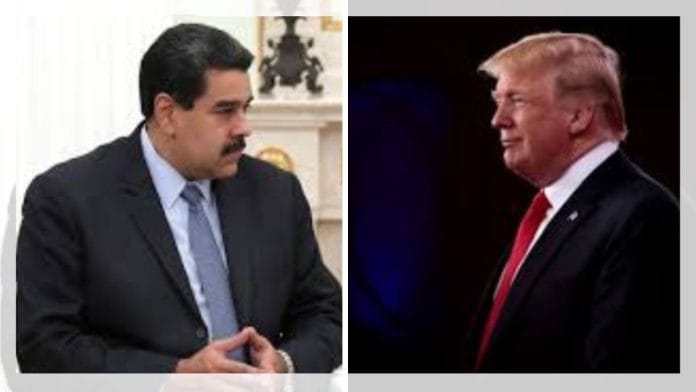



In pursuing a months-long military intimidation campaign against Venezuela that culminated in the Jan. 3 capture and removal of President Nicolás Maduro, the US has offered a varied and evolving set of justifications. In seizing Maduro and announcing plans to prosecute him in the US, officials alleged that he was involved in drug trafficking. But President Donald Trump has also made clear he has designs on Venezuela’s oil resources. And Maduro’s removal from power could serve additional interests of his administration.
What does the Trump administration say are its goals?
Trump and top administration officials say their main objective is to stem the flow of illegal narcotics to the US. In the administration’s telling, Maduro’s government is a “narco-state” that enables cartels to traffic fentanyl and cocaine into the country. The administration has accused Maduro himself of orchestrating the Venezuelan drug trade from the highest level of government, a charge that formed the basis of a 2020 indictment during the first Trump administration. US officials have characterized Maduro, who took office in 2013, as an illegitimate leader who posed a direct national security threat to the US.
In recent months, this narrative underpinned a dramatic military operation: a buildup of warships, aircraft and troops near Venezuela, strikes on vessels in the Caribbean and Pacific that the US says were operated by cartels, a covert strike on an alleged drug-trafficking facility, and a blockade of sanctioned oil tankers going to and from the country. Then came a series of airstrikes on Venezuela and the capture of Maduro and his wife on Jan. 3.
The Trump administration said the blockade — and other actions it has taken to limit Venezuela’s oil exports — cut off revenue streams that fund drug-trafficking groups. But in recent weeks, Trump has also made clear his desire for access to Venezuelan oil. “We’re gonna take back the oil that frankly we should have taken back a long time ago,” he said following the capture of Maduro. Venezuela has the world’s largest oil reserves.
What role does Venezuela play in the flow of illicit drugs to the US?
In September 2025, Trump told US military officials that each intercepted boat leaving Venezuela carried enough drugs to kill 25,000 Americans, describing the shipments as “mostly fentanyl and other drugs, too.”
The synthetic opioid fentanyl accounted for about 48,000 of the 80,000 overdose deaths in the US in 2024. However, US authorities say Venezuela plays little-to-no role in the flow of fentanyl to the US. Fentanyl is almost entirely produced in Mexico, where cartels such as the Sinaloa and Jalisco New Generation synthesize it using precursor chemicals imported from China. Mexico is also the primary exporter of the drug to the US.
The Trump administration has also framed Maduro’s government as leading one of the largest cocaine trafficking networks in the world. Cocaine was responsible for about 22,000 overdose deaths in the US in 2024. Venezuela’s role in cocaine trafficking is more substantial but still limited. The country serves as a transit hub for cocaine grown and processed in Colombia, Bolivia and Peru, according to the UN Office on Drugs and Crime. But only a minority of cocaine passing through Venezuelan routes is believed to be bound for the US. Most cocaine entering the US comes via Mexico, according to the US Drug Enforcement Administration.
Why does Trump argue the US deserves Venezuela’s oil?
US oil companies were the main architects of Venezuela’s oil industry starting a century ago, building the country into a leading US supplier. The industry was nationalized in the mid-1970s and reopened to foreign investment in the 1990s. Maduro’s influential predecessor Hugo Chávez expropriated major US oil projects in 2007. Exxon Mobil Corp. and ConocoPhillips pulled out and later won sweeping international arbitration awards for the seizure of their assets.
Chevron was the only US oil company to remain in Venezuela. The Houston-based company currently has a restricted license from the US Treasury Department to operate in four joint ventures with state-owned Petróleos de Venezuela SA.
In a social media post on Dec. 17, White House Deputy Chief of Staff Stephen Miller characterized the expropriations as an injustice against the US. “American sweat, ingenuity and toil created the oil industry in Venezuela,” Miller wrote. “Its tyrannical expropriation was the largest recorded theft of American wealth and property.”
Trump said after the Jan. 3 operation, Venezuela “stole our oil. They took it over … and we did something about it.”
Read More: How Venezuelan Oil Factored Into US Seizure of Maduro
What else does the Trump administration stand to gain from ending Maduro’s regime?
The Trump administration objects to the presence in the US of some 700,000 Venezuelan immigrants who received protections allowing them to stay under then-president Joe Biden. They are part of a massive exodus of some 7.7 million people provoked by the collapse of Venezuela’s economy and authoritarianism under Maduro.
The Trump administration has taken steps to revoke the immigrants’ protections but has faced legal challenges. If conditions were to improve in Venezuela in the absence of Maduro, presumably many of the immigrants would return home, sparing the Trump administration the challenges of removing them forcibly.
Bringing down Maduro also serves the Trump administration’s goal of undermining the communist government of Cuba, a priority especially for Secretary of State Marco Rubio, the son of Cuban emigres. Under Maduro, Venezuela has supported Cuba’s economy with cheap oil. “If I lived in Havana and I was in the government, I’d be concerned,” Rubio said in a press conference after the US operation removing Maduro.