








By Khanh Vu, Phuong Nguyen and Francesco Guarascio
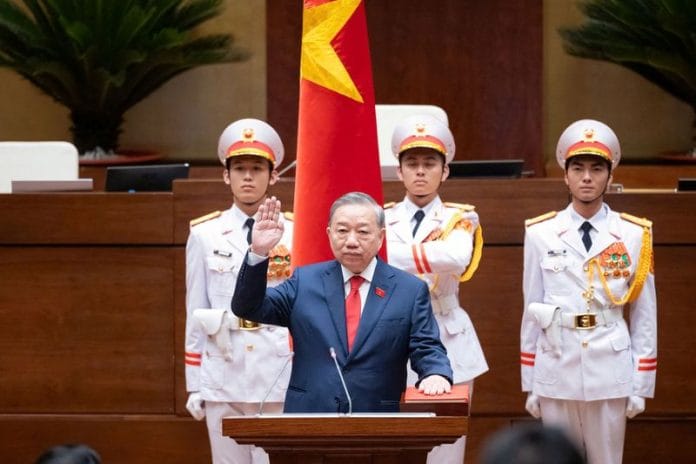
HANOI, April 7 (Reuters) – Vietnam’s lawmakers on Tuesday unanimously elected Communist Party Secretary General To Lam as the country’s state president for the next five years, making him the most powerful Vietnamese leader in decades.
The widely anticipated move marks a break from Vietnam’s traditional collective leadership system, consolidating authority in one figure in ways analysts say could tilt the one‑party state toward greater authoritarianism, while also enabling faster decision making, similar to its neighbour China.
The parliament said on its website that all 495 deputies present at Tuesday’s National Assembly session endorsed the Communist Party’s nomination, while five lawmakers were absent. Officials have said the nominations for top state leadership posts were finalised in a meeting in late March.
The former head of public security now has a double mandate to rule the country for the next five years, after he secured a second term as general secretary in January.
Parliament is scheduled later on Tuesday to elect a new prime minister who will replace the outgoing Pham Minh Chinh.
LAM PLEDGES NEW GROWTH MODEL
After the vote, Lam told deputies in a televised address that it was an honour to hold both posts and pledged “a new growth model with science, technology, innovation, and digital transformation as the primary driving forces”. He also said he would prioritise self-reliance in defence.
He said his top priorities were to maintain stability, promote rapid and sustainable national development and improve “all aspects of people’s lives”.
Analysts said Lam’s dual role could make it easier for him to achieve his goals, while cautioning against the risks of excessive power concentration.
“Concentrating greater power in To Lam’s hands could pose risks to Vietnam’s political system, such as increased authoritarianism,” said Le Hong Hiep, senior fellow at the ISEAS Yusof Ishak Institute in Singapore.
However, such consolidation “could enable Vietnam to formulate and implement policies more quickly and effectively,” supporting growth, he said.
The combination of the two roles “will shift Vietnam’s domestic politics to a new normal where most of the old assumptions about Vietnam’s politics, including those about collective leadership, are no longer valid,” said Alexander Vuving of the Asia-Pacific Center for Security Studies in the United States.
Lam held both posts for a period of a few months following the death in 2024 of the late party General Secretary Nguyen Phu Trong.
Even after relinquishing the state presidency in favour of army general Luong Cuong, Lam often acted as if he had retained the role, travelling extensively and representing the country in meetings with foreign leaders.
REFORMIST, BACKS NATIONAL CHAMPIONS
In his first stint as party chief, 68-year-old Lam launched sweeping economic reforms designed to make Vietnam more competitive, which drew both praise and criticism.
Lam has vowed to pursue double-digit growth through a new development model that is less reliant on low-cost manufacturing, long the backbone of Vietnam’s export-driven boom and led by foreign multinationals.
Lam’s moves have at times unsettled the administration and businesses, but he has shown a pragmatic flexibility in executing them.
He has backed the expansion of private conglomerates, but before his reappointment, also issued a directive emphasising the leading role of state-owned enterprises in a bid to reassure party traditionalists.
Foreign investors, a key component of Vietnam’s export‑reliant economy, have often praised the country’s political stability and see Lam as a pro‑business leader. However, his backing of national champions and push for breakneck growth have raised concerns among some about favouritism, corruption risks, asset bubbles and waste.
In foreign policy, Lam has also been pragmatic.
He has maintained Vietnam’s “Bamboo Diplomacy” and sought to balance relations with major powers while expanding international partnerships.
“Lam’s double-hat would not signal any changes in Vietnam’s foreign policy, even if there are concerns that Vietnam is concentrating more power in a single individual,” said Khang Vu, a visiting scholar at Boston College.
(Reporting by Khanh Vu, Phuong Nguyen and Francesco Guarascio; Editing by David Stanway)
Disclaimer: This report is auto generated from the Reuters news service. ThePrint holds no responsibility for its content.