








By Olivia Le Poidevin, David Lawder and Lisandra Paraguassu
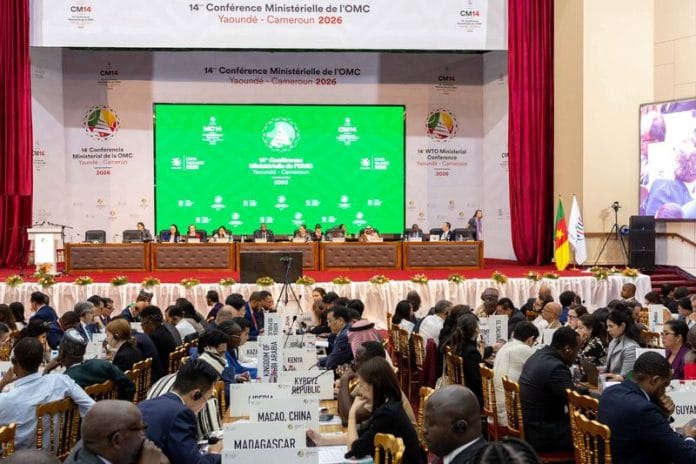
YAOUNDE, March 30 (Reuters) – World Trade Organization countries failed to agree on a reform path or even a routine extension of an e-commerce duty moratorium, prompting a fresh vow from the U.S. to seek alternative deals with like-minded countries and relegate the body to only a limited role in global trade policy.
Four days of talks among trade ministers in Cameroon’s capital Yaounde broke up in the early hours of Monday with Brazil and Turkey blocking a bid to extend the WTO’s e-commerce moratorium, including on digital downloads and streaming.
The moratorium, agreed at the dawn of the internet, lapsed for the first time in 28 years.
U.S. Trade Representative Jamieson Greer said in a statement that he has secured agreements from dozens of countries, including nearly all major trading partners, not to impose tariffs on U.S. digital transmissions. He vowed that if the WTO fails to restore the moratorium, “the United States will work outside of the WTO with all interested partners to get it done.”
Greer, who is the architect of U.S. President Donald Trump’s multi-front tariff assault on global trading partners, said he was disappointed that the meeting ended in an impasse. He said some countries demonstrated a “lack of seriousness” in WTO reform by not sending their trade ministers to Cameroon.
“I have always been skeptical of the value of the WTO, and this week’s conference confirmed that this organization will play only a limited role in future global trade policy efforts,” Greer said.
The WTO has been increasingly sidelined by economic nationalism in the past decade, and its 14th ministerial conference in Cameroon will further that trend, analysts said.
RISK OF A ‘SPAGHETTI BOWL’ OF DEALS
“It marks another crack in the foundations of the WTO system,” said Andrew Wilson, Deputy Secretary General of the International Chamber of Commerce.
Meanwhile, Jonathan McHale, vice president of digital trade at the Computer and Communications Industry Association, said that WTO members have allowed the digital trade issue to become “a negotiating football”.
“WTO Members must return to this issue urgently in Geneva, build on the draft texts developed at MC14, and deliver a durable solution that restores certainty and credibility to the system,” he said.
The talks tested the WTO’s relevance after a year of huge trade turmoil and more recent disruptions in the Middle East.
Still, a subset of 66 members did agree to sidestep previous hurdles to usher in the world’s first baseline deal on digital trade rules among participants.
The parties of the Comprehensive and Progressive Agreement for Trans-Pacific Partnership – 12 countries including Australia, Britain, Canada, Japan and Mexico but not the U.S. – met with the EU on the sidelines of the WTO talks.
As diplomats pursue a mix of agreements between two or larger subsets of countries, they risk creating a complex “spaghetti bowl” of agreements, said Dmitry Grozoubinski, executive director of the Geneva Trade Platform.
E-COMMERCE TEST
Extending the e-commerce moratorium was seen as key to securing WTO support from the U.S., which under President Donald Trump has retreated from global multilateral bodies.
WTO Director-General Ngozi Okonjo-Iweala said the trade body hoped the moratorium could still be restored, adding that Brazil and the U.S. were trying to reach agreement on it.
She said progress was made on a reform roadmap, and talks on issues like making subsidy use more transparent and facilitating decision-making are expected to continue in Geneva.
The U.S. and the EU argue that China in particular has taken advantage of current rules to their detriment. China has long dismissed accusations that it flouts trade rules and said it supports the multilateral system, including the WTO.
Diplomats worked through Sunday to close the gap between Brazil’s initial two-year proposal on the moratorium and the permanent extension sought by the U.S. by drafting a plan for a four-year extension with a one-year sunset buffer.
Brazil then offered a four-year extension with a mid-term review clause, but it lacked sufficient support.
Developing countries opposing a lengthy extension argue the moratorium denies them potential tax revenue.
A U.S. official said Brazil had opposed a “near-consensus document”. A Brazilian diplomat said “the U.S. wanted the sky,” and that a longer extension was not prudent given rapid developments in digital trade.
Another diplomat said U.S. Trade Representative Greer made delegates “uncomfortable” by warning of “natural consequences” if a long-term extension was not agreed.
Keith Rockwell, a trade analyst at the Hinrich Foundation and a former WTO director, said Brazil’s efforts to leverage e-commerce for concessions on agriculture failed because the U.S. was no longer so invested in the WTO.
“In the old days, because they felt responsibility for the system, the Americans would have swallowed hard and taken a hit,” he said. “But now they won’t do that anymore.”
(Additional reporting by Emma Farge in Geneva and Lisandra Paraguassu in Brasilia and David Lawder in Washington, D.C.; Writing by Dave Graham and David Lawder; Editing by Hugh Lawson, Andrew Heavens and Kevin Buckland)
Disclaimer: This report is auto generated from the Reuters news service. ThePrint holds no responsibility for its content.