





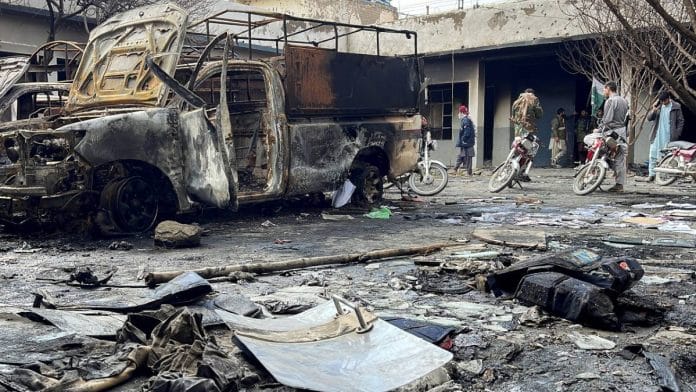



New Delhi: The US has voiced support for Pakistan in the aftermath of a series of coordinated attacks in Balochistan, backing Islamabad’s push to “hold the perpetrators of these horrific attacks accountable”.
“We stand steadfast with Pakistan in the wake of recent attacks in Balochistan. The Balochistan Liberation Army remains a designated Foreign Terrorist Organization, and we support efforts to hold the perpetrators of these horrific attacks accountable,” US State Department’s Bureau of South and Central Asian Affairs said on X Friday.
The coordinated assaults were launched by BLA, a separatist group designated as a terrorist organisation by Pakistan and US, in January-end across at least 12 districts in Pakistan’s restive Balochistan province, including Quetta, Gwadar, Mastung, Noshki and Panjgur, targeting military installations, police stations, banks and railway tracks.
The BLA claimed responsibility, releasing videos showcasing coordinated strikes involving suicide bombings, gunfire, and even female rebels to underscore their “liberation struggle” against what they call Islamabad’s exploitation.
Pakistan’s military said at least 92 militants had been killed on 1 February, battling the security forces in multiple cities across Balochistan. However, BLA claimed in a statement that over 80 security personnel had been killed and 18 people taken hostage in “Operation Herof Phase II”.
Pakistan has vowed escalated counter-operations, with the army already reporting 216 rebels killed in the weeklong campaign since 29 January, including 177 in immediate retaliation.
Provincial Chief Minister Sarfraz Bugti stated that security forces had eliminated nearly 700 insurgents in 2025 alone, vowing no let-up against the separatists.
Pakistan’s Defence Minister, Khawaja Asif, addressing the National Assembly, admitted that Baloch rebels had advanced weapons, including rifles and night vision devices. He further claimed that the rebels receive support from Afghanistan, which borders Balochistan.
Pakistan’s military spokesperson, Director General of Inter-Services Public Relations (DG-ISPR), in a statement described the assaults as an attempt to overrun strategic sites, asserting that intelligence stated the attacks had been orchestrated from “outside Pakistan”.
Pakistan’s Interior Minister Mohsin Naqvi echoed this, alleging backing from India.
New Delhi, however, dismissed the accusations as “frivolous claims” designed to divert attention from Pakistan’s internal failures.
Randhir Jaiswal, spokesperson for the Ministry of External Affairs, said in a communication: “Instead of parroting frivolous claims each time there is a violent incident, it (Pakistan) would do better to focus on addressing long-standing demands of its people in the region. Its record of suppression, brutality and violation of human rights is well known.”
Balochistan, which borders Iran and Afghanistan, remains Pakistan’s largest yet least developed province, rich in gas and minerals. The province has suffered a long period of marginalisation, heavy militarisation, and economic neglect despite its wealth generation for Islamabad.
The nation’s plan to make the province a logistical hub with Beijing through the China-Pakistan Economic Corridor has been largely viewed with suspicion by local groups and separatists, and even led to attacks on Chinese workers on the project.
(Edited by Nida Fatima Siddiqui)
Also Read: US tags BLA as foreign terrorist group days after Pakistan army chief Munir’s visit. What it means