








By Lucinda Elliott and Marco Aquino
LIMA, April 10 (Reuters) – As Peru heads into the first round of its presidential election on Sunday, Washington is mounting its most assertive push in years to shore up influence in the major copper producer that has become a key strategic partner for China, according to business leaders and senior officials.
The outreach led by newly appointed U.S. ambassador Bernie Navarro marks a shift after a decade in which China overtook the United States as Peru’s dominant trade partner, particularly in mining and infrastructure.
The upcoming election – in which over 30 candidates are competing for the presidency, with no clear frontrunner – could offer Washington a new chance to rebuild ties as it seeks to safeguard access to critical minerals and push back on growing Chinese influence in South America.
“The relationship with the U.S. is really strengthening,” said Felipe James, head of Peru’s manufacturing industry chamber, who met with Navarro in February to open a working group to boost trade and investment.
In January, the White House designated Peru a major non-NATO ally, a move that would deepen defense cooperation and expand access to trade and security programs. The next day, the State Department approved an equipment package to help modernize a naval base near the port of Callao.
Peruvian officials joined U.S. President Donald Trump and his closest regional allies in Florida last month to launch a new coalition to fight Latin American drug cartels. And U.S. company Lockheed Martin is competing with firms from Sweden and France to sell Peru fighter jets.
Navarro’s engagement with Peruvian stakeholders reflected Trump’s “commitment to strengthening the U.S.-Peru partnership on shared priorities including economic growth and security cooperation,” a State Department spokesperson said.
SECURITY CONCERNS
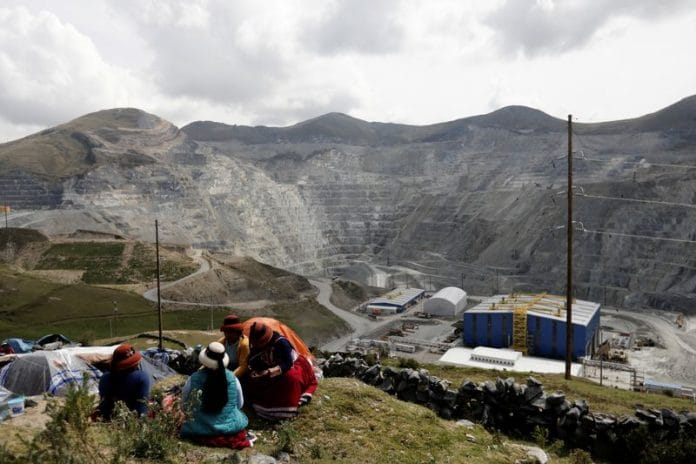
Peru is the world’s third-largest copper producer and a major supplier of other critical minerals used in semiconductors, defense systems and renewable technologies. Its trade with China hit a record $50 billion last year, eclipsing the roughly $19 billion traded with the United States.
Rather than trade volumes, Washington has been stressing the transparency and reliability of U.S. firms working in Peru, executives say, while Ambassador Navarro has urged leaders in Lima to rein in judicial risks and tackle concerns about public security at a time of surging organized crime.
“He has clearly called for legal certainty and stronger public security to attract investment,” said Julia Torreblanca, head of mining and energy association SNMPE and vice president of corporate affairs at Cerro Verde, a copper producer run by Freeport-McMoRan.
Navarro has also flagged Peru’s recent political volatility as a growing concern for the business environment. The country has had eight presidents since 2018.
“The United States will never interfere in Peruvians’ right to self-determination, but stability is needed,” he told local radio station RPP last month.
The U.S. Embassy declined to make Navarro available for an interview.
With Peruvian presidents often more occupied with surviving regular impeachment attempts than building a consistent geopolitical strategy, analysts said the economic heft of China’s trade relationship has outweighed historic U.S. ties.
“There’s a correlation between those last ten years of political instability and more Chinese investments being able to trickle to Peru,” said Martin Cassinelli of the Atlantic Council.
TRADING PLACES
The renewed push from Washington comes as Peru has opened itself as a gateway for Chinese trade with South America.
The Chinese-built Chancay megaport north of Lima, operated by Cosco Shipping, has cut sea journey times to Asia and is beginning to serve as a transit hub for goods such as electric vehicles bound for regional markets.
The port, inaugurated in late 2024, has raised concerns in Washington over foreign control of strategic infrastructure.
Former U.S. Southern Command chief General Laura Richardson has warned it could serve as a “gateway” for Chinese military and intelligence activities in South America.
Efforts by Peruvian authorities to strengthen regulatory oversight were blocked earlier this year when a court ruled in favor of Cosco’s claim that Chancay is a private investment. The decision is under appeal.
Peru’s economic ties to China will be hard to unwind.
Trade imbalances have widened in recent months, with Peru slipping back into a deficit with the U.S. after a brief surplus in 2024. Officials in Lima are trying to lift tariffs imposed by U.S. President Donald Trump, which they argue violate a bilateral free trade agreement in effect since 2009.
“China is not leaving,” said Margaret Myers of the Inter-American Dialogue, who said U.S. efforts are likely to focus on areas that intersect with national security interests rather than attempting to displace China’s economic importance to Peru.
That will hinge on the outcome of the vote this Sunday. All the candidates are polling below 15%, making a June runoff all but certain.
Right-leaning Keiko Fujimori, educated in the U.S. and seen as a leading contender, has cast herself as a safer partner for Washington than rivals she links to Beijing, while conservative Carlos Alvarez has balanced praise for renewed U.S. engagement in Latin America with an emphasis on the value of Chinese investment.
“They say: do you want a gringo hamburger or some chifa (Chinese fusion)?” said Alvarez in an interview with Reuters.
Alvarez said he preferred a local specialty: fried guinea pig.
(Reporting by Lucinda Elliott and Marco Aquino in Lima. Additional reporting by Beijing newsroom. Editing by Cassandra Garrison, Brad Haynes and Rosalba O’Brien)
Disclaimer: This report is auto generated from the Reuters news service. ThePrint holds no responsibility for its content.