





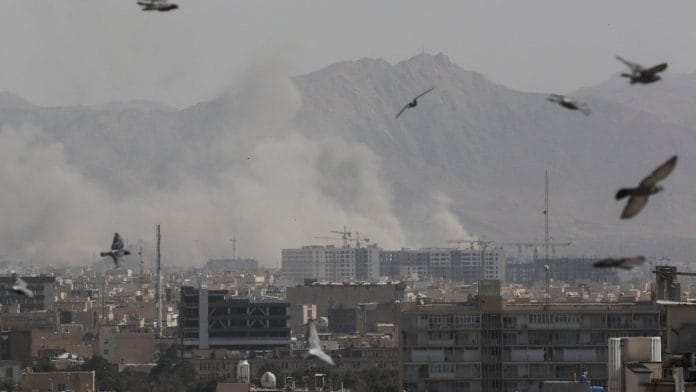



New Delhi: The US and Israel launched sweeping military strikes against Iran Saturday morning, targeting its top leaders, prompting a swift reaction from Tehran and plunging the Gulf into an escalating crisis that could drag the region into a full-fledged war.
President Donald Trump said the move—named ‘Operation Epic Fury’ by Pentagon—would end a security threat to the US and give Iranians a chance to topple the ruling regime. Israeli Prime Minister Benjamin Netanyahu echoed a similar stand, calling Iranians to “make their own destiny”.
But Saturday’s joint Israel-US strikes were deemed unprovoked and illegal by Tehran, which rapidly launched missiles at Israel and at least five Gulf allies of the US that host American military bases.
The conflict came two days after indirect talks mediated by Oman failed to produce a breakthrough on Iran’s nuclear programme.
The strikes, according to Israeli officials, targeted Iranian Supreme Leader Ayatollah Ali Khamenei and President Masoud Pezeshkian, among other. Satellite imagery showed that the official compound of Khamenei in Tehran was among the sites hit in the attack, but the outcome was unclear.
At least three sources told Reuters that Iran’s Defence Minister Amir Nasirzadeh and Iranian Revolutionary Guards commander Mohammed Pakpour were killed in Israeli attacks.
Iran’s Foreign Minister Abbas Araghchi later told NBC in an interview that “we may have lost few commanders but that wasn’t a big problem”. On Khamenei, he said the Supreme Leader was alive “as far as I know”.
Iranian state media reported that Khamenei was safe and had been moved to a secure location. Pezeshkian, it said, was also safe and sound.
As explosions rang out in Qatar, Kuwait, the UAE, Bahrain and Jordan–the countries said they had intercepted most missiles—Tehran warned that its retaliation had only begun.
Senior Revolutionary Guards commander Ebrahim Jabbari said on state television that Iran had used only “scrap missiles” so far and would “soon unveil unforeseen weapons”. The Revolutionary Guards said all US bases and interests in the region were within reach and retaliation would continue until “the enemy is decisively defeated”. The Iran-aligned armed group Kataib Hezbollah in Iraq also said it would attack US bases in the region.
Bahrain said the US Fifth Fleet base had been struck, with videos circulating on social media showing thick plumes of smoke rising from its coastline. Loud booms sounded in Abu Dhabi and Dubai.
Qatar said it had downed all incoming missiles but reserved the right to respond. Kuwait confirmed a missile attack on a US military base. And Jordan’s military said it had intercepted two ballistic missiles.
At least one person was killed in Abu Dhabi, with UAE saying it was a Pakistani national who died as a “result of these attacks”.
On the other side, Israeli Defence Forces (IDF) said it had “completed a broad strike” on the Iranian regime, targeting its aerial defence systems in the Kermanshah area, as well as military sites in Qum, Isfahan, Tabriz, Karaj and Kenarak, BBC reported.
Iran said dozens of more than 80 were killed in an Israeli strike on an elementary girls’ school in Minab in south of the country.
In a video message on Truth Social after the strikes were launched, US President Donald Trump said the operation aimed to eliminate “imminent threats from the Iranian regime”.
He urged Iranians to stay sheltered because “bombs will be dropping everywhere”, before adding: “When we are finished, take over your government. It will be yours to take. This will be probably your only chance for generations.”
Iranian state media responded with a near-total internet blackout across the country, confirmed by watchdog Netblocks, as the country’s Supreme National Security Council urged 10 million-odd residents to leave Tehran.
Netanyahu, in his address, said the joint action would “create the conditions for the brave Iranian people to take their destiny into their own hands”. Defence Minister Israel Katz, the first to announce the news on Saturday morning, called it a “pre-emptive” strike to remove threats to Israel.
Iran’s Foreign Minister Abbas Araghchi countered that Tehran would use “all its defensive and military capabilities under legitimate right of self-defence” and warned the Gulf states of “their responsibility to prevent the misuse of their facilities and territories” by the US and Israel.
Global reaction was swift and divided. The UK, France and Germany said in a joint statement they “did not participate” in the strikes but condemned Iranian attacks on Gulf nations and urged Tehran to “seek a negotiated solution”.
Saudi Arabia condemned Iran’s retaliation in the “strongest terms”, while UK Prime Minister Keir Starmer said British planes were “in the sky” in West Asia “as part of co-ordinated regional defensive operations”.
Norway’s Foreign Minister Espen Barth Eide said the US-Israel strikes were “not in line with international law”.
India said it was “deeply concerned” and urged “all sides to exercise restraint, avoid escalation, and prioritise the safety of civilians”, issuing advisories for citizens across the region.
An emergency meeting of the UN Security Council—requested by Russia, China, Bahrain, France and Colombia—was called for later on Saturday in New York. It will be held after UN Secretary General Antonio Guterres condemned “military action in the Middle East” and called for an “immediate cessation of hostilities”.
Iran also submitted a letter to the UN Security Council and Guterres, calling on the international body to “bear responsibility for international peace”.
The world will be looking at economic fallout of the conflict in oil-rich Gulf, especially since the US and Israel have said publicly that the operation’s intent was regime change in Iran and was likely to last some time.
Four sources told Reuters that oil majors and trading houses suspended crude shipments from the Strait of Hormuz, through which roughly a fifth of global oil consumption passes. Iran is OPEC’s third-largest producer, accounting for about 4.5 percent of global supplies.
Another uncertainty was on disruption to air travel, with several Gulf countries closing their airspace for commercial flights as missiles and drones zoomed across the region.
The strikes come at a time when Iran’s clerical regime was already in a difficult position after mass anti-government demonstrations in January led to a crackdown in which thousands were killed.
Israel, in June 2025, pounded Iran in a 12-day war that was joined by the US. Some of Iran’s senior military officials were killed in these operations, which also weakened several of Tehran’s once-feared proxy forces across the region. After this operation, the US and Israel had warned that they would strike again if Iran pressed ahead with its nuclear and ballistic missile programmes. The threats were backed up in recent weeks by a US military buildup in the region.
(Edited by Prerna Madan)
Also Read: Trump’s message to Iranians—‘When we’re done, take over your govt & reclaim your nation’