








By Nate Raymond
Jan 15 (Reuters) – A federal appeals court ruled on Thursday that a judge had no jurisdiction to order the release of Columbia University graduate Mahmoud Khalil from immigration detention, delivering President Donald Trump’s administration a victory in its efforts to deport the pro-Palestinian activist.
The 2-1 ruling by a panel of the Philadelphia-based 3rd U.S. Circuit Court of Appeals opens the door to Khalil being rearrested after it ordered the dismissal of a lawsuit he filed challenging his initial detention.
The court said that under the Immigration and Nationality Act, the district court that considered his lawsuit was not the proper forum to address his claims, which should have been heard through an appeal of a removal order from an immigration judge.
Khalil was among the most prominent of a number of foreign students detained last year after engaging in pro-Palestinian activism on their college campuses. While the ruling is likely to be appealed, if it stands it could close off a legal avenue that many have used to challenge deportation orders.
Thursday’s ruling came from U.S. Circuit Judges Thomas Hardiman and Stephanos Bibas, both of whom were appointed by Republican presidents.
“The scheme Congress enacted governing immigration proceedings provides Khalil a meaningful forum in which to raise his claims later on in a petition for review of a final order of removal,” they wrote in an unsigned opinion.
U.S. Circuit Judge Arianna Freeman dissented, saying Congress did not mean to foreclose meaningful judicial review over Khalil’s claims that his detention and potential re-detention violate his free speech rights under the U.S. Constitution’s First Amendment.
“Khalil claims that the government violated his fundamental constitutional rights,” wrote Freeman, who was appointed by Democratic President Joe Biden. “He has also alleged, and proven, irreparable injuries during his detention.”
Khalil in a statement said the ruling is “deeply disappointing, but it does not break our resolve.” His lawyers vowed to appeal the ruling, which does not take immediate effect, preventing his re-detention for now.
“The door may have been opened for potential re-detainment down the line, but it has not closed our commitment to Palestine and to justice and accountability,” Khalil said.
PRO-PALESTINIAN CAMPUS ACTIVISTS TARGETED
Tricia McLaughlin, a spokesperson for the U.S. Department of Homeland Security, which oversees Immigration and Customs Enforcement, in a statement said that given the ruling, Khalil should “self-deport now before he is arrested, deported, and never given a chance to return.”
“Today’s ruling from the 3rd Circuit is a vindication of the rule of law and the simple truth that DHS has argued from the beginning: an immigration judge, not a district judge, has the authority to decide if Mr. Khalil should have been released,” she said.
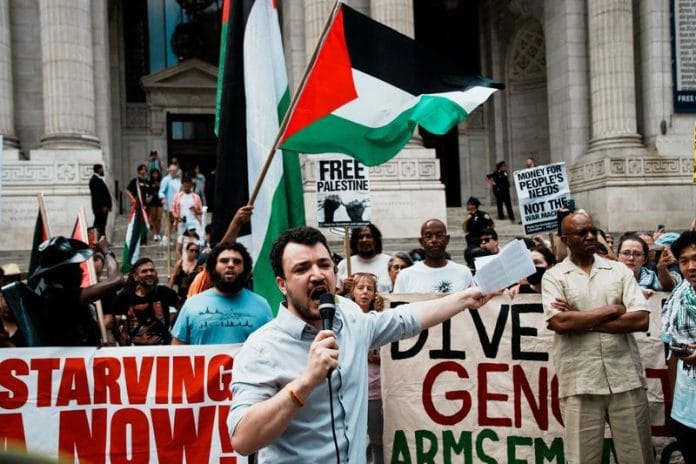
Khalil, a prominent figure in pro-Palestinian protests against Israel’s war in Gaza, was arrested on March 8 by immigration agents in the lobby of his university residence in Manhattan.
Trump had called the protests antisemitic and vowed to deport foreign students who took part. Khalil became the first target of this policy.
Though Khalil was initially detained in New York, by the time his lawyer sued over his detention there, immigration officials had moved him to New Jersey, leading his case to be transferred to a judge there.
He walked out of a Louisiana immigrant detention center in June, after U.S. District Judge Michael Farbiarz, a Biden appointee in New Jersey, ordered the Department of Homeland Security to release him from custody.
The Trump administration appealed, calling Farbiarz’s ruling an “unprecedented” intrusion into its efforts to detain and deport a key figure in “violent and antisemitic riots and protests” that occurred at Columbia in 2024 over Israel’s war.
In September, an immigration judge ordered Khalil to be deported to Algeria or Syria over claims that he omitted information from his green card application. His lawyers have said they will appeal that order.
Thursday’s ruling came hours before a federal judge in Boston was scheduled to consider whether to block the Trump administration from arresting, detaining and deporting foreign students and faculty engaged in pro-Palestinian advocacy, after he concluded last year that the policy was unconstitutional.
(Reporting by Nate Raymond in Boston; Editing by Chizu Nomiyama, Alexia Garamfalvi, Bill Berkrot and Diane Craft)
Disclaimer: This report is auto generated from the Reuters news service. ThePrint holds no responsibility for its content.