





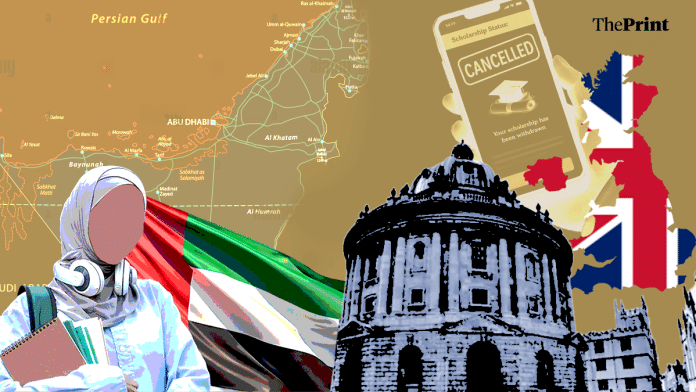



New Delhi: The United Arab Emirates has cut funding for its citizens looking to study in the United Kingdom after London failed to proscribe the Islamist Muslim Brotherhood organisation. Abu Dhabi’s move to slash funding for its high-achieving students to receive scholarships to UK universities comes as ties continue to fray between the two allies, according to British daily Financial Times.
US Vice President J.D. Vance called the reports of UAE’s latest action an “absolutely insane headline”. “Some of our best Muslim allies in the Gulf think the Islamist indoctrination in certain parts of the West is too dangerous,” he wrote on X.
For nearly a 100 years, the Muslim Brotherhood has sought to expand its footprint and is considered a transnational Sunni organisation. The US, in November, began the process to label the Brotherhood’s branches in Egypt, Jordan and Lebanon as “terrorist organisations”. This reflects the growing split on the views on the organisation between Washington and its European allies.
“The exclusion of British universities is linked to anxiety in the UAE over what it sees as the risk of Islamist radicalisation on UK campuses, according to three people familiar with the matter,” notes Financial Times in its report.
The Brotherhood has had difficult ties across West Asia, especially in the aftermath of the Arab Spring, where it was able to briefly gain power in Egypt between 2012 and 2013, before being removed by the current leadership under Abdel Fattah al-Sisi.
On the fringes of Egyptian politics, the Brotherhood had gained prominence in the aftermath of the 1967 Six-Day war, which had marked the decline of Nasserism and enshrined Islamism across West Asia and beyond, according to Brookings.
The group has been proscribed across countries in West Asia, but remains active in Europe and the United Kingdom, leading to fears of radicalisation of Arabs who travel there for their further studies.
“For the UAE and several other Arab states, anxiety and concerns over the Muslim Brotherhood is long-standing rather than episodic—rooted in deep ideological and political divergences. The Brotherhood’s model of political Islam has consistently challenged the credibility and legitimacy of powerful Gulf monarchies like the UAE,” explained Nadeem Ahmed Moonakal, assistant professor at Department of Geopolitics and International Relations at the Manipal Institute of Social Sciences, Humanities and Arts.
Moonakal told ThePrint: “In recent years, these concerns have been reinforced by external developments, notably the Gaza war and the responses of some regional Brotherhood affiliates, as well as the executive order signed by President Donald Trump last year, initiating the process of designating certain Brotherhood chapters in Egypt, Jordan, and Lebanon as Foreign Terrorist Organisations.”
Hamas has in its founding document claimed to be founded as the chapter of the Brotherhood in Palestine, which has also added to the debate around the role of the organisation across Europe and West Asia.
Founded in 1928 by Hassan al Banna in Egypt, the Muslim Brotherhood called for reformation across the Islamic world and a political unification under a “Caliphate”. According to its belief, westernisation and secularisation was the root of issues within the Muslim world, and that nationalism was not the answer to the situation.
Also Read: Saudi-UAE tensions rise as Riyadh accuses Abu Dhabi of aiding southern leader’s flight from Yemen
Growing fears of radicalisation across Europe
While no European government has yet proscribed the organisation, the fears of radicalisation have led to different responses across the continent. In some countries, the argument has also received pushback from Muslim organisations and political parties, highlighting a growing sense of Islamophobia across the continent.
In his New Year’s address, Danish Prime Minister Mette Frederiksen promised a comprehensive reform on deportation, underlining that Copenhagen would refuse to embrace those who come from a “culture of domination”.
Austria in 2021 had started taking action against “political Islam”, going after the Muslim Brotherhood in an attempt to be seen as reducing its role in the country. However, across the spectrum, such actions have received strong pushback from parties like the Greens in Austria particularly, while facing the ire of the courts.
The UK, for example, has made no movement towards proscribing the Muslim Brotherhood, after a 2015 government report found no links between the organisation and terrorism within its country.
“Charles Farr examined in detail the Muslim Brotherhood’s development, ideology and
activities in the UK. He found that organisations associated with the Muslim Brotherhood were established in the UK (and elsewhere in Europe) over fifty years ago. They mainly comprised exiles and overseas students. In the UK, these organisations worked very closely with like minded counterparts from South Asia, established to promote the work of Abu A’la Mawdudi and representing Jama’at-e-Islami. They regarded themselves as a single Islamic movement,” noted the report.
“In the 1990s the Muslim Brotherhood and their associates established public facing and apparently national organisations in the UK to promote their views. None were openly identified with the Muslim Brotherhood and membership of the Muslim Brotherhood remained (and still remains) a secret,” it added.
Moonakal further said, “The UAE has been particularly vocal in criticising the UK’s approach, arguing that London has evolved into a permissive hub for Brotherhood-linked activities. These concerns are further amplified by the current regional context: shifting geopolitical alignments, heightened public sentiment following the Gaza war, and the renewed salience of the Palestinian issue have increased pressure on Gulf states to balance domestic opinion with their strategic interests.”
In Paris, the government report into the Brotherhood’s activities last year warned that the organisation—reported to be in control of a number of places of worship from Brussels and France—could impact the country’s secular identity—a claim rejected by Muslim organisations in Europe.
The Brotherhood, however, has its supporters in West Asia, specifically Türkiye and Qatar, notes the French government report. Qatar, between 2017 and 2021, faced a diplomatic crisis after a number of its West Asian partners, including Egypt, Saudi Arabia and UAE, broke ties with Doha over its continued support for certain “opposition groups”, including the Brotherhood.
(Edited by Mannat Chugh)
Also Read: ‘Modi, Trump spoke 8 times in 2025’: India says Lutnick’s claims on stalled US trade deal inaccurate
I had a good laugh but at the same time I realized that we don’t stop our kids from going to places like turkey and Bangladesh where kids are becoming radicalized.
Stop accepting degrees from places like this. I don’t know what to say about UK other than just laugh at it. Britain has become a joke.