








By Luc Cohen and Jack Queen
NEW YORK, March 26 (Reuters) – A U.S. judge questioned on Thursday the U.S. government’s justification for blocking ousted Venezuelan president Nicolás Maduro from using the South American country’s funds to pay for his legal defense against U.S. drug trafficking charges.
Maduro and his wife, Cilia Flores, wore beige prison garb to the hearing in Manhattan federal court more than two months after U.S. military forces captured them in a surprise raid on Caracas and ferried them to New York.
Maduro, 63, and Flores, 69, have pleaded not guilty to charges including narcoterrorism conspiracy and are jailed in Brooklyn pending trial.
They have asked U.S. District Judge Alvin Hellerstein to dismiss the charges, saying their inability to rely on Venezuelan public funds is interfering with their right to have a lawyer of their choosing under the Sixth Amendment of the U.S. Constitution.
Their lawyers have said Maduro and Flores cannot afford to pay their defense fees on their own.
Prosecutor Kyle Wirshba said the U.S. sanctions blocking the payments were based on existing national security and foreign policy interests. Hellerstein appeared skeptical of that argument, noting that the U.S. had relaxed sanctions on Venezuela since Maduro’s ouster.
“The defendant is here, Flores is here. They present no further national security threat,” said Hellerstein, a judicial appointee of Democratic President Bill Clinton. “The right that’s implicated, paramount over other rights, is the right to constitutional counsel.”
Pollack, who represented WikiLeaks founder Julian Assange, has said he wants to withdraw from the case if Hellerstein doesn’t dismiss the charges and the Venezuelan government cannot pay his fees. It was unclear how much Pollack is charging Maduro for his services. Pollack did not respond to a request for comment.
Earlier on Thursday, U.S. President Donald Trump told reporters that additional cases would be brought against Maduro, without offering details.
MADURO CAPTURED BY SPECIAL FORCES
U.S. special forces captured Maduro and Flores in a surprise January 3 raid on their Caracas residence and flew them to New York to face drug trafficking charges, an operation detailed in a Reuters examination of the covert mission and its geopolitical fallout.
Maduro was transported from the Metropolitan Detention Center in Brooklyn to the federal courthouse in lower Manhattan early on Thursday.
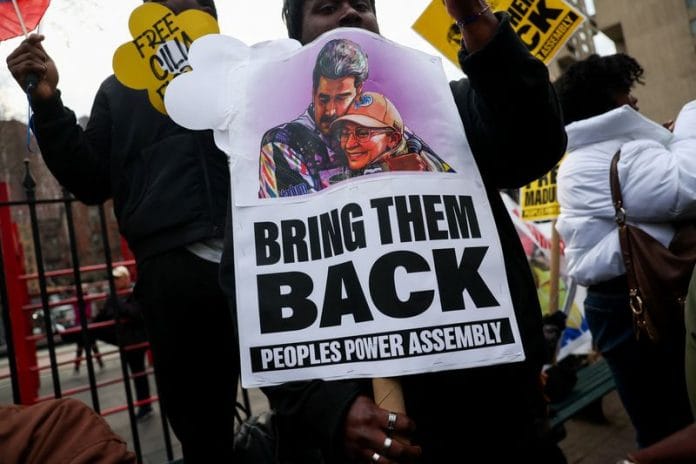
Outside the courthouse, police separated dozens of Maduro opponents – one holding an effigy of Maduro in an orange jumpsuit – from dozens of pro-Maduro demonstrators holding signs reading “Free President Maduro.”
Maduro and his wife say that under Venezuelan law and custom, the government pays the expenses of the president and first lady.
Prosecutors argue that because the U.S. has not recognized Maduro as Venezuela’s legitimate president since 2019, he and Flores should not expect the U.S. government to allow Venezuela to pay their legal fees. The prosecutors say Maduro and Flores can be assigned public defenders if they cannot afford their own lawyers.
NARCOTERRORISM LAW HAS HAD LIMITED TRIAL SUCCESS
Maduro faces four felony charges including narcoterrorism conspiracy, which criminalizes drug trafficking to help finance activities the United States considers terrorism. The statute has rarely been tested at trial, and two of four trial convictions have been overturned over issues stemming from witness credibility, a Reuters analysis of court records found.
During his first term in the White House, Trump ramped up sanctions on Venezuela over allegations that Maduro’s government was corrupt and undermining democratic institutions. Washington called Maduro’s 2018 reelection fraudulent.
Maduro dismissed those accusations, along with allegations of his participation in drug trafficking, as pretextual justifications for what he called a U.S. desire to seize control of the South American OPEC nation’s vast oil reserves.
Relations between Caracas and Washington have improved since Delcy Rodriguez, Maduro’s former vice president, became interim president after his capture.
(Reporting by Luc Cohen and Jack Queen in New York; Editing by Noeleen Walder and Howard Goller)
Disclaimer: This report is auto generated from the Reuters news service. ThePrint holds no responsibility for its content.