





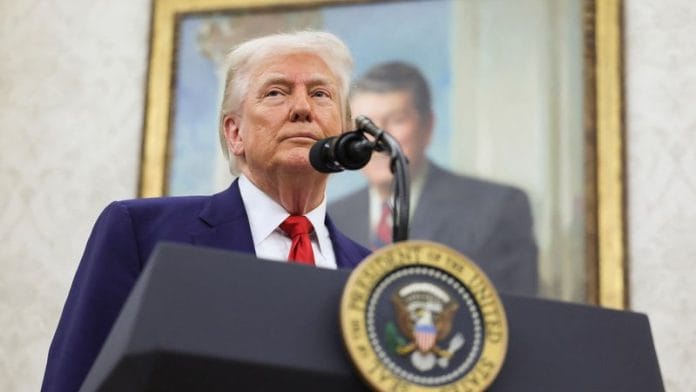



Tokyo/Singapore: As the Trump administration’s “big, beautiful bill” grinds its way through the U.S. Senate, incentives are growing for foreign investors to diversify out of U.S. Treasuries losing sheen from prospects of deficit spending and inflation-boosting tariffs.
President Donald Trump’s sweeping tax cut and spending measure will boost U.S. debt by $3.3 trillion, the nonpartisan Congressional Budget Office estimates, while runaway deficits and swelling debt led Moody’s to cut its credit rating in May.
“Definitely I’m concerned about the fiscal deficit expansion,” said Toshinobu Chiba, a Tokyo-based rates and credit fund manager for Simplex Asset Management.
Chiba said he has been using futures to shift away from Treasuries and into European debt, but aims to move that trade to the cash bond market when Trump’s “big, beautiful bill” passes and inflation expectations tick upwards.
“I think the first options should be Europe, especially the bunds and French bonds, and also Australia and Singapore are options for global investors.”
Traditionally a refuge for markets, Treasuries have been volatile since April, becoming less attractive for overseas investors as Trump’s erratic policies on tariffs and taxes drove them to pare exposure to the dollar and U.S. markets.
U.S. Treasury International Capital (TIC) data shows foreign money leaving U.S. short and long-term debt and banking flows stood at a net $14.2 billion in April, the same month that Trump rattled global markets with his “Liberation Day” tariffs.
The U.S. national debt has increased fourfold in less than 10 years to some $36 trillion, with about $29 trillion held publicly.
Japan is the biggest external holder of Treasuries with $1.13 trillion, followed by Britain with $807.7 billion and China with $757.2 billion, TIC data shows.
Treasuries fell in the aftermath of the tariff news, with benchmark 10-year yields reaching as high as 4.629% on May 22 before settling down to about 4.277%. Treasury 10-year yields have swung between 3.9% and 4.629% since April.
Passage of Trump’s long-simmering bill would give investors another reason to fret about the state of U.S. finances.
“That not only creates an upward, better opportunity for the equity markets, but it also is going to increase the issuance of risk-free German bunds and pan-European debt,” Medeiros said.
“So you’re going to have a lot of incentive for capital to come back.”
Yet a widespread sell-off is unlikely, despite fiscal concerns over Trump’s spending bill that are expected to steepen the Treasury yield curve as investors demand higher returns to hold U.S. debt for longer, said analyst Masahiko Loo.
“The reduction in foreign US Treasury holdings has been a long-term structural trend rather than a sudden exodus,” said Loo, a senior fixed income strategist at State Street.
“It is a ‘diversification, not divestment’ story with foreign investors, particularly in Asia.”
Hemant Mishr, group CIO of SCUBE Capital, is also betting on a steeper Treasury curve.
“The markets are worried and U.S. risk premiums will further widen,” he said. “We expect U.S. credit default swaps to continue quoting at a substantial premium to similarly rated sovereigns.”
Senators debating the measure in a marathon weekend session were expected to pass it late on Monday and in the Asian trading day on Tuesday.
Senate Republicans are set on using an alternative calculation method for the bill’s cost that does not factor in extending the 2017 tax cuts and seems to save $500 billion, according to an analysis by the Bipartisan Policy Center.
Prospects for even wider deficits in the U.S. may compel European investors to dump Treasuries and bring their money home, said Gustavo Medeiros, London-based global head of research at emerging markets investment manager Ashmore Group.
When Treasuries and other major bond markets sold off in April, the Bund market held firm.
Though the amount of German debt is also growing after the new government’s trillion euro defence and infrastructure spending push, Europe’s biggest economy is the only G7 member with a debt-to-GDP ratio below 100%, bolstering its safe-haven credentials.
(Reporting by Rocky Swift, Additional reporting by Kevin Buckland, Vidya Ranganathan and Jamie McGeever, Editing by Clarence Fernandez)
Disclaimer: This report is auto generated from the Reuters news service. ThePrint holds no responsibility for its content.
Also Read: ‘Don’t know what the F*** they are doing’—Trump lashes out at Israel & Iran for violating ceasefire