








By Bo Erickson
DETROIT, Michigan, Jan 13 (Reuters) – President Donald Trump touted his economic record in Detroit on Tuesday, aiming to refocus attention on U.S. manufacturing and his efforts to tackle high consumer costs as the White House strives to show it is addressing the economic anxieties gripping U.S. households.
In remarks to the Detroit Economic Club, Trump boasted that he had rebuilt the U.S. economy in the span of 11 months. His sprawling speech was marked by his typical stream-of-consciousness discursions.
“Growth is exploding, productivity is soaring, investment is booming, incomes are rising,” he said. “Inflation is defeated. America is respected again like never before.”
However, consumer prices rose last month, driven by higher food and rent costs, and job growth has been sluggish. Affordability remains a top concern for voters: the president’s approval on cost-of-living issues was just 27%, a Reuters/Ipsos poll in December found.
Some White House aides have urged the president to prioritize domestic concerns as his Republican Party faces a tough battle to maintain control of Congress in November’s midterm elections.
Tuesday’s visit to the heart of America’s auto industry follows weeks of global saber-rattling by Trump, including forcing out Venezuela’s president, threats to Iran and Cuba, warnings to Russia and China and even a challenge to Denmark over Greenland.
DETROIT AUTOS
Trump’s trip coincided with the Detroit Auto Show, where this week the Motor City’s “Big Three” automakers – Ford, General Motors and Stellantis – will showcase their latest innovations.
But the backdrop is grim: Factory employment fell nationwide by 8,000 jobs in December, dipping below levels seen during much of Trump’s first term and despite Trump’s pledge that his aggressive import taxes would lead to a manufacturing renaissance.
Trump on Tuesday repeated his assertion that tariffs were prompting a wave of new auto factories, although there is little evidence of a construction boom.
“Now we have more plants being built in our country than at any time in history,” Trump told reporters ahead of touring a Ford production center in Dearborn.
He also said he was “indifferent” to the idea of renegotiating the United States-Mexico-Canada trade pact, which he called “irrelevant.”
“You know, we don’t need cars made in Canada,” he added. “We don’t need cars made in Mexico. We want to make them here.”
U.S. automakers have urged Trump to extend the free trade agreement, which is set to go through a formal review this year, saying they need parts sourced from Mexico and Canada to manufacture vehicles in the United States.
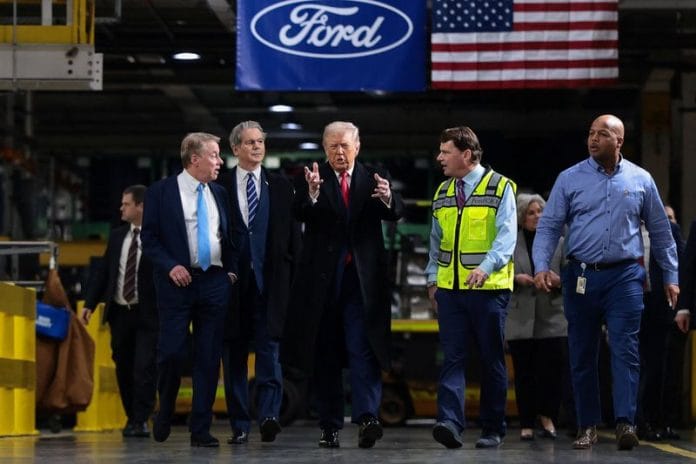
Trump was accompanied by Ford CEO Jim Farley and Executive Chairman Bill Ford, along with U.S. Treasury Secretary Scott Bessent, as he walked through the center where the automaker assembles the bestselling F-150 pickup truck.
Auto executives spent much of 2025 scrambling to react to the president’s on-again, off-again tariffs, which have cost the companies billions of dollars. Carmakers also have navigated the knock-on effects of Trump’s trade wars, including China’s retaliatory restrictions on rare-earth magnets, used extensively in cars.
MORE TRAVEL TO COME
Trump will travel around the country this year to speak directly to voters about his economic accomplishments ahead of the midterm elections, aides have said, after Democrats swept several high-profile state races in 2025.
But his speech on Tuesday, billed as being focused on the economy, whipsawed from one topic to another, including immigration, former President Joe Biden, transgender athletes and Venezuela.
In recent days, Trump has targeted some of the largest U.S. industries with economic-focused moves that shook markets but lack legislative backing. He pressed credit card companies to temporarily cut interest rates, announced a ban on Wall Street purchases of single-family homes and pressured global oil companies to boost Venezuelan crude output, which would increase global oil supply and potentially bring down prices for consumers in the coming years.
Michigan is a key political battleground ahead of the 2026 midterms, with an open U.S. Senate seat and several competitive House of Representatives races. Trump carried the state twice, although Michigan voters also elected Democratic Governor Gretchen Whitmer.
(Reporting by Bo Erickson, Steve Holland and David Shephardson in Washington, additional reporting by Mike Colias in Detroit and Joseph Ax in New York; Editing by Colleen Jenkins, Ross Colvin, Nick Zieminski and Rosalba O’Brien)
Disclaimer: This report is auto generated from the Reuters news service. ThePrint holds no responsibility for its content.