








By Jana Choukeir, Idrees Ali and Phil Stewart
DUBAI/WASHINGTON/JERUSALEM, March 21 (Reuters) – Israel said on Saturday that Iranian forces had for the first time fired long‑range missiles, expanding the risk of attacks beyond the Middle East, even as U.S. President Donald Trump said Washington was considering “winding down” its military operation against Iran.
Iran launched two 4,000-kilometer-range ballistic missiles at the U.S.-UK military base Diego Garcia in the Indian Ocean, Israeli military chief Eyal Zamir said.
“These missiles are not intended to strike Israel. Their range reaches European capitals — Berlin, Paris, and Rome are all within direct threat range,” Zamir said in a statement.
The Israeli military said it was the “first time” Iran had used long‑range missiles in the conflict, marking its first expansion beyond the Middle East since the United States and Israel began attacking Iran on February 28.
A source at Britain’s defence ministry said the attack had occurred before the government gave specific authorisation on Friday for the U.S. to use British military bases to carry out strikes on Iranian missile sites.
In a social media post, Trump said the U.S. was close to meeting its goals but insisted that other countries should take the lead in policing the Strait of Hormuz, the shipping lane whose near-closure threatens a global energy shock.
“We are getting very close to meeting our objectives as we consider winding down our great Military efforts in the Middle East with respect to the Terrorist Regime of Iran,” Trump said on Truth Social.
“The Hormuz Strait will have to be guarded and policed, as necessary, by other Nations who use it — The United States does not!” he added. “If asked, we will help these Countries in their Hormuz efforts, but it shouldn’t be necessary once Iran’s threat is eradicated.”
Trump and his administration have sent mixed messages about U.S. goals throughout the war, now entering its fourth week, leaving traditional U.S. allies struggling to respond.
Trump has suggested the war could wind down as the Iranian threat was being eliminated, while at the same time U.S. Marines and heavy landing craft head to the region.
More than 2,000 people have been killed in Iran since the U.S. and Israel attacked on February 28, while American voters appear increasingly concerned at signs the war could expand.
Energy price shocks are fuelling inflation, hitting consumers and businesses hard – a major political liability for Trump as he seeks to justify the war to the U.S. public before November elections in which he could lose control of Congress.
Trump had also accused NATO allies of cowardice over their reluctance to help open the strait. Some allies have said they will consider it, but most say they are reluctant to join a war that Trump started without consulting them.
IRAN STRIKES NEAR ISRAELI NUCLEAR REACTOR
Separately, an Iranian missile attack on Saturday hit the southern Israeli desert town of Dimona, badly wounding a child, according to Israel’s ambulance service, and injuring dozens of others.
Israel’s secretive nuclear reactor is near Dimona. Israel is widely believed to possess the only nuclear arsenal in the Middle East. It neither confirms nor denies having the bomb, keeping a decades-old “ambiguity” policy.
Iranian media said U.S.-Israeli forces had attacked the Shahid Ahmadi-Roshan Natanz enrichment complex on Saturday morning. Technical experts found no radioactive leaks had occurred and nearby residents were not at risk. Israel said it was unaware of such a strike while the head of the International Atomic Energy Agency (IAEA) said it was investigating.
Iranian media later reported strikes on a passenger terminal in the southern port of Bushehr and an empty passenger ship at nearby Kharg Island. The island, where Iran loads nearly all its oil exports, is seen as a potential target if Washington decides to hit Iranian energy or to use ground troops to seize it.
Iran said it fired drones at U.S. bases in the UAE and Kuwait used to stage attacks on Iranian islands in the Gulf.
Israel also attacked Beirut, saying it was targeting the Iran-backed Lebanese Hezbollah militia, part of the deadliest spillover from the war on Iran. Hezbollah fired on Israel in support of Tehran on March 2.
Defence Minister Israel Katz said Israel was planning to step up attacks in the coming days and was “determined to continue leading the attack against the Iranian terrorist regime, to behead its commanders and to thwart its strategic capabilities until any security threats to Israel and U.S. interests in the region are removed.”
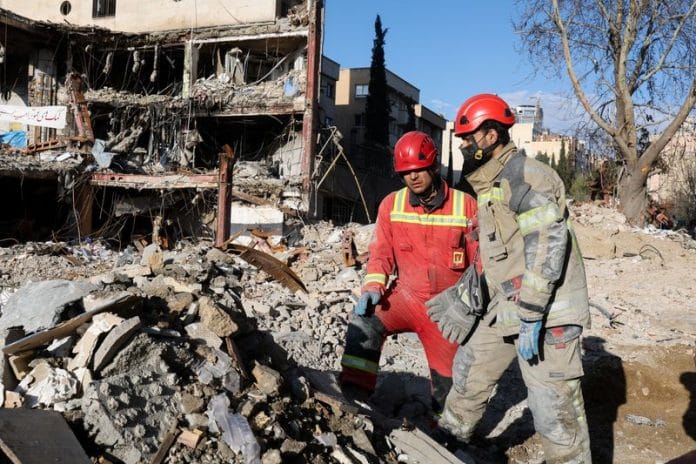
Israel said its aircraft attacked ballistic missile production sites around Tehran. Three members of a family were killed in a strike on a residential building in the city of Ramsar, Iranian media reported.
Air raid sirens in Israel warned of incoming missiles from early morning, sending millions to shelters as the blasts of interceptions rang out from above.
EUROPEAN GAS PRICES SURGE
Natural gas prices in Europe surged as much as 35% this week after Israel hit Iran’s biggest gas field and Iran responded by attacking neighbours’ energy infrastructure. The European Union urged members to lower gas-storage targets and start refilling reserves gradually to curb demand, the Financial Times reported on Saturday.
The Strait of Hormuz, conduit for around a fifth of global oil and liquefied natural gas supplies, has been effectively closed to most shipping.
India, suffering a severe shortage of cooking gas, has been one of the few countries so far to persuade Iran to let any of its ships through the strait, with two tankers carrying liquefied petroleum gas leaving last week and two more in position on Friday. Prime Minister Narendra Modi spoke to Iran’s President Masoud Pezeshkian on Saturday.
Iran’s Foreign Minister Abbas Araqchi told Kyodo news agency that Tehran was ready to let Japan-related vessels pass through the strait, which carries around 90% of Japan’s oil imports.
(Reporting by Phil Stewart and Idrees Ali in Washington, Andrew Mills in Doha, Timour Azhari in Riyadh, and Maayan Lubell in Jerusalem; Additional reporting by Reuters bureaus; Writing by Tom Hogue and Matthias Williams; Editing by William Mallard, Sergio Non and Diane Craft)
Disclaimer: This report is auto generated from the Reuters news service. ThePrint holds no responsibility for its content.