





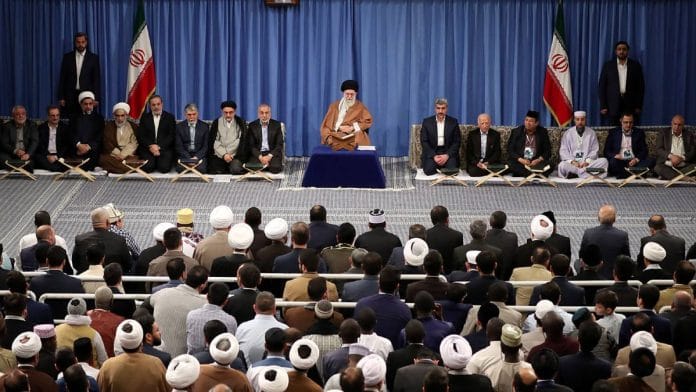



New Delhi: Iran Sunday announced that President Masoud Pezeshkian, the head of the judiciary and a senior cleric from the Guardian Council will oversee the transition period following the death of Supreme Leader Ayatollah Ali Khamenei.
According to Islamic Republic News Agency (IRNA), the three-member body will assume the responsibility of running the nation during the transition period. Iran has also announced a 40-day mourning period following the death of Khamenei, who was killed Saturday after the US and Israel launched an attack on Tehran and a number of cities across the West Asian nation, with the stated goal of regime change.
Article 111 of the Iranian constitution allows for the formation of a transition council, with the cleric from the Guardian Council decided by the Expediency Council. The transition council will continue with the responsibility of managing the country until the Assembly of Experts are able to convene and select a new Supreme Leader, also known as the Velayat-e Faqih, or the Guardian Jurist. The concept of the Guardianship of the Islamic Jurist as the head of the nation is associated with Ruhollah Khomenei, the first Supreme Leader of the Islamic Republic of Iran.
The Assembly of Experts is the clerical body in charge of selecting the next Supreme Leader. Ali Khamenei was selected to lead Iran a day after Ruhollah passed away. However, delays are expected now, given that Iran is currently under attack from both the US and Israel.
The Assembly of Experts consists of 88 members who are chosen through a semi-competitive electoral process.
Khamenei’s killing is a definitive moment in the almost five-decade history of the Islamic Republic, and comes right after the current administration faced its biggest domestic challenge earlier this year, when protests spread across the country over the economic situation.
Much of Iran’s post-revolutionary history has been defined by Khamenei’s grip on power, defiance of the West and a sprawling “axis of resistance” which allowed Tehran to project its influence across the region. The Islamic Revolutionary Guard Corps (IRGC) grew from a militia into an elite security force, underpinning the Supreme Leader’s grip on power.
Khamenei had long planned his transition, according to reports. He faced numerous assassination attempts over the years, including the 12-day war in June 2025 when the US and Israel struck at sensitive installations across Iran.
Now is the time where Khamenei’s plans will be put to the test and whether there will be a smooth transition of power in Tehran, as the country continues to face strikes from the US and Israel, as well as domestic ire.
Also Read: Regime change in Iran will be bad for India. The alternative will be worse
The three successors
Last year, following strikes by the US and Israel, Khamenei picked three candidates to succeed him in the event of an untimely death, according to The New York Times. The three candidates were reported to be Gholam-Hossein Mohseni-Eje’i, head of the judiciary, Ali Asghar Hejazi, Khamenei’s chief of staff, and Hassan Khomeini, grandson of Ruhollah Khomeini.
Israel has claimed to have killed Hejazi. Khamenei’s son Mojtaba was also reported to be in the running, however, the Supreme Leader is said to have dismissed his candidacy to prevent a hereditary transition of power.
In the months since the June 2025 strikes, Khamenei handed over large swathes of responsibility to Ali Larijani, the head of the National Security Council. Larijani held meetings with India’s Deputy National Security Adviser Pavan Kapoor last month in Tehran.
Of the three preferred successors, as reported by The New York Times, Hassan Khomeini represents the moderate and reformist factions. Since 2025-end, authorities in Tehran have faced waves of protests over the ongoing economic situation within the country and further with the continued costs of shadow wars across the region.
Tehran has consistently backed its allies, Hezbollah in Lebanon, the Houthis in Yemen and Hamas in the Gaza Strip. Iran has also supported its militias in Iraq to maintain political influence across the region.
The costs of crippling economic sanctions and the proxy conflicts across the region have heavily strained Tehran’s governance. President Ebrahim Raisi, who was killed in a helicopter crash in 2024, was heavily favoured to take the reins from Khamenei, given his executive experience and hard-liner support within the corridors of power in Iran. However, his untimely death has further challenged the transition of power within the West Asian nation.
(Edited by Nida Fatima Siddiqui)