








By David Shepardson and Allison Lampert
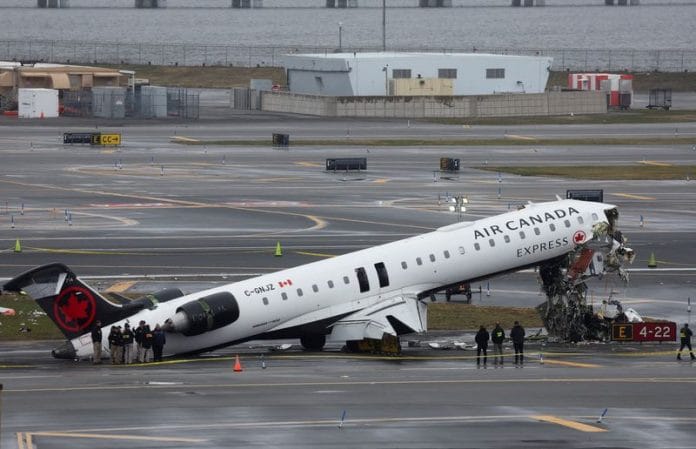
NEW YORK/MONTREAL March 24 (Reuters) – Tracking technologies designed to prevent runway collisions did not work at New York’s LaGuardia airport when an Air Canada Express jet struck a fire truck on Sunday night, killing the two pilots, the National Transportation Safety Board said on Tuesday. NTSB Chair Jennifer Homendy said the airport’s ground surveillance system did not generate an alert warning of the close proximity of vehicles to the runway.
In addition, the fire truck that collided with the jet lacked a transponder that would have transmitted its location to air traffic control, she said.
The NTSB is leading the investigation into the fatal collision of the CRJ-900 jet operated by Air Canada’s regional partner Jazz Aviation. The crash sent 39 of the 76 passengers and crew to hospital with varying degrees of injuries, with six still hospitalized, Air Canada said on Tuesday evening.
The Federal Aviation Administration has encouraged airports to equip fire trucks with transponders because it makes the vehicles’ movements easier to track at busy airports.
“Controllers should have all the information, the tools to do their job,” Homendy said. “You have to have information on ground movements, whether that’s aircraft or vehicles moving.”
U.S. air safety experts have said communications between the plane that was landing, the air traffic controller and the fire truck would be key areas of the investigation.
Air crashes typically are caused by multiple factors, and the investigation’s goal is to improve aviation safety.
The NTSB can make safety recommendations to the FAA, which manages U.S. air traffic control, but they are not binding.
Homendy flagged longstanding NTSB concerns that controller staffing was limited for the busy airport, despite meeting FAA norms for an overnight shift. There were two controllers working in a glass-enclosed section of the airport’s traffic control tower at the time of the crash, just before midnight.
“In this situation, for the midnight shift, it is standard operating procedure that they only have two on duty and those two perform the duties of other controllers,” she told reporters at LaGuardia. “Certainly, I can tell you that our air traffic control team has stated this is a concern for them for years.”
But she said questions remained over how the tasks were divided between the two controllers and why the one involved in clearing the truck was not relieved from duty immediately after the accident.
20 SECONDS FROM CLEARANCE TO CRASH
Citing data from the cockpit voice recorder, the NTSB said there were only 20 seconds from the moment the truck was given clearance to cross the runway to assist another plane and the end of the recording. Nineteen seconds before the end, an electronic callout told the pilots they were 100 feet above the ground.
Former FAA Air Traffic Control Specialist Mike McCormick said the Air Canada Express pilots would likely not have had enough time to abort their landing. The truck crossed the runway just nine seconds before the crash.
Homendy said the runway status lights that flash red and warn it is unsafe to cross a runway were operational. That raises questions about why the truck crossed, McCormick said.
The accident occurred on a misty evening, and Homendy said visibility from the airplane and truck would be examined.
The NTSB, which has sounded the alarm about close calls and runway incursions for years, last month found the deadly January 2025 mid-air collision of an American Airlines regional jet and an Army helicopter occurred in part because the high workload “degraded controller performance and situation awareness”.
Homendy said that the NTSB was interviewing on Tuesday the local controller who started at 10:45 p.m. ET after a shift change 15 minutes earlier and whose interactions with different planes and the truck were heard on liveatc.net.
Air traffic controllers make decisions about when planes can land and take off, and when ground vehicles can enter runways. The controller who made the call for the Air Canada flight to land had been trying to find a gate for a separate United Airlines flight that complained of a bad odor, according to the recording.
The incident has raised concerns over whether the controller was distracted by the United Airlines flight, which had declared an emergency.
“I would caution pointing fingers at controllers and saying distraction was involved,” Homendy said. “This is a heavy workload environment.”
(Reporting by David Shepardson in New York and Allison Lampert in Montreal; Editing by Chris Reese, Aurora Ellis and Jamie Freed)
Disclaimer: This report is auto generated from the Reuters news service. ThePrint holds no responsibility for its content.