





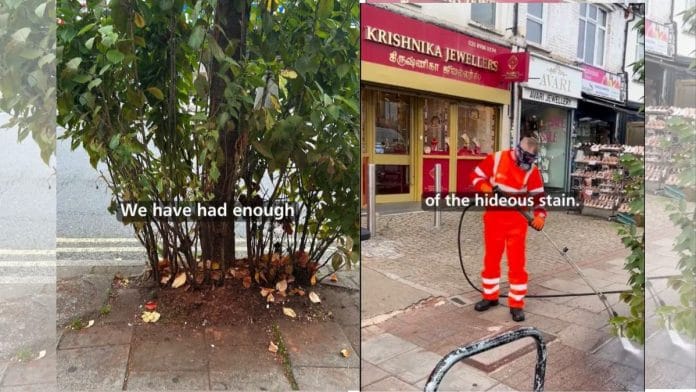



New Delhi: If you thought the repulsive image of paan spit stains on the streets is just common in India, think again. In London’s northwest borough of Brent, which houses the suburb Wembley, the local government authority is at its wit’s end.
The Brent Council, which handles local public services, is shelling out a whopping £30,000 a year cleaning reddish brown splatters off pavements and buildings.
According to a BBC report, the Labour-run council had promised a “zero tolerance” approach to this problem, emphasising that it causes “serious health and environmental damage”.
Paan is a traditional mouth freshener popular across South Asia, Southeast Asia, and parts of the Pacific. Like bubblegum, it is not meant to be swallowed, just chewed and discarded. Its main ingredients are betel leaf, which serves as a wrapper encasing areca nut, and a smear of slaked lime (calcium hydroxide), also called chuna. Areca nut is a psychoactive substance, like tobacco, alcohol, and caffeine.
In India, even the Swachh Bharat Mission, initiated by Prime Minister Narendra Modi himself 11 years ago, hasn’t managed to make a dent in the practice of paan splatter. In Delhi’s stately Connaught Place, the New Delhi Municipal Council (NDMC) keeps painting over the white walls and pillars, only for the revolting red stains to return within a few days. Just two months ago, an Allahabad High Court judge issued a directive banning paan spit-stained legal documents from his courtroom.
According to the local authorities in London’s Wembley—known for its iconic stadium that hosts major football matches as well as concerts (Coldplay, Ed Sheeran)—their powerful cleaning jets too have failed to make a dent. Therefore, the Brent Council is doubling down. Not only has it put up banners in paan spit hotspots, enforcement officers will also be on the prowl, fining offenders a potential £100.
Paan spitting £30k clean-up bill sparks crackdown🗣️
❗️Paan chewing and spitting causes serious health issues
🧹The stains cost the council over £30,000 to clean up each year pic.twitter.com/H6zkGfkG0T
— Brent Council (@Brent_Council) November 26, 2025
And this is not the first time Wembley is facing this problem. The Brent Council had announced a fine and a crackdown in 2010 too.
A few days ago, Right-wing activist Tommy Robinson, who had led the ‘Unite the Kingdom’ anti-immigration rally in central London in September, also posted about the issue on X: “Import the third world. Become the third world. Not only are we to pay them to breed like rabbits, we’re paying to clean up their spit.”
His remarks raked up a storm, with many voicing support and others calling him out for being racist.
A 2012 World Health Organization (WHO) report had cautioned about the serious health risks of chewing areca nut. The International Agency for Cancer Research, it had pointed out, classifies betel nut as a Group 1 carcinogen.
“Although people understand the harms of smoking and exposure to second-hand smoke, they don’t generally appreciate the dangers of tobacco and betel nut chewing,” the report quoted Dr Shin Young-soo, WHO regional director for the Western Pacific, as saying. “People need to know that chewing tobacco and betel nut are highly dangerous, too, whether taken together or separately.”
Priyakshi Gogoi is a TPSJ alum, currently interning with ThePrint.
(Edited by Gitanjali Das)
Also Read: In cess Bill, govt plans new levy on some tobacco products