





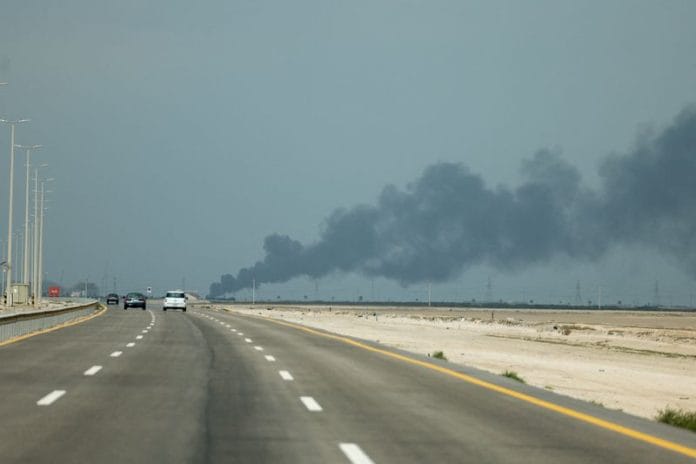



DUBAI, March 18 (Reuters) – Iranian gas facilities in the Gulf came under attack on Wednesday, state media reported, prompting Tehran to say it would target a range of energy installations across Saudi Arabia, the United Arab Emirates and Qatar “in the coming hours”.
Oil prices jumped on the news, with Brent crude futures gaining more than 6% to a session high just shy of $110 per barrel.
The attacks on Iran’s energy industry in South Pars and Asaluyeh have raised concerns that Iran could also target infrastructure of global energy majors across the Gulf, and alternative regional export routes such as Saudi Arabia’s Red Sea port of Yanbu, prolonging a conflict that has already effectively closed the Strait of Hormuz.
The Qatari foreign ministry spokesperson said Wednesday’s attack was a “dangerous and irresponsible” escalation that put global energy security at risk, and the UAE stressed the need to avoid targeting vital facilities. Qatar called it an Israeli attack without mentioning any U.S. role.
The Israeli military did not immediately respond to a request for comment.
Qatar has fully shut its liquefied natural gas production because of the war, and any damage to facilities could extend the outage beyond May, threatening to keep a fifth of global LNG supply offline.
Tasnim news agency said Wednesday’s attacks targeted petrochemical facilities in South Pars and added the extent of the damage was not yet clear.
Iranian gas flows to Iraq were halted as Iran diverted its gas domestically, a senior Iraqi official told Reuters. Tehran supplies between a third and 40% of Iraq’s gas and power needs.
The attacks on South Pars make it even more likely the war will continue into May, said Torbjorn Soltvedt, principal Middle East analyst at risk intelligence company Verisk Maplecroft.
“The biggest concern will be the potential for attacks against Saudi Arabia’s East-West pipeline or export facilities on the Red Sea which alongside Fujairah offer the only significant alternative to the Strait of Hormuz,” Soltvedt added.
EVACUATION WARNINGS
Iran’s Revolutionary Guards issued evacuation orders for Saudi Arabia’s Samref Refinery and Jubail Petrochemical Complex, the UAE’s Al Hosn Gas Field, and Qatar’s Mesaieed Petrochemical Complex, Mesaieed Holding Company and Ras Laffan Refinery, saying they would be targeted by strikes, Iranian state media reported.
The Ras Laffan LNG installations were being evacuated, a source with knowledge of the matter told Reuters.
The notification to evacuate specific sites marks a clear escalation in rhetoric around energy infrastructure, at a time when the global LNG market is already tight because of disruptions, said Tom Purdie, lead LNG analyst at consultancy Energy Aspects.
Iran’s offshore South Pars gas field makes up around a third of the world’s largest reservoir of natural gas. Iran shares the reservoir with major exporter Qatar.
Most gas Tehran produces from South Pars is for domestic use. Iran’s gas production totalled 276 billion cubic meters in 2024, with 94% consumed in Iran, according to data by the Gas Exporting Countries Forum.
The U.S.-Israeli war on Iran and Tehran’s attacks on Gulf neighbours have disrupted oil and natural gas exports from the Middle East and forced production stoppages.
(Reporting by Stephanie Kelly, Ahmad Ghaddar, Marwa Rashad, Dubai Newsroom, Ahmed Elimam; Additional reporting by Alexander Cornwell; Writing by Stephanie KellyEditing by Nia Williams, Kirsten Donovan)
Disclaimer: This report is auto generated from the Reuters news service. ThePrint holds no responsibility for its content.