








ALEPPO, Syria, Jan 8 (Reuters) – Syria’s defence ministry declared a ceasefire in three neighbourhoods of the northern city of Aleppo early on Friday, a move that could halt fresh fighting between government troops and Kurdish fighters.
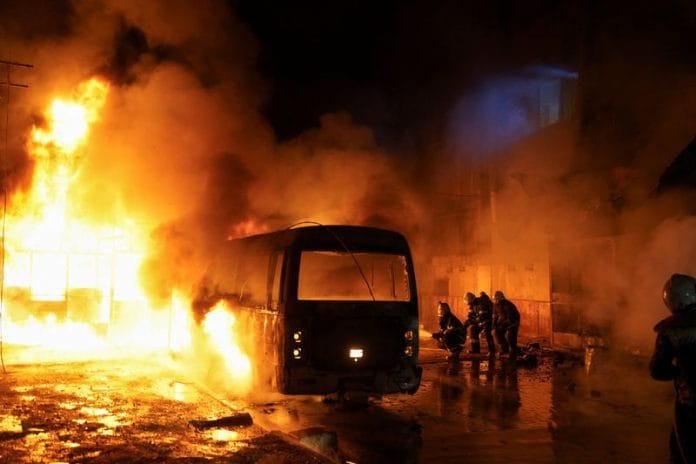
A fierce exchange of fire extended into the night, with rescue workers scrambling to extinguish fires ignited by shelling, before the defence ministry said it would give armed groups a six-hour window to leave the contested areas.
The deadly stand-off between Damascus and Kurdish authorities who have resisted integrating into the central government is a major challenge for Syrian President Ahmed al-Sharaa, who has pledged to unite the country after 14 years of civil war.
“A ceasefire is to take effect in the vicinity of the Sheikh Maqsoud, Ashrafiyah, and Bani Zaid neighbourhoods in the city of Aleppo, starting at 03:00 a.m. after midnight,” the defence ministry said in a statement.
“Armed groups in the neighbourhoods are requested to leave the area starting at 03:00 a.m. after midnight. The deadline expires at 09:00 a.m. on Friday.”
Earlier, Plumes of smoke rose above the city skyline at dusk and the boom of artillery could be heard across Aleppo as the Kurdish fighters tried to repel the troops’ advance and cling on to neighbourhoods under their control.
The fighting, which erupted on Tuesday, has driven more than 140,000 people from their homes and left at least seven civilians dead, according to Syrian authorities.
STALLED TALKS ON CEASEFIRE
Syria’s army gave a window on Thursday for residents to evacuate the neighbourhoods held by Kurdish forces in Aleppo before launching new strikes there. It released more than seven maps identifying areas it said would be targeted and announced a curfew in the neighbourhoods of Sheikh Maqsoud and Ashrafieh from 3 p.m. (1200 GMT).
The Kurdish forces, including the Syrian Democratic Forces (SDF) and the Asayish, or internal security forces, said they had pushed back Syrian troops’ attacks.
The United States on Thursday called for an end to clashes between government troops and Kurdish fighters in Aleppo, saying it was gravely concerned by the situation.
Tom Barrack, Trump’s special envoy for Syria, said the
United States and its allies were ready to help efforts to
de-escalate tensions between government troops and Kurdish
forces, which include the SDF.
SDF head Mazloum Abdi said the government forces’ strikes and deployment of tanks had undermined “the chances of reaching understandings, create conditions for dangerous demographic changes, and expose civilians trapped in the two neighbourhoods to the risk of massacres”.
Two government officials told Reuters that negotiations were underway over the withdrawal of Kurdish forces from the city.
In a statement, the Syrian government said stability could not be achieved with weapons outside the authority of the state, adding the only solution was return of government control to “preserve the unity of Syria.”
The Asayish, in a written statement, denied that its forces had requested safe passage and called instead on the Damascus government to withdraw its forces.
Turkey said it stood ready to help Syria if asked.
“The attacks carried out against civilians in Aleppo have unfortunately exacerbated concerns about the true intentions of the SDF and created a pessimistic picture regarding peace efforts,” Turkish Foreign Minister Hakan Fidan told a joint press conference with his Omani counterpart on Thursday.
“The SDF’s insistence on protecting what it has at all costs is the biggest obstacle to achieving peace and stability in Syria,” Fidan added.
Turkey views the U.S.-backed SDF, which controls swathes of northeastern Syria, as a terrorist organisation and has warned of military action if the group does not honour the integration agreement.
ACCUSATIONS OF ETHNIC CLEANSING
The Kurdistan Regional Government’s Prime Minister Masrour Barzani said he was deeply concerned by attacks on Kurdish neighbourhoods in Aleppo, warning that targeting civilians and attempts to alter the area’s demography amounted to what he described as ethnic cleansing.
The SDF said Damascus’s evacuation warnings ahead of shelling could amount to forced displacement and war crimes under international humanitarian law.
Kurdish-led authorities established a semi-autonomous administration in northeast Syria and parts of Aleppo during Syria’s 14-year war and have resisted fully integrating into the Islamist-led government that took power after former President Bashar al-Assad was ousted in late 2024.
Damascus reached a deal with the SDF last year that envisaged full integration by the end of 2025, but progress has been limited, with both sides accusing the other of stalling.
The U.S. has sought to mediate, holding meetings as recently as Sunday, though those talks ended without tangible results.
(Reporting by Mahmoud Hasano and Karam al-Masri in Aleppo, Khalil Ashawi in Damascus, Jana Choukeir in Dubai, Huseyin Hayatsever in Ankara and Orhan Qereman in Qamishli; Writing by Jana Choukeir and Maa Gebeily; Editing by Alexandra Hudson, Gareth Jones and Diane Craft)
Disclaimer: This report is auto generated from the Reuters news service. ThePrint holds no responsibility for its content.