





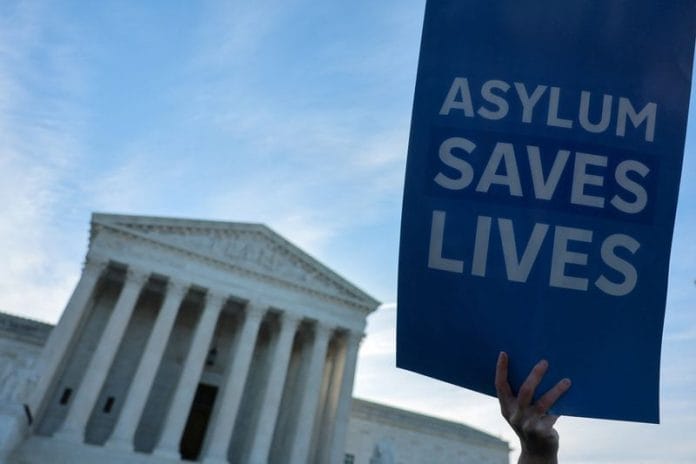



By John Kruzel and Andrew Chung
WASHINGTON, March 24 (Reuters) – U.S. Supreme Court justices indicated sympathy on Tuesday toward President Donald Trump’s administration in its defense of the government’s authority to turn away asylum seekers when officials deem U.S.-Mexico border crossings too overburdened to handle additional claims.
The legal dispute centers on a policy called “metering” that the Republican president’s administration may seek to revive after it was dropped by Trump’s Democratic predecessor Joe Biden in 2021. The policy allowed U.S. immigration officials to stop asylum seekers at the border and indefinitely decline to process their claims.
The Trump administration has appealed a lower court’s finding that the policy violated federal law. This policy is separate from the sweeping ban on asylum at the border that Trump announced after returning to the presidency last year. That policy also faces an ongoing legal challenge.
Under U.S. law, a migrant who “arrives in the United States” may apply for asylum and must be inspected by a federal immigration official. The narrow legal issue in the current case is whether asylum seekers who are stopped on the Mexican side of the border have arrived in the United States.
The Supreme Court has a 6-3 conservative majority.
Vivek Suri, the Justice Department lawyer who argued on behalf of the Trump administration, told the justices during the arguments, “You can’t ‘arrive in the United States’ while you’re still standing in Mexico. That should be the end of this case.”
Conservative Justice Amy Coney Barrett pressed Kelsi Corkran, the layer who argued on behalf of the immigrant advocacy group Al Otro Lado, on what it means to arrive in the United States.
“How close do you have to be to the border?” Barrett asked. “Could you say that someone arrives in the United States if they’re at a portion of the border that does not have a port of entry? Like, what is it, if it’s not crossing the physical border? What is the magic thing, or the dispositive thing, that we’re looking for where we say, ‘Ah, now that person, we can say, arrives in the United States?”
Liberal Justice Sonia Sotomayor posed sharp questions to Suri about whether the metering policy violates the letter or spirit of federal law protecting refugees.
“These are people who come to the line, there’s an agent standing at the line that’s open to everybody else, except refugees, correct?” Sotomayor asked. “They’re letting in workers with permits to come in to work. They’re letting everybody else in. But they’re not permitting the people who come to the line – to the door and knock on it (who) want to claim refugee status.”
“Someone on a plane arriving to land in LaGuardia may not have put their foot on U.S. land. But they’ve arrived in the United States. They’re arriving. They’re knocking on the door,” Sotomayor added, referring to a New York City airport.
U.S. immigration officials began turning away asylum seekers at the border in 2016 under Democratic former President Barack Obama amid a migrant surge. The metering policy was formalized in 2018 during Trump’s first term in office, with border officials authorized to decline processing asylum claims when the government decides it is unable to handle additional applications. Biden rescinded the policy during the first year of his presidency.
The Trump administration in court papers told the Supreme Court it likely would resume the use of metering “as soon as changed border conditions warranted that step,” without providing specifics.
Al Otro Lado, which provides legal and humanitarian support to migrants, launched the long-running legal challenge in 2017. The San Francisco-based 9th U.S. Circuit Court of Appeals in 2024 ruled that federal law requires border agents to inspect all asylum seekers who “arrive” at designated border crossings, even if they have not yet crossed into the United States, and the metering policy violated that obligation.
A ruling in the case is expected by the end of June.
The Supreme Court has backed Trump in several immigration-related rulings issued on an emergency basis since his return to the presidency, including allowing him to deport migrants to countries other than their own and to revoke temporary legal status for hundreds of thousands of Venezuelan migrants in the United States.
The justices next week are due to hear arguments over the legality of Trump’s directive to restrict birthright citizenship in the United States. Next month, the court will hear arguments in the administration’s bid to revoke temporary legal protections for more than 350,000 Haitians and about 6,100 Syrians living in the United States.
(Reporting by John Kruzel and Andrew Chung; Editing by Will Dunham)
Disclaimer: This report is auto generated from the Reuters news service. ThePrint holds no responsibility for its content.