





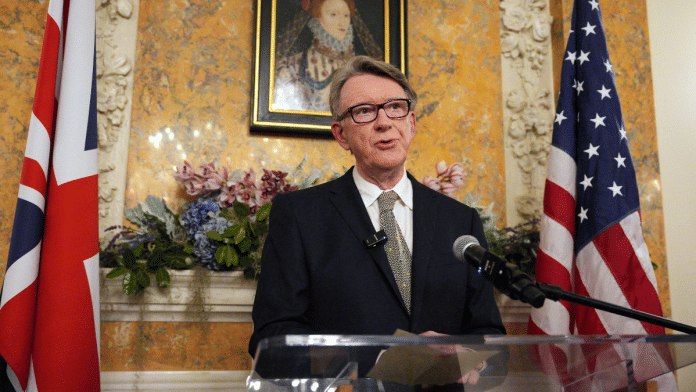



What was billed as an “emergency” Monday morning press conference offered Keir Starmer a now-or-never chance to hit back at Donald Trump over his latest assault on the transatlantic alliance.
Some — especially on the left of British politics — hanker for a moment reminiscent of when the prime minister played by Hugh Grant in Love Actually says he fears the UK-US relationship has become a bad one based on the US president taking “exactly what he wants.”
Instead, the UK prime minister explained to a weary public why he will never stop exhausting diplomatic avenues with the US president, futile as they may currently seem.
Trump was “completely wrong” to threaten the UK and other European countries with tariffs for defending Greenland against his ambitions to take it over, Starmer said. But he insisted Britain’s relationship with America “matters profoundly” and that “under President Trump, as under previous presidents, we are determined to keep it strong.”
Despite Starmer’s appeal for a “pragmatic, sensible” approach, his strategy for handling Trump is being tested to breaking point by the president’s aggressive stance on Greenland and his renewed trade war on Europe.
“We’re at a critical point now where whether or not Starmer’s diplomacy has worked is going to be revealed in the next days, weeks at most,” said Sam Edwards, a historian at Loughborough University who specializes in US-UK relations.
The British leader, like his predecessors, has sought to use the so-called “special relationship” with the US to hold Trump close despite the continued pressures he has placed on America’s allies. It’s an approach best symbolized by Starmer brandishing an invitation from King Charles III to an unprecedented second state visit, to Trump’s delight. Some others in Europe have adopted similar methods, most notably NATO chief Mark Rutte calling the president “daddy.”
On occasion, it has had some benefits. Starmer helped repair relations after Ukrainian President Volodymyr Zelenskiy’s Oval Office shouting match with Trump. Only a few weeks ago, it seemed the US had moved closer to the European position on Ukraine by appearing to offer robust security guarantees for Kyiv at a joint press conference in Paris. Government officials argue it’s hard to prove a counter-factual but insist Europe’s efforts may have prevented a far worse outcome.
Yet Ukraine is fighting on through a freezing winter with only limited pressure being applied on Russian President Vladimir Putin. A much-vaunted “trade deal” between the UK and US has hit the buffers, and 25% tariffs remain in place on British steel exports, despite an agreement by the US last May to eliminate them.
Meanwhile a much-vaunted tech deal with the US is on ice, and the UK has had to make clear to their American counterparts they won’t budge on their red lines when it comes to standards, people familiar with the matter said.
Now Trump has turned on Europe over Greenland, threatening 10% tariffs next month, escalating to 25% in June unless a deal is reached for the US to buy the Danish territory. Even the staunchest Atlanticist would start to question whether Starmer’s efforts were working.
The harsh reality, the prime minister made clear, is that Britain is not in a position to rip up relations with the US, neither in terms of its security nor its economy.
On defense, Britain has arguably benefited more than much of Europe from its close US relations and so would be more exposed by a breakup.
Government officials said the unique inter-connectedness of the military, nuclear and intelligence partnerships has made the UK the most secure country in Europe. Ending and replacing it with sovereign capabilities would either be impossible or take years, an unthinkable outcome that would leave the UK exposed, they said.
The truth is Britain is the junior partner and beneficiary in the security relationship and would lose out more from it fracturing, they said.
“Our cooperation on defense, nuclear capability, and intelligence remains as close and effective as anywhere in the world – keeping Britain safe in an increasingly dangerous environment,” Starmer said.
“Unfortunately we just don’t have that much control,” said Olivia O’Sullivan Director of Chatham House’s UK in the World Program. “Most important is that we start thinking long-term about how we manage the risk that the US continues to use our economic and security relationship in this way.”
Since Britain left the European Union, its economy is even more exposed to a potential global trade war. Outside the bloc, it has little leverage to negotiate with the US, and there is no guarantee it could easily get more favorable terms with Europe either. That was evident as Starmer all-but ruled out retaliatory tariffs on the US, differentiating his response from the EU’s.
It leaves Britain in a dangerous place, open to the age-old charge that it is a vassal state of the US, even more reliant on its unpredictable ally after Brexit.
Starmer faces calls to change that by rapidly increasing defense spending far above his current aim of hitting 2.6% of gross domestic product by next year or by seeking a closer relationship with the EU, perhaps by rejoining a customs union.
At the moment, there is little sign Starmer is ready to do either as he sticks to his diplomatic approach. He has not been planning to attend the World Economic Forum in Davos this week but there have been discussions on whether to reconsider his attendance due to the changing international picture, a person familiar with the matter said. A late decision has been made to send Foreign Secretary Yvette Cooper.
“Moments like this, there will always be people who reach for the performative, who think an angry social media post, or grandstanding is a substitute for hard work,” the premier said Monday morning. “That’s an understandable instinct. But it’s not effective.”
The problem is right now diplomacy isn’t looking so effective either.
Disclaimer: This report is auto generated from the Bloomberg news service. ThePrint holds no responsibility for its content.