





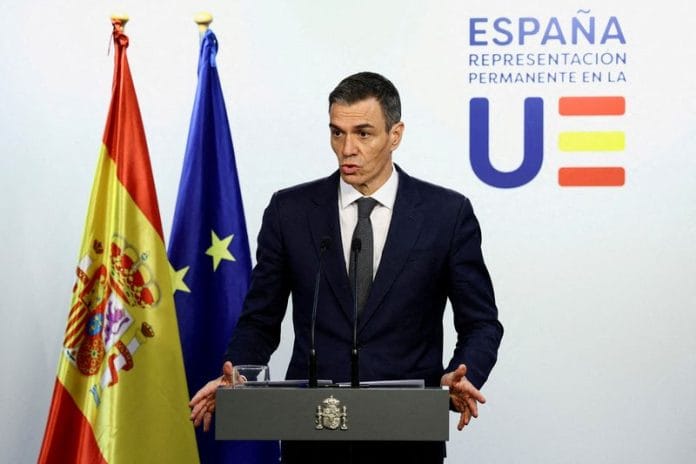



MADRID, April 6 (Reuters) – Spain’s ruling Socialist Party has gained voter support amid Prime Minister Pedro Sanchez’s staunch opposition to the U.S.-Israeli war on Iran, while far-right Vox, which supports the offensive, has seen a decline, two surveys published on Monday showed.
Sanchez has emerged as one of the most vocal Western leaders criticising what he calls an illegal and reckless war, closing Spanish airspace to U.S. planes involved in the strikes and banning them from using jointly operated military bases in southern Spain.
Vox – closely allied with U.S. President Donald Trump’s MAGA movement – has harshly criticised Sanchez’s stance.
A survey by state pollster CIS showed last month that 85% of respondents rejected the war.
Monday’s new poll by Sigma Dos for newspaper El Mundo showed support for Sanchez’s Socialists rising to 27.7% from 26.4% last month, reducing the lead of the conservative People’s Party (PP). Another survey, by 40dB for El Pais, put them at 28.6%, up from 27.7%.
Meanwhile, Vox dropped to 17.1% in April from 18.3% according to Sigma Dos, and slipped by 0.1 percentage point to 18.7% in the 40dB survey.
The PP topped both polls, securing 32.5% and 31.1% of voting intentions, respectively, up by less than one percentage point in both polls. The party accuses Sanchez of damaging transatlantic relations and has refrained from publicly denouncing Trump and Israel, though its leader has also echoed the “no to war” slogan.
A common trend is the transfer of voting intention from the extremes of the spectrum to the two mainstream outfits. The PP appears to be stemming the flow of votes to Vox and the Socialists are picking up former voters of its hard-left junior coalition partner Sumar, the polls showed.
A fragmented electorate still means coalitions are required to secure a government and both polls point to a right-wing majority if elections were held now.
The next general election is due in August 2027.
The surveys each polled some 2,000 people and had margins of error of 2.2%.
(Reporting by David Latona; Editing by Andrei Khalip and Susan Fenton)
Disclaimer: This report is auto generated from the Reuters news service. ThePrint holds no responsibility for its content.