








By Nina Lopez and Michael Francis Gore
ADAMUZ, Spain, Jan 20 (Reuters) – Spain’s rail operator Adif ordered trains on the Madrid-Barcelona high-speed line to limit their speed on Tuesday on concerns about the track’s condition, two days after one of Europe’s deadliest train crashes on another line left at least 42 dead.
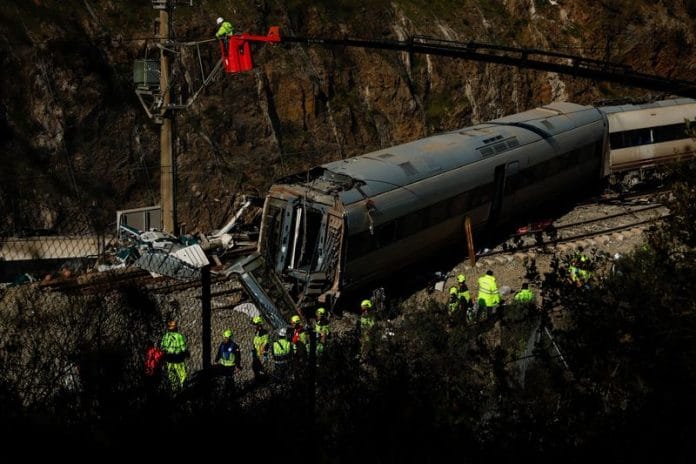
The country remains in shock after the first-ever fatal accident on the country’s extensive high-speed rail network, which occurred on Sunday evening near Adamuz in Cordoba province, about 360 km (223 miles) south of Madrid. Experts say a faulty rail joint may be key to determining the cause of the derailment that led to the collision between two trains.
Train drivers last year called on Adif to limit speeds due to their unease about deterioration on several of Spain’s high-speed lines, after it opened the network to private competition in 2020 to offer low-cost alternatives to state-run Renfe’s trains.
“We have detected and reported to all operators much more vibration and wear and tear on the infrastructure since the liberalisation and a 60% increase in traffic,” Diego Martin, general secretary of the Semaf drivers’ union, told Reuters.
Adif said it hoped to lift the speed limit on the line once its maintenance team had inspected two stretches totalling nearly 150 km (93 miles) where drivers have reported bumps on the tracks.
At the site of the crash near Adamuz, rescuers used heavy machinery overnight and in the early hours of Tuesday to level the ground and gain access to the worst-hit carriages as they sought to recover the remains of people still missing.
They aimed to use two cranes to lift the front carriages of the train belonging to the state-run Alvia service, which had plunged down a 4-metre (13 ft) embankment after the crash, and the rear carriages of the train operated by private consortium Iryo.
The collision occurred in rolling, olive-growing countryside in the foothills of a mountain range at a site only reachable by a single-track road, making it difficult for rescuers to gain access with heavy machinery.
One more body was found overnight within the wreck of the Iryo train, which had derailed, and another death was confirmed later on Tuesday raising the death toll to 42, authorities said.
BODIES STILL TRAPPED IN WRECKAGE
Interior Minister Fernando Grande-Marlaska said police had received 43 missing-person reports, which broadly matched the provisional death toll, but cautioned that the final number would not be confirmed until rescue teams had lifted the worst-affected carriages to see what was underneath.
Some relatives continued to wait for news of their loved ones as authorities worked on identifying the dead.
Osiris Sevilla described her anxiety as she waited for news about her husband outside an emergency centre in Cordoba but said she hadn’t given up hope that he’d survived.
“He didn’t like trains… Since we got together, this is the first time he took a train,” she said.
Spain’s King Felipe visited the site of the tragedy on Tuesday and spoke to residents, including 16-year-old Julio Rodriguez, who with his mother and a friend was one of the first to reach the scene of the accident.
He described the scene to El Mundo newspaper as “like a massacre… with dismembered bodies, limbs here and there”.
Survivors also spoke of their ordeal.
Lola Beltran told TVE she had changed carriage minutes before the crash, moving from her assigned seat in one of the hardest-hit cars to another carriage to sit with a colleague.
“We had to break the windows with emergency hammers and pry open the doors to get out,” Beltran said, describing scenes of chaos, screams, and torn-out seats.
BROKEN RAIL: CAUSE OR CONSEQUENCE?
A photo circulated by Spanish police showing a broken rail with the marker “1” beside it strongly suggested the fracture occurred at, or very near, the initial point of the derailment, Scottish railway engineer and author Gareth Dennis told Reuters.
He said the track just before the break looked intact, making it the likely trigger for the train leaving the tracks.
Dennis also said the fracture appeared close to a rail weld, where steel beside the weld can be a weak spot. Cold weather can raise tensile stress as rails contract, he said.
“The interesting question is why did the rail break,” Dennis said, rather than why the train derailed.
Transport Minister Oscar Puente urged patience as the investigation proceeds. He said all hypotheses were open but it was “very strange” for the rear of a train that was not exceeding the speed limit to derail on a straight stretch.
The discovery of a broken rail was “one more piece of data” and did not itself prove any single scenario, Puente said, adding that the key question was whether it was the cause or the consequence of the derailment.
($1 = 0.8516 euros)
(Reporting by Nina Lopez, Michale Gore, Susana Vera, Leonardo Benassatto, Corina Pons and Emma Pinedo; Writing by David Latona and Charlie Devereux; Editing by Charlie Devereux, Tomasz Janowski and Gareth Jones)
Disclaimer: This report is auto generated from the Reuters news service. ThePrint holds no responsibility for its content.