








By Reyam Mokhasef, Ahmed Elimam and Jana Choukeir
ADEN, Jan 8 (Reuters) – The Saudi-led coalition in Yemen said on Thursday that the United Arab Emirates had spirited a separatist leader out of the country by boat in a dramatic twist to a rift between the Gulf powers, as Saudi-backed forces advanced to the port of Aden after losing ground there.
The escape of Aidarous al-Zubaidi, head of a UAE-backed southern separatist group, could exacerbate tensions between Saudi Arabia and the UAE, global oil heavyweights and both close allies of the United States.
The Saudi claim that the UAE helped him escape raises the stakes in a crisis that erupted last month when the separatists swept through southern Yemen, including Aden, advancing within reach of the border with Saudi Arabia. Riyadh declared the move a threat to its national security.
The Saudi-led coalition said Zubaidi had left Yemen for Somaliland, before boarding an aircraft to Mogadishu that was later tracked to a military airport in Abu Dhabi.
Zubaidi had failed to show up in Riyadh for crisis talks over turmoil in southern Yemen on Wednesday. Zubaidi’s Southern Transitional Council (STC) said he had been asked to go to Saudi Arabia under threat.
Saudi Arabia and the UAE previously worked together in a coalition battling the Iran-backed Houthis in Yemen’s civil war, which caused one of the world’s worst humanitarian crises.
But the two most powerful countries in the Gulf have sharp differences over a wide range of volatile issues across the Middle East — from geopolitics to oil output — and those burst into the open with the STC advance.
BRAZEN ESCAPE
After Zubaidi’s unexplained absence from the Riyadh talks, his group said he was overseeing military and security operations in Aden to prevent a security vacuum there.
Aden had been the main seat of power in Yemen outside Houthi-controlled areas since 2015, but leaders of the Saudi-backed government left the city for Saudi Arabia when the STC took control last month.
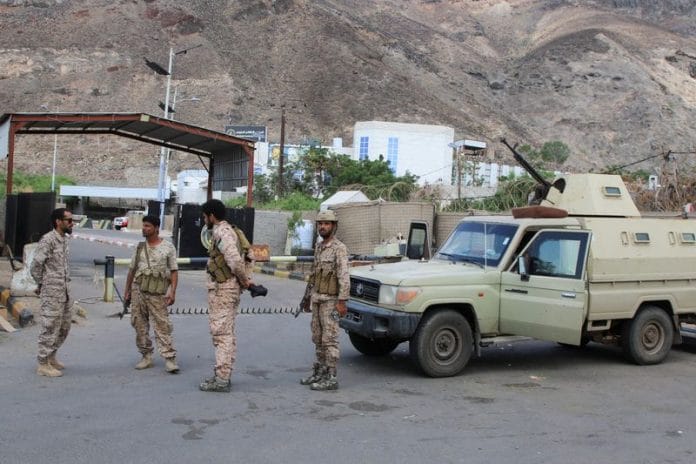
On Thursday, a Reuters witness said the situation in Aden appeared stable with Saudi-backed Yemeni government forces patrolling the streets, and no sign of STC forces. Authorities have imposed a nighttime curfew.
The Saudi-backed forces have also been retaking ground in other areas in recent days, after Saudi Arabia pressured the UAE to rein in the separatists.
In a sign that a split may be emerging among the separatists, an STC delegation said it had held fruitful talks in Riyadh with the Saudi ambassador to Yemen, according to comments by Mohammed Al Ghaith, a senior official of the group.
Any such fracture could complicate efforts to stabilise Yemen’s south.
Any confirmation of Zubaidi’s presence in Abu Dhabi could anger Saudi Arabia. In a statement, the Saudi-led coalition said Zubaidi and others accompanying him on the plane to Mogadishu from Somaliland were under the supervision of UAE officers and waited an hour before flying to a military airport in the UAE capital.
The coalition statement also mentioned by name the UAE officer whose help Zubaidi had sought.
The aircraft was of a type similar to those frequently used in conflict zones on the routes of countries such as Ethiopia, Libya and Somalia, the coalition added.
The plane turned off its identification system over the Gulf of Oman, before turning it back on 10 minutes prior to arrival at Al Reef military airport in Abu Dhabi, the coalition said.
The coalition did not clearly say if Zubaidi was still aboard en route to the UAE capital.
There was no immediate comment from the UAE or Zubaidi’s STC.
UAE’S ASSERTIVE FOREIGN POLICY
The UAE has pursued an assertive foreign policy and carved out its own sphere of influence across the Middle East and Africa, a strategy thrown into the spotlight after the rare military escalation with Saudi Arabia in Yemen.
It withdrew its remaining forces from Yemen and has called for de-escalation in the country, reeling from one of the world’s worst humanitarian crises caused by the civil war.
Saudi Arabia and the UAE first intervened in Yemen after the Houthis seized the Yemeni capital, Sanaa, in 2014.
The UAE joined the Saudi-backed coalition the following year in support of the internationally recognised government.
The STC was set up in 2017 with UAE backing and eventually joined the government coalition.
(Reporting by Reyam Mokhasef in Aden; Ahmed Elimam, Jana Choukeir in Dubai and Hatem Maher in Cairo; Writing by Michael Georgy, Editing by Clarence Fernandez and Aidan Lewis)
Disclaimer: This report is auto generated from the Reuters news service. ThePrint holds no responsibility for its content.