








By Lucinda Elliott and Marco Aquino
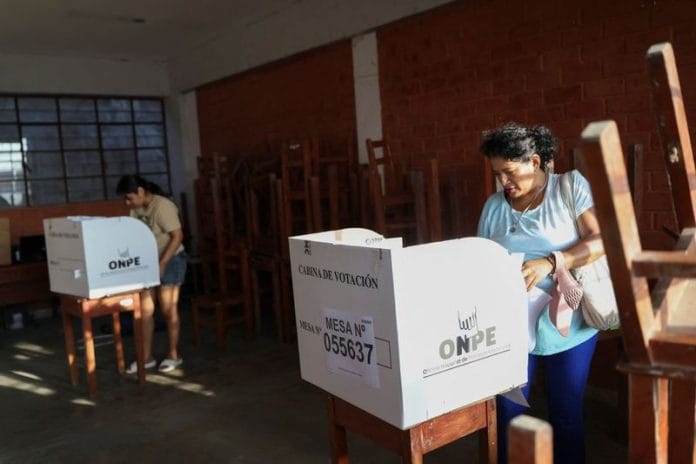
LIMA, April 13 (Reuters) – Polling station delays and early uncertainty over the runoff contenders marked Peru’s general election on Sunday, as voters chose a new president and Congress from a fragmented field of more than 30 candidates.
Early official results showed former congresswoman Keiko Fujimori narrowly in the lead with 17.17% closely followed by right-wing former Lima mayor, Rafael Lopez Aliaga with 16.97%, with 37% of votes counted, according to Peru’s electoral body, ONPE.
Exit polls had shown Fujimori, daughter of ex-President Alberto Fujimori https://www.reuters.com/world/americas/peru-ex-president-fujimori-dies-86-2024-09-11/ who was imprisoned for human rights abuses, in the lead, although Lopez Aliaga emerged in the lead earlier in the count underlining the fluidity of the race.
Years of political turmoil in the Andean nation have eroded confidence in institutions and left voters deeply disillusioned.
With no clear frontrunner and all major candidates polling well below the 50% needed to win outright, a June 7 runoff appeared likely — a scenario that could prolong uncertainty in the world’s third‑largest copper producer at a time of rising crime and intensifying competition for influence https://www.reuters.com/world/us/us-pushes-renew-ties-with-peru-ahead-uncertain-election-2026-04-10/ between the United States and China.
“I want to express my solidarity with the citizens who today were denied the opportunity to exercise their right to vote,” Fujimori said in a brief statement to the press, adding that she would begin a new campaign for the runoff from Monday.
Delays to polling stations opening were reported in some areas on Sunday morning, centered in the capital Lima, following logistical issues involving a contractor responsible for the distribution of electoral material.
The disruptions prompted authorities to extend voting hours by one more day, until 6 p.m. local time (2300 GMT) on Monday, for over 50,000 people who were unable to cast their ballots.
Roberto Burneo, head of Peru’s electoral authority (JNE), said legal action would be taken against the company responsible for distributing the voting materials.
Voter Margarita Sandoval, 35, said she had waited in line for two hours without being able to enter her ballot station in Chorrillos, a southern district of the capital.
“I have to work and I can’t vote,” Sandoval said. “These elections are a disaster.”
CANDIDATES SPAN IDEOLOGICAL SPECTRUM
Since 2018, Peru has cycled through eight presidents, fueling skepticism that any new administration will last a full five-year term following a dizzying turnover https://www.reuters.com/world/americas/peru-faces-record-field-election-corruption-crime-top-voter-concerns-2026-04-09/ driven by impeachments, corruption scandals and weak governing coalitions that have paralyzed decision-making.
“People really despise the current Congress,” said Martin Cassinelli at the Atlantic Council. “They recognize them as responsible for the political chaos we’ve had over the last 10 years,” he added.
Political distrust has fueled a crowded field nL6N40I0XW spanning the ideological spectrum, including seasoned politicians, a far-right businessman and a television comedian.
Among the best known is conservative Fujimori https://www.reuters.com/world/americas/right-wing-candidates-fujimori-lopez-aliaga-top-crowded-peru-field-ahead-2026-03-25/, making her fourth presidential bid after reaching the runoff in all three previous races.
Educated in the U.S. and leader of the powerful Popular Force party in Congress, Fujimori has framed herself as a guarantor of order and economic stability, appealing to voters alarmed by surging violent crime. Her candidacy remains polarizing, however, due to her family legacy and past legal troubles https://www.reuters.com/world/americas/peru-judge-throws-out-keiko-fujimoris-money-laundering-trial-2025-01-13/.
Former Lima mayor Lopez Aliaga, a wealthy businessman with socially conservative views, campaigned on an ultra-conservative platform and had seen support fluctuate in the weeks leading up to the election.
Center-left Jorge Nieto, who has pitched himself as a unifying figure with institutional experience, was polling in third place late on Sunday, with 14.1% of the vote.
Ricardo Belmont, a former Lima mayor running for the center-left Civic Works Party, saw a late rise in support, elevating him in polls in recent days.
Public insecurity has emerged as the dominant theme of the campaign. Homicides and extortion have climbed in recent years, driven in part by drug trafficking and illegal mining. Most leading candidates have proposed expanding the role of the armed forces in internal security.
The election also carries geopolitical implications. Peru’s deepening economic relationship with China — now its largest trading partner and a major investor in mining and infrastructure – has raised concerns in Washington https://www.reuters.com/world/us/us-pushes-renew-ties-with-peru-ahead-uncertain-election-2026-04-10/, which has stepped up diplomatic and security engagement ahead of the vote. The two leading candidates have said they will maintain close ties with the U.S.
Whoever advances to the runoff will face a fractured Congress and newly reinstated Senate, which may complicate efforts to pass legislation and raise the risk of renewed impeachment battles.
(Reporting by Lucinda Elliott and Marco Aquino; Editing by Cassandra Garrison, Bill Berkrot, Laura Gottesdiener, Lincoln Feast and Kate Mayberry)
Disclaimer: This report is auto generated from the Reuters news service. ThePrint holds no responsibility for its content.