








By Ariba Shahid, Rami Ayyub and Alexander Cornwell
ISLAMABAD/JERUSALEM/TEL AVIV, March 24 (Reuters) – Pakistan’s prime minister said on Tuesday he was willing to host talks between the U.S. and Iran on ending the war in the Gulf, a day after President Donald Trump postponed threats to bomb Iranian power plants, saying there had been “productive” talks.
In a post on X, Prime Minister Shehbaz Sharif said Pakistan welcomed and fully supported ongoing efforts to pursue dialogue to end the war.
“Subject to concurrence by the U.S. and Iran, Pakistan stands ready and honoured to be the host to facilitate meaningful and conclusive talks for a comprehensive settlement,” he said.
The U.S. and Israel launched strikes on Iran on February 28 after saying they had failed to make enough headway in talks aimed at ending Iran’s nuclear program, although mediator Oman said significant progress had been made.
Since then, Iran has attacked countries that host U.S. bases, struck Gulf energy infrastructure and effectively closed the Strait of Hormuz, conduit for a fifth of the world’s oil and liquefied natural gas, creating the worst energy supply shock in history.
A Pakistani government source said discussions on a meeting were at an advanced stage and if it did happen, “a big ‘if'”, it would take place within a week.
The war is already taking a toll on major economies around the world, according to business surveys on Tuesday which showed how a surge in energy prices and rising uncertainty were dampening activity and pushing inflation expectations higher.
IRAN DENIES TALKS HAVE TAKEN PLACE
On the ground, there were no signs of conflict abating in the Gulf or Lebanon, where Israel is carrying out a parallel operation against the militant group Hezbollah, which has fired at Israel in support of its patron Iran.
An Iranian missile was intercepted over Lebanese airspace for the first time on Tuesday, three senior Lebanese security sources said, with two of them saying a foreign naval vessel was responsible for the interception.
Trump said on Monday the U.S. and Iran had held “very good and productive” conversations about a “complete and total resolution of hostilities in the Middle East” and that he was postponing for five days a plan to hit Iran’s energy grid.
He said talks had begun on Sunday and continued into Monday, with Special Envoy Steve Witkoff and his son-in-law Jared Kushner involved.
But after Trump’s Truth Social comment on Monday, Iran denied that any talks had been held.
Iran’s powerful parliament speaker Mohammad Baqer Qalibaf – the interlocutor on the Iranian side, according to an Israeli official and two other sources familiar with the matter – described reports of direct talks as “fake news”.
Trump’s threat to bomb Iran’s electricity plants had prompted Tehran to threaten retaliatory strikes on the power infrastructure of U.S. allies across the region, sending the price of benchmark Brent crude oil soaring as high as $114.43 on Monday morning.
After declining on Trump’s step-back, prices were about 3% higher again on Tuesday around $103 on concern over supply shortages. [O/R]
Three senior Israeli officials, speaking on condition of anonymity, said Trump appeared determined to make a deal, although they viewed it as unlikely that Iran would agree to U.S. demands.
They said these were likely to include curbs on Iran’s nuclear program and ballistic weapons development.
Three senior sources in Tehran said Iran’s negotiating stance had only hardened since the start of the war, under the growing influence of the Islamic Revolutionary Guard Corps, and that it would demand significant concessions from the U.S.
Israeli Prime Minister Benjamin Netanyahu, who spoke to Trump less than 48 hours before their countries began the war, was expected to convene security officials for talks on Trump’s bid for a deal with Iran, two senior Israeli officials said.
AIR SIRENS SOUND IN TEL AVIV
Iranian missiles triggered air raid sirens in densely populated Tel Aviv, Israel’s commercial hub, where there are also military sites.
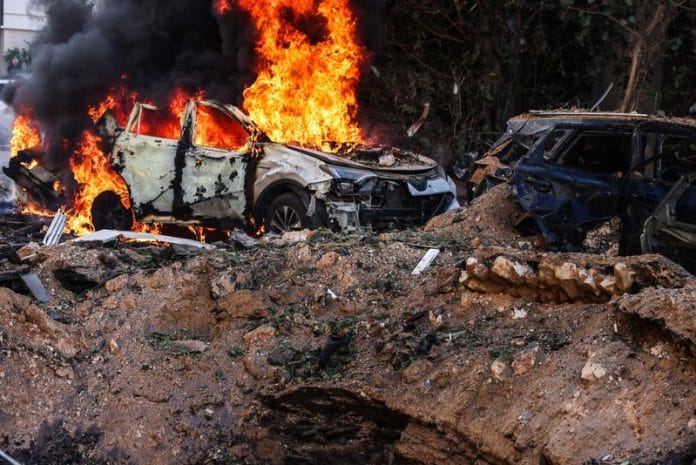
A missile carved a massive crater in the road of one neighbourhood, and the blast blew out the walls of a multi-storey apartment building, scattering debris across the street. It was the latest in a series of Iranian attacks in recent days that have penetrated Israel’s sophisticated air defences. There were no reported deaths.
Israel’s military said its fighter jets had carried out a wave of strikes in central Tehran on Monday, targeting command centres including facilities associated with the IRGC’s intelligence arm and the Intelligence Ministry. It said it had hit more than 50 other targets overnight, including ballistic missile storage and launch sites.
Air defence systems were activated across Tehran as explosions were heard simultaneously in several areas of the capital, according to the Iranian news agency Nournews.
At least eight people were killed and 28 injured in a strike on a residential area of Tabriz, a city of 1.7 million in Iran’s northwest, the provincial director for crisis management told Tasnim news agency.
(Reporting by Phil Stewart, Idrees Ali, Gram Slattery and Humeyra Pamuk in Washington, Maayan Lubell in Jerusalem and Alexander Cornwell in Tel Aviv, Ariba Shahid in Islamabad and Saad Sayeed in Bangkok; Additional reporting by Reuters bureaus; Writing by David Brunnstrom, Michael Perry and Sharon Singleton; Editing by Kevin Liffey and Ros Russell)
Disclaimer: This report is auto generated from the Reuters news service. ThePrint holds no responsibility for its content.