





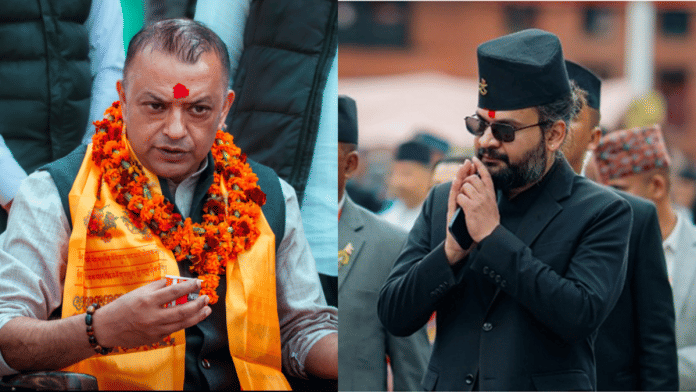



Kathmandu: Nepal voted on Friday for two very different visions of political change that appear to be taking shape after the Gen Z protest, or what they call here the Fall Uprising of 2025. One is embodied by the insurgent outsider, rapper-turned-mayor Balendra Shah, contesting on a Rastriya Swatantra Party (RSP) ticket, the other by reformist establishment figure Gagan Thapa, the new president of the Nepali Congress.
Both men are seen as representatives of a younger generation challenging Nepal’s ageing political leadership. But their routes to power and ideas of governance could not be more different.
For Shah, politics has been defined by disruption but analysts say he lacks ideology or political patience. For Thapa, it has been about reform from within, but for most analysts he’s the ‘status quoist’.
“I have serious doubts about where the country will be headed under the RSP, which has neither a functioning ideology nor what amounts to a coherent position on any number of issues facing the nation,” political columnist Deepak Thapa writes in an article titled ‘Dawn of a New Era’.
Says Thapa: “The only thing going for it is that they are not the Congress, the UML or the Maoists. Not to mention, the still-inexplicable Balen factor despite his record of a half-hearted and half-baked tenure as the capital’s mayor.”
For Gagan Thapa, he writes: “There is every possibility that Thapa’s gamble will not pay off. The Nepali Congress (and the UML and Prachanda’s outfit and the many that have been around for years) is sorely in need of a do-over, and in politics, five years will just zip by. For the good of the country, it is not only Gagan Thapa who needs to be prepared but also the party he leads.”
Balen, the outsider
Few politicians in Nepal have risen as quickly or as unpredictably as Balendra Shah. Known to the public simply as Balen, he first gained prominence as a rapper whose music blended political critique with the frustration of youth. His songs condemned corruption, police harassment and the failure of traditional political parties, building a loyal following among younger Nepalis.
In 2022, he transformed that cultural visibility into political power. Contesting as an independent candidate, Shah stunned the political establishment by winning the Kathmandu mayoral election with more than 61,000 votes, defeating candidates backed by major parties including the Nepali Congress and Oli’s Communist Party of Nepal (Unified Marxist–Leninist).
His victory was widely interpreted as a rebellion against Nepal’s entrenched political class. Once in office, Shah moved quickly to establish his style of governance which many call dramatic, visible and confrontational, Bulldozers became the defining symbol of his administration. Vendors were removed and illegal constructions were done away with.
It was said he prioritised spectacle over institutional reform. In an article on his rise, urban planning expert in Nepal, Pitambar Sharma questioned the broader vision behind the enforcement drives. “Someone arriving in Kathmandu might feel the city looks cleaner and more organised,” he said. “But the real question is: who is this city for?”
Shah’s tenure also exposed the limits of outsider politics. Kathmandu’s budget utilisation remained among the lowest of Nepal’s metropolitan cities. His administration faced repeated disputes with the bureaucracy, including a prolonged standoff with the city’s chief administrative officer. Street vendors accused municipal police of violent crackdowns, accusing the mayor of abandoning the poor he once championed in his music.
Despite these controversies, Shah’s popularity remains intact. Large crowds have greeted his campaign rallies across the country. His appeal lies not so much in policy proposals as in the belief that he represents a break from politics as usual. In the streets of Kathmandu they say, “Ab ki baar, Balen sarkaar,” echoing the 2014 BJP slogan in India for Modi.
Political analyst Deepak Thapa in his article, describes the phenomenon as the “Balen factor”—a largely unexplained wave of support for a politician whose governing record remains mixed. Most analysts agree that Shah also has a massive digital reach which is impacting how people react to him or the RSP.
The momentum around Shah has also helped fuel the rise of the Rastriya Swatantra Party, which has projected him as its prime ministerial candidate. But questions remain about whether his model of politics built on personal branding, social media mobilisation and confrontational governance can translate into national leadership.
As former diplomat Vijay Kant Karna notes, governing Nepal requires navigating complex relationships across institutions and neighbours. “Being the country’s top statesman isn’t just about balancing two countries,” Karna was quoted as saying in an article on Balen. “It is about building trust at political, bureaucratic and diplomatic levels.” So far, Shah has shown little interest in that kind of institutional engagement. In 2023, his placing of the Greater Nepal map in his office in response to India’s Akhand Bharat map also stirred a controversy.
Tanuja Pandey, a 26-year-old who was one of the key faces of the September protests agrees. “Sometimes it feels like he has created chaos and is now positioned to benefit politically from it. There is a strong public relations strategy around him that turns almost every action into a positive narrative,” she told ThePrint. She also argues that Shah’s silence is deliberate and part of his strategy.
“Unlike many leaders who regularly address the public, he rarely speaks. That silence itself has become part of his political image: the idea that he is above everyday politics and focused only on ‘doing the work’,” Pandey says. “During his campaign he spoke about environmental justice and the rights of ordinary people. But later, when settlements and street vendors were removed without proper notice or alternatives, it felt like a betrayal of the very communities he once claimed to represent,” she adds.
She then says: “Have you seen how he dresses up? He follows the King’s attire.”
Also Read: Will a Gen Z revolt spur Nepal to pick young over old? The chatter on the streets of Kathmandu
The insider-reformer: Gagan Thapa
If Shah represents disruption, Gagan Thapa represents reform within the system. A long-time leader of the Nepali Congress, Thapa built his political career through student activism, parliamentary politics and policy advocacy. Over the past two decades, he has positioned himself as one of the party’s most articulate reformists.
Unlike Shah, Thapa speaks the language of reform and changing existing institutions rather than disrupting them. During election campaigns, Thapa spoke more on reform than Shah’s anti-establishment rhetoric. With that, political commentator CK Lal argues that the 2026 election has taken on an almost theatrical dimension.
“Two narratives dominate the airwaves,” Lal writes in his article for The Kathmandu Post. “The well-resourced buzz around Balendra and the carefully curated image of responsibility projected by Gagan.”
Where Shah relies on momentum and outsider appeal, Thapa depends on party organisation and institutional networks. Thapa himself has largely deflected questions on his reformist credentials, arguing that new parties like the RSP are just as populist, driven by politics of hatred and opposition.
“The politics of populism needs an enemy,” he told The Kathmandu Post in an interview. Yet Thapa faces his own challenges. Nepali Congress has issues of internal factionalism and most are tired of the traditional parties. Not everyone is convinced about Thapa’s potential to revitalize his party. Prakash Bhandari, a political science lecturer in Kathmandu, argues that while Thapa has strengthened his position through careful image-building following the Gen-Z protests, he is unlikely to breathe new life into the party. “He is a capable manager, but having spent so long in the old Congress machinery, we can’t expect him to radically reorient the party,” Bhandari told The Kathmandu Post for an article on Thapa.
Similarly, Lal describes Thapa as a “status quoist.” “People are disillusioned now. The Congress party didn’t need Singha Durbar to burn to realize it had to reform,” Lal says. “To be truly new in politics, one requires a fresh agenda and a new ideology.”
He compares the party’s reform efforts to a passenger clinging to a handle on a moving bus: a change of leadership alone won’t overhaul the system. “Thapa seems to be positioning himself as a reformist,” Lal adds, “but it remains to be seen whether the party will merely change the driver or actually rebuild the engine.”
Editor and writer Kanak Mani Dixit differs. In a conversation with ThePrint he says, “If I were to choose among these leaders, I would support Gagan Thapa of the Nepali Congress,” he says. “I believe he brings both a legacy of democratic governance and a deep understanding of Nepali society and economy. Among the three major parties, his has also undertaken significant internal reforms. After the September protests, when new leadership was needed, he challenged the old guard and stepped forward.”
(Edited by Nardeep Singh Dahiya)