








By Jorge Garcia and Lisa Richwine
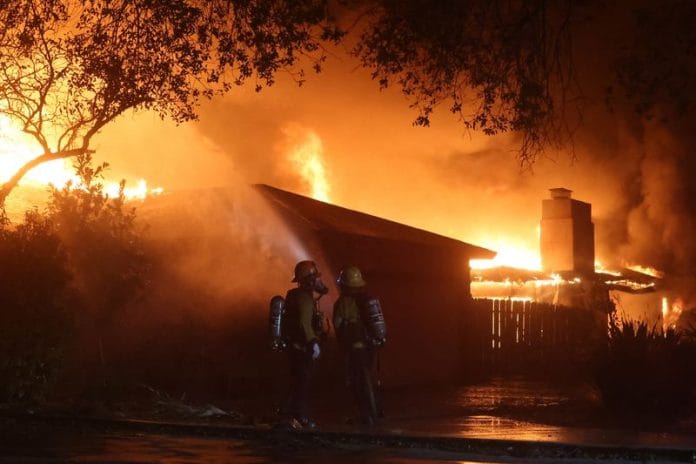
LOS ANGELES (Reuters) -Firefighters on Wednesday contended with persistently strong and dry winds fueling two giant wildfires that have terrified Los Angeles for eight days, testing the resolve of a city upended by the worst disaster in its history.
Officials urged residents to remain vigilant and be prepared to evacuate at a moment’s notice with peak wind gusts forecast to last through Thursday afternoon.
Some 6.5 million people remained under a critical fire threat, after the fires consumed an area nearly the size of Washington, D.C.
“We want to reiterate the particularly dangerous situation today. Get ready now and be prepared to leave,” County Supervisor Lindsey Horvath told a press conference on Wednesday.
Although anticipated winds of up to 70 mph (112 kph) had yet to materialize, firefighters reported winds of 30 to 40 mph (48 to 64 kph) combined with low humidity in a region that has failed to receive any appreciable rain in nine months.
The fires have killed at least 25 people, damaged or destroyed more than 12,000 homes and other structures, and forced as many as 200,000 people from their homes. Some 82,400 people were under evacuation orders and another 90,400 faced evacuation warnings as of Wednesday, County Sheriff Robert Luna said.
Entire neighborhoods have been leveled, leaving smoldering ash and rubble. Many homes only have a chimney stack left standing.
Some 8,500 firefighters from the western United States, Canada and Mexico are battling the flames while twice that many other law enforcement and emergency management officials are helping keep the growth of the fires in check for three days.
The Palisades Fire on the west edge of the city held steady at 23,713 acres (96 sq km) burned, and containment nudged up to 19% – a measurement of how much of the perimeter was under control. The Eaton Fire in the foothills east of the city stood at 14,117 acres (57 sq km) with containment at 45%.
A fleet of aircraft dropped water and fire retardant into the rugged hills while ground crews with hand tools and hoses have worked around the clock since the fires broke out on Jan. 7, with the aircraft occasionally grounded by high winds.
Hundreds of visiting firefighters and emergency workers are staying outside the Rose Bowl football stadium, temporarily converted into a base camp where colleagues have built camaraderie in between shifts. Teams work for 24 hours straight and then rest for 24 hours before going out again.
“You’re all in it for the same mission,” said Martin Macias of the St. Helena Fire Department in Northern California. “We all got into this as service, to make somebody’s day better at the worst time.”
Some Angelenos have been attempting to return to a semblance of normalcy.
Students and teachers displaced by wildfire from Palisades Charter Elementary School found a new home on Wednesday at the nearby Brentwood Elementary Science Magnet, where they were welcomed with open arms.
“For children who lost homes and also lost their school, it’s absolutely devastating. And the way that I can help and the way that I can give back is to make sure that those children have a place to go. And even though we lost the physical building, we still have our community,” Palisades Charter Elementary Principal Juliet Herman said.
FIRE PREPARATION QUESTIONED
While the fires rage on, critics have questioned whether the city properly prepared for fire danger in the face of National Weather Service warnings about hazardous weather, even though firefighters were on alert and able to deploy assets beforehand.
Fire Chief Kristin Crowley and Los Angeles Mayor Karen Bass fielded queries on Wednesday about a Los Angeles Times report that fire officials had opted against ordering 1,000 firefighters to remain on duty for a second shift last Tuesday as fires were beginning to grow out of control.
The Times cited critics who said the outgoing shift should have been kept on duty and that as many as 25 additional fire engines should have been moved into hillsides, including in Pacific Palisades.
Crowley defended her department’s preparation, saying it was impossible to know exactly where fires might break out and that some firefighters needed to remain in place to field ordinary emergency calls anywhere in the city.
“We did everything in our capability to surge where we could,” Crowley said.
The Times quoted Deputy Chief Richard Fields, who was in charge of staffing and equipment decisions ahead of the fire, as saying the scrutiny was welcome but that critics were too easily second-guessing decisions after the fact.
“It’s very easy to Monday-morning quarterback and sit on the couch and tell us what we should have done now that the thing has happened. What we did was based on many years of experience and also trying to be responsible for the rest of the city at any given time of that day,” Fields told the Times.
(Reporting by Jorge Garcia, Lisa Richwine, Mike Blake, Sandra Stojanovic, Alan Devall, Jackie Luna, Matt McKnight, Nathan Frandino, Omar Younis, Rollo Ross, David Ryder and Daniel Cole in Los Angeles; Additional reporting by Brendan O’Brien; Writing by Daniel Trotta; Editing by Mark Porter, Nia Williams and Sandra Maler)
Disclaimer: This report is auto generated from the Reuters news service. ThePrint holds no responsibility for its content.