








By John Geddie and Tim Kelly
TOKYO, Feb 8 (Reuters) – Japanese Prime Minister Sanae Takaichi’s party is set to secure a big majority in Japan’s lower house in an election on Sunday, public broadcaster NHK forecast, based on exit polls.
Takaichi’s Liberal Democratic Party is set to win 274 to 328 of the 465 seats in the chamber, well above the 233 needed for a majority, according to NHK.
Together with coalition partner the Japan Innovation Party, known as Ishin, she could control up to 366 of the seats.
Japan’s first female prime minister, 64, called the rare winter snap election to capitalise on her buoyant personal approval ratings since she was elevated to lead the ruling LDP late last year.
TAKAICHI’S BET ON RARE WINTER ELECTION PAYS OFF
Voters have been drawn to her straight-talking, hardworking image, but her nationalistic leanings and emphasis on security have strained ties with powerful neighbour China, while her promises of tax cuts have rattled financial markets.
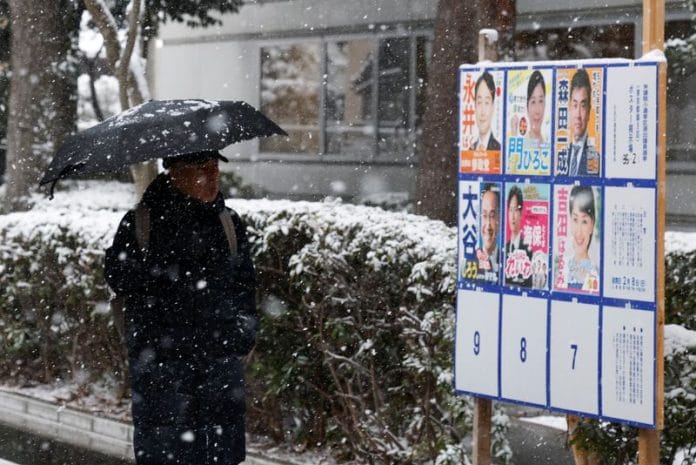
Residents trudged through snow to cast their ballots with record snowfall in parts of the country snarling traffic and requiring some polling stations to close early.
It is only the third postwar election held in February, with elections typically called during milder months.
Outside a polling station in the town of Uonuma in the mountainous Niigata prefecture, teacher Kazushige Cho, 54, braved below-freezing temperatures and deep snow to cast his vote for Takaichi’s Liberal Democratic Party.
“It feels like she’s creating a sense of direction – like the whole country pulling together and moving forward. That really resonates with me,” he said.
But Takaichi’s election promise to suspend the 8% sales tax on food to help households cope with rising prices has spooked investors concerned about how the nation with the heaviest debt burden among advanced economies will fund the plan.
“If Takaichi wins big, she will have more political room to follow through on key commitments, including on consumption-tax cuts,” said Seiji Inada, managing director at FGS Global, a consultancy. “Markets could react in the following days, and the yen could come under renewed pressure.”
Niigata resident Mineko Mori, 74, padding through the snow with her dog, said she worried that Takaichi’s tax cuts could saddle future generations with an even bigger burden.
But younger voters are among the most supportive of Takaichi, with one recent poll finding more than 90% of those under 30 favoured her.
The prime minister has sparked an unlikely youth-led craze called “sanakatsu”, roughly translated as “Sanae-mania”, with the products she uses, such as her handbag and the pink pen she scribbles notes with in parliament, in high demand.
On Thursday, Takaichi received the “total endorsement” of U.S. President Donald Trump.
China will also be keeping a close eye on the results.
Weeks after taking office, Takaichi touched off the biggest dispute with China in over a decade by publicly outlining how Tokyo might respond to a Chinese attack on Taiwan.
A strong mandate could accelerate her plans to bolster Japan’s defence, which Beijing has cast as an attempt to revive its militaristic past.
“I voted for a party that clearly has the will to protect the country,” Masanobu Igarashi, a retired soldier, said after casting his ballot for the LDP in Uonuma.
(Reporting by John Geddie, Tim Kelly, Kantaro Komiya, Chang-Ran Kim, Joseph Campbell and Tom Bateman; Editing by William Mallard)
Disclaimer: This report is auto generated from the Reuters news service. ThePrint holds no responsibility for its content.