








By Raghed Waked and Maya Gebeily
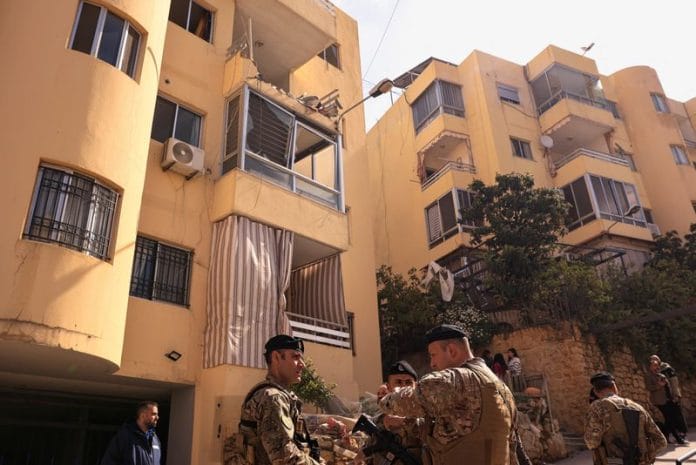
AIN SAADEH, Lebanon April 6 (Reuters) – An Israeli strike on an apartment east of Beirut late on Sunday killed a local official from a Christian political party, sharpening internal divides over Hezbollah as Israel’s strikes expand to new parts of the country.
Israel’s air and ground campaign in Lebanon over the past month has deepened fractures between supporters of Hezbollah and those who blame the Iran-backed group for igniting a new conflict with Israel just 15 months after the last one.
On Sunday, an Israeli strike hit an apartment in Ain Saadeh, a predominantly Christian town in the hills east of Beirut, killing a man and two women, Lebanon’s health ministry said.
The Lebanese Forces Party, a fiercely anti-Hezbollah Christian party, identified two of the dead as Pierre Moawad, a local party official, and his wife Flavia.
“We are paying a heavy price for a war into which we have been dragged by the lawless organisation Hezbollah,” Lebanese Forces parliamentarian Razi El Hage told Lebanese broadcaster MTV.
The full-scale Israeli campaign, launched in retaliation for Hezbollah firing into Israel on March 2 in solidarity with Iran, has killed nearly 1,500 people, according to Lebanese authorities.
They include 130 children, 101 women and 57 medics. On Monday, the Lebanese health ministry said three medics had been killed in two separate Israeli attacks within 12 hours of each other.
MOAWAD WAS ‘NOT A TARGET,’ ISRAEL SAYS
The Israeli military told Reuters on Monday it had struck a “terror target east of Beirut” without providing further details, and said it was reviewing reports that “several uninvolved individuals were harmed as a result of the strike”.
When asked about the killing of civilians including Moawad at a briefing later on Monday, Israeli military spokesperson Lieutenant Colonel Nadav Shoshani said, “the person you are referring to was definitely not a target.”
He said the military was trying to understand the circumstances of the incident and was working on declassifying more details on the intended target.
The Lebanese army said on Monday that its investigation into the strike found it involved two GBU-39 bombs that pierced the building’s roof and detonated on the third floor of the building.
GBU-39s are U.S.-made, and Israel requested approximately 2,000 of them in February 2025, according to a press release from the U.S. Department of Defense.
Israel’s air campaign and orders for people to leave swathes of Lebanon’s south, east, and Beirut’s southern suburbs have displaced more than a million people, most of them from the Shi’ite Muslim community from which Hezbollah draws its support.
On Monday, the Israeli military ordered residents of 40 additional villages to leave their homes immediately and head north. Israel’s evacuation orders cover 15% of Lebanese territory.
CIVIL PEACE IS ‘RED LINE’
Some residents and officials in predominantly Christian areas have expressed concern that displaced communities are harboring militants that Israel may target, with local authorities vetting those seeking rented accommodation.
There was no Israeli order for people to flee before Sunday’s strike on Ain Saadeh. Residents said no displaced people were living in the targeted apartment or surrounding buildings.
“I’ve been in my house for 20 years, I’ve never even seen this apartment lit. There’s no one in it,” Antoine Aalam, a 70-year-old man who lives across from the targeted apartment, told Reuters on Monday.
Israel’s military declined to comment on concerns that strikes on Christian communities were aimed at inflaming sectarian tensions.
Sunday’s strike came hours after Lebanon’s President Joseph Aoun, in his first televised address since the conflict began, said the country’s “primary concern is preserving civil peace, which is a red line.”
(Additional reporting by Pesha Maged in Jerusalem; Writing by Maya Gebeily; Editing by Kirsten Donovan and Hugh Lawson)
Disclaimer: This report is auto generated from the Reuters news service. ThePrint holds no responsibility for its content.