





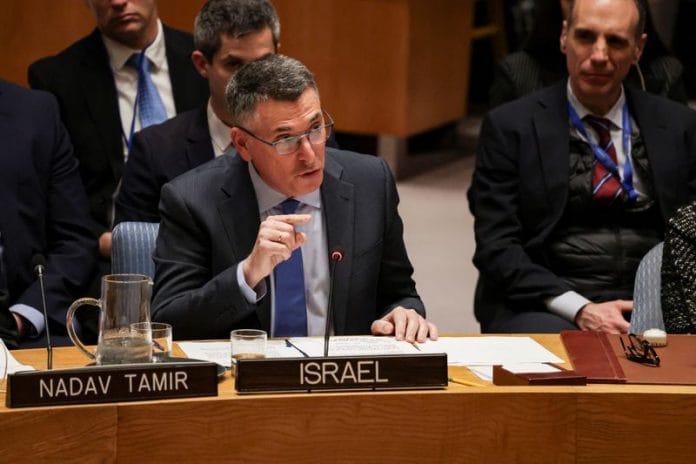



ZAZIR, northern Israel, March 15 (Reuters) – Israeli Foreign Minister Gideon Saar on Sunday denied a report that Israel was facing a shortage of ballistic missile interceptors after more than two weeks of war that has seen repeated attacks from Iran and Iran-backed Hezbollah in Lebanon.
American news website Semafor on Saturday cited an unnamed U.S. official as saying that Israel had told Washington it was running critically low on ballistic missile interceptors.
Asked whether the report was accurate, along with an Israeli media report that Israel was set to hold direct talks with Lebanon, Saar responded: “For both questions, the answer is no.”
An Israeli military source also denied any shortage, saying that the armed forces were prepared for a prolonged campaign.
Iran has fired close to 300 ballistic missiles at Israel, according to the Institute for National Security Studies (INSS) at Tel Aviv University, and hundreds of drones since U.S. and Israeli strikes on Iran on February 28.
Half of the missiles fired by Iran have carried cluster munitions, according to the Israeli military, which has also noted a sharp drop in the number of missiles launched daily since the first days of the war.
Hezbollah has also launched rockets at Israel from Lebanon since opening fire on March 2, which the Lebanese armed group says was in retaliation for the killing of Iran’s supreme leader at the start of the U.S.-Israeli war on Iran.
Israeli newspaper Haaretz reported on Saturday that Israel and Lebanon were expected to hold direct talks in the coming days, citing two sources with knowledge of the matter.
Israel’s Army Radio on Sunday reported that Prime Minister Benjamin Netanyahu’s confidant and former minister Ron Dermer visited Saudi Arabia last week to explore a new initiative for diplomatic talks with Lebanon that would begin once the current military campaign against Hezbollah is exhausted.
A spokesman for Netanyahu did not immediately respond to a Reuters request for comment.
Energy Minister Eli Cohen neither confirmed nor denied the report in an interview with the radio station on Sunday but said he was skeptical any deal could be reached before the Lebanese government takes firm action against Hezbollah.
He said that the security cabinet, a small group of senior ministers responsible for key decisions, had discussed cancelling the 2022 Israel-Lebanon maritime border deal, though no action has been taken.
(Reporting by Alexander Cornwell, Maayan Lubell & Steven Scheer; Editing by Joe Bavier, Kirsten Donovan)
Disclaimer: This report is auto generated from the Reuters news service. ThePrint holds no responsibility for its content.