








By Alex Lawler and Arathy Somasekhar
March 21 – The war in the Middle East has triggered a nightmare scenario for the global energy system, slashing so much supply that consumers around the world must both pay up big and lower consumption.
The effective closure of the Strait of Hormuz, a narrow channel along the Iranian coast, has stopped the passage of 20% of the world’s oil and liquefied natural gas since the U.S. and Israel began airstrikes on Iran on February 28.
Meanwhile, ongoing strikes by Iran and Israel have targeted Middle East energy infrastructure, doing damage to gas fields, oil refineries, and terminals that industry representatives say will take years to repair.
All of that adds up to what the International Energy Agency has already called the worst global energy disruption in history, eclipsing even the Arab oil embargo of 1973 that caused fuel shortages and triggered widespread economic damage.
“You’re not going to conserve your way around this. What it’s going to translate to is price rises high enough that people stop consuming,” said Dan Pickering, chief investment officer for Pickering Energy Partners.
So far, the crisis has removed about 400 million barrels – about four days of world supply – from the market, triggering price increases of around 50%.
Oil, gas, and their refined byproducts are critical to many parts of the modern world, from fueling cars, trucks and planes, to powering homes and industry, to producing plastics and fertilizers.
“The breadth of what is at risk here in fuels, chemicals, LNG and fertilizer inputs is what makes this moment qualitatively different from previous episodes of Gulf tension,” said Aditya Saraswat, senior vice president at consultancy Rystad Energy.
Energy price shocks also fuel inflation, hitting consumers and businesses hard. This has become a major political liability for U.S. President Donald Trump as he seeks to justify the war to the American public.
Trump has assailed NATO allies over their lack of support for the U.S.-Israeli war against Iran, calling the longtime U.S. allies “cowards.”
PRICE SHOCK
Global benchmark oil prices have already risen more than 50% to over $110 a barrel since the war started. The impacts are more pronounced for Middle East crudes – a staple for Asian economies – with prices hitting records near $164.
That has translated to soaring prices for transport fuels, pressuring consumers and businesses across the globe, and triggering government action to conserve supplies.
Thailand, for example, ordered civil servants to conserve energy by suspending overseas trips and using stairs instead of elevators, while Bangladesh closed its universities.
Sri Lanka has imposed fuel rationing, China has banned refined fuel exports, and the UK government’s energy contingency plan includes a cut in speed limits to save fuel.
On Friday, the International Energy Agency outlined other proposals to reduce demand, such as working from home and avoiding air travel, which has already been severely disrupted after the war forced the closure of key Middle Eastern hubs.
The IEA earlier this month agreed to make a record 400 million barrels of oil available from emergency stockpiles. But analysts say the measure is too small since 400 million barrels covers only about 20 days of the war’s impact.
Natasha Kaneva, a JP Morgan analyst, said reducing demand is the only solution when supplies fall short.
“The market is facing an acute shortage of products (…) that cannot be consumed simply because they are not available,” she said.
For everything that remains, prices are surging.
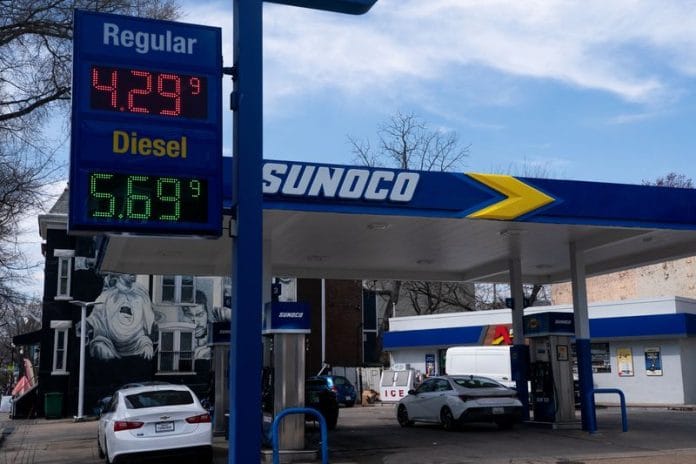
Jet fuel prices in Europe, for example, hit a record of around $220 per barrel – a cost that is likely to filter down fast in the form of more expensive airline tickets. In the U.S., which imports very little Middle Eastern oil, retail gasoline prices are up more than a dollar a gallon since February 28 to around $4 a gallon.
Natural gas prices in Europe and Asia are soaring after tit-for-tat strikes by Israel and Iran in recent days slammed Gulf gas installations. Consumer power costs could also leap.
Israel struck Iran’s South Pars gas field on Wednesday, and Iran hit Qatar’s massive Ras Laffan LNG complex the day after. QatarEnergy’s CEO Saad al-Kaabi told Reuters Iranian attacks will knock out 12.8 million tons per year of LNG – about 3% of world supply – for three to five years.
The situation is critical since oil and gas products are vital to everything from pharmaceuticals to plastics and fertilizers, said Menelaos Ydreos, secretary general of the International Gas Union, a grouping of world gas producers.
“We, again, call for an immediate stop to the targeting of energy facilities and for the resumption of cargo traffic through the Strait of Hormuz as fertilisers, petrochemicals for the pharmaceutical industry, oil, grain, and gas are all critical to our existence,” he said in a statement.
FOOD THREAT
The war also threatens food supply. It has severely disrupted fertilizer markets because about a third of global trade in fertilizers typically passes through the Strait of Hormuz and is now stuck.
Prices for nitrogen-based products like urea, the most critical fertilizer product, have risen 30% to 40% since the conflict began. U.S. farmers were already reporting empty shop shelves ahead of spring planting.
Fertilizer factories in India, Bangladesh and Malaysia are moving to halt orders, cut production or shut down altogether because of a lack of feedstocks.
If the conflict lasts just a few more weeks, global food supplies will be significantly disrupted, said Maximo Torero, chief economist with the UN’s Food and Agriculture Organization (FAO).
“This will affect planting. … There will be a lower supply of commodities in the world – of staple cereals, of feed, and therefore of dairy and meat,” he said.
About half the world’s food is grown using fertilisers, which in some countries account for up to half the cost of grain production.
(Reporting by Stephanie Kelly, Robert Harvey, May Angel, Marwa Rashad, Ahmad Ghaddar, Susanna Twidale, Arathy Somasekar and Scott Disavino; writing by Alex Lawler, editing by Richard Valdmanis and David Gregorio)
Disclaimer: This report is auto generated from the Reuters news service. ThePrint holds no responsibility for its content.