








By Jana Choukeir, Nayera Abdallah and Tala Ramadan
DUBAI, Jan 12 (Reuters) – Iran said on Monday it is keeping communications open with the U.S. as President Donald Trump weighed responses to a violent crackdown on protests that have posed one of the biggest challenges to clerical rule since the 1979 Islamic Revolution.
Trump said on Sunday the U.S. may meet Iranian officials and that he is in contact with the opposition, while piling pressure on the Islamic Republic’s leaders, including threatening possible military action in response to violence against protesters.
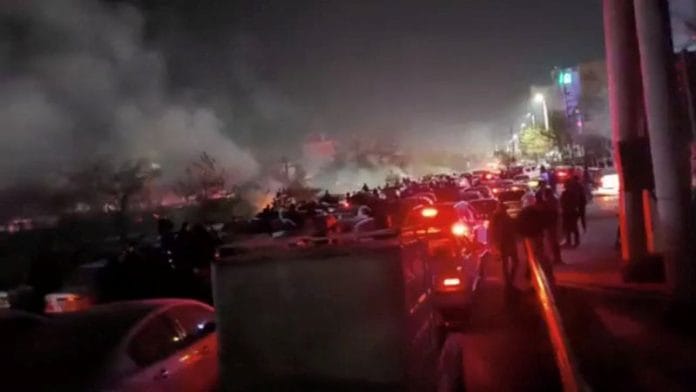
Iran has weathered past waves of protests with crackdowns like the current bloody suppression. But this time the leadership is facing nationwide demonstrations that evolved from complaints about dire economic hardships to defiant calls for the fall of the clerical establishment, and with its regional clout much reduced.
“The communication channel between our Foreign Minister Abbas Araqchi and the U.S. special envoy (Steve Witkoff) is open and messages are exchanged whenever necessary,” foreign ministry spokesperson Esmaeil Baghaei said on Monday.
Contacts also remain open through traditional intermediary Switzerland, he said.
“They (U.S.) touched upon some cases, ideas were brought up and in general (…) the Islamic Republic is a country that never left the negotiating table”. But he added that “contradictory messages” from the U.S. showed a lack of seriousness and were not convincing.
Araqchi reiterated in a briefing to foreign ambassadors in Tehran that the Islamic Republic was ready for war but also open to dialogue.
MORE THAN 500 KILLED, RIGHTS GROUP SAYS
U.S.-based rights group HRANA said it had verified the deaths of 490 protesters and 48 security personnel, with more than 10,600 people arrested since the protests began on December 28.
Iran has not given an official toll and Reuters was unable to independently verify the tallies. The flow of information from Iran has been hampered by an internet blackout since Thursday.
Trump said on Sunday that Iran had called to negotiate on its nuclear programme. Israel and the U.S. bombed Iranian nuclear sites in a 12-day war in June.
“Iran wants to negotiate, yes. We might meet with them. A meeting is being set up, but we may have to act because of what is happening before the meeting, but a meeting is being set up. Iran called, they want to negotiate,” he told reporters on Air Force One.
Trump was to meet with senior advisers on Tuesday to discuss options for Iran, a U.S. official told Reuters. The Wall Street Journal reported that options included military strikes, using secret cyber weapons, widening sanctions and providing online help to anti-government sources.
Striking military installations could be highly risky. Some bases of elite military and security forces may be located in heavily populated areas so any attack ordered by Trump could inflict large civilian casualties.
Iranian Parliament Speaker Mohammad Baqer Qalibaf warned Washington against “a miscalculation”.
“Let us be clear: in the case of an attack on Iran, the occupied territories (Israel) as well as all U.S. bases and ships will be our legitimate target,” said Qalibaf, a former commander in Iran’s elite Revolutionary Guards.
However, Tehran is still recovering from last year’s war, and its regional clout has been much weakened by blows to allies such as Lebanon’s Hezbollah since the October 7, 2023 attacks against Israel. Israel also killed top Iranian military commanders in the June war.
SITUATION ‘UNDER TOTAL CONTROL’, ARAQCHI SAYS
Iranian authorities accused the U.S. and Israel of fomenting trouble and called for a nationwide rally on Monday to condemn “terrorist actions led by the United States and Israel,” state media reported.
State TV aired live footage on Monday of large crowds attending a funeral procession for security forces killed in Shahrud and pro-government demonstrations in cities such as Kerman, Zahedan and Birjand, held “in condemnation of recent terrorist events”.
Araqchi said the situation in Iran was “under total control” after violence linked to protests spiked over the weekend. He said Trump’s warning against Tehran of action if protests turned bloody had motivated what he called terrorists to target protesters and security forces in order to invite foreign intervention.
The protests began in response to soaring prices, before turning against the clerical rulers who have governed for more than 45 years.
Iranians have grown increasingly resentful of the powerful Revolutionary Guards, whose business interests including oil and gas, construction and telecommunications are worth billions of dollars.
Footage posted on social media on Saturday from Tehran showed large crowds marching at night, clapping and chanting. The crowd “has no end nor beginning,” a man is heard saying.
Trump said on Sunday he would talk to Elon Musk about restoring internet access in Iran through his Starlink satellite service.
Araqchi said internet service will be resumed in coordination with security authorities.
Authorities on Sunday declared three days of national mourning “in honour of martyrs killed in resistance against the United States and the Zionist regime,” according to state media.
Alan Eyre, a former U.S. diplomat and Iran expert, thought it unlikely the protests would topple the establishment.
“I think it more likely that it puts these protests down eventually, but emerges from the process far weaker,” he told Reuters, noting that Iran’s elite still appeared cohesive and there was no organised opposition.
(Additional reporting by Elwely Elwelly in Dubai. Rami Ayyub, Maayan Lubell and Alexander Cornwell in Jerusalem, Steve Holland in WashingtonVideo verification by Mahezabin Syed, Eleanor Whalley and Marine DelrueWriting by Michael GeorgyEditing by Lincoln Feast, Michael Perry and Frances Kerry)
Disclaimer: This report is auto generated from the Reuters news service. ThePrint holds no responsibility for its content.