








By Humeyra Pamuk, Rami Ayyub and Alexander Cornwell
WASHINGTON/JERUSALEM/TEL AVIV, March 24 (Reuters) – Iran launched waves of missiles at Israel on Tuesday, a day after U.S. President Donald Trump said there had been “very good and productive” talks aiming at halting the war unleashed by the U.S. and Israel now raging across the Middle East.
Three senior Israeli officials, speaking on condition of anonymity, said Trump appeared determined to reach a deal, but that they thought it highly unlikely Iran would agree to U.S. demands in any new round of negotiations.
After Trump’s Truth Social comment on Monday, Iran said no talks had yet been held. Its embassy in South Africa posted an image on X showing a child’s pink steering wheel placed on a car dashboard in front of the passenger seat, apparently mocking Trump’s idea, aired to reporters, that he could control the Strait of Hormuz waterway alongside Iran’s supreme leader.
Israeli Prime Minister Benjamin Netanyahu, who spoke to Trump less than 48 hours before their countries began the war, was expected to convene security officials for talks on Trump’s bid for a deal with Iran, two senior Israeli officials said.
A Pakistani official has said direct talks may be held in Islamabad this week.
REVOLUTIONARY GUARDS’ INFLUENCE GROWS IN IRAN
In a sign of the Islamic Revolutionary Guard Corps’ (IRGC) growing sway, a former commander of the elite force, directly accountable to Supreme Leader Ayatollah Mojtaba Khamenei, was appointed secretary of Iran’s top security body.
Mohammad Baqer Zolqadr replaced Ali Larijani, killed by an Israeli strike last week, as head of the Supreme National Security Council. However, he was not expected to assume Larijani’s role as a key powerbroker.
The U.S. and Israel launched strikes on Iran on February 28 after saying they had failed to make enough headway in talks aimed at ending Iran’s nuclear program, even though mediator Oman said significant progress had been made.
Since then, Iran has attacked countries that host U.S. bases, struck key Gulf energy infrastructure and effectively closed the Strait of Hormuz, conduit for a fifth of the world’s oil and liquefied natural gas.
Israel is also carrying out a separate operation against the Iranian-backed Hezbollah militants who have attacked it from Lebanon in support of Iran.
Despite diplomatic signals from Washington, there were no signs of conflict abating in the Gulf or Lebanon.
Defence Minister Israel Katz said it now planned to occupy southern Lebanon up to the Litani River – about a tenth of the country. He said there could be no homes or residents in areas where there was “terror”, an apparent reference to Hezbollah.
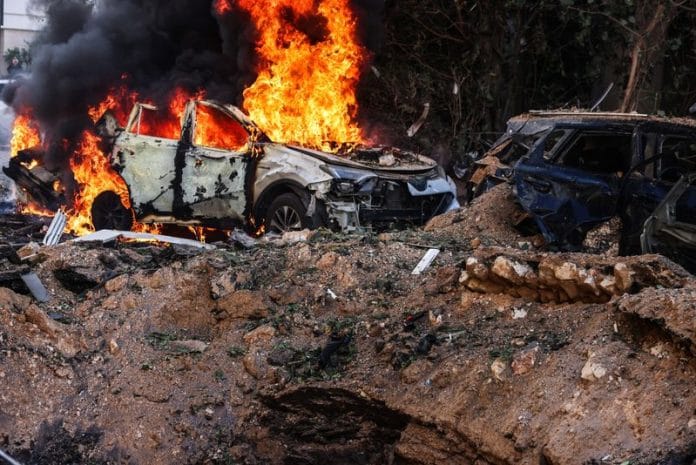
Iranian missiles triggered air raid sirens in Israel’s biggest city, Tel Aviv, where gaping holes were torn through a multi-storey apartment building. It was not immediately clear if the damage had been caused by a direct hit or debris from an interception.
Israel’s Fire and Rescue Service said they were searching for civilians trapped in one building.
Israel’s military said its fighter jets had carried out a large wave of strikes in central Tehran on Monday, targeting key command centres, including facilities associated with the IRGC’s intelligence arm and the Intelligence Ministry. It said it had hit more than 50 other targets overnight, including ballistic missile storage and launch sites.
Air defence systems were activated across Tehran as explosions were heard simultaneously in several areas of the capital, according to the Iranian news agency Nournews.
At least eight people were killed and 28 injured in a strike on a residential area of Tabriz, a city of 1.7 million in Iran’s northwest, the provincial director for crisis management told Tasnim news agency.
Elsewhere, the United Arab Emirates said it had intercepted five ballistic missiles and 17 drones coming from Iran.
Trump said on Monday he was postponing for five days a plan to attack Iran’s power plants unless it reopened the Strait of Hormuz.
Iran had promised to respond to such attacks by hammering the infrastructure of U.S. allies in the Middle East.
IRAN DENIES NEGOTIATIONS WITH U.S.
Trump’s step-back sent share prices higher and oil prices sharply lower to below $100 a barrel, a sudden reversal of a market swoon caused by his weekend threats and Iran’s vows to respond. [O/R]
Those gains were in jeopardy on Tuesday, however, after Iran’s powerful parliament speaker Mohammad Baqer Qalibaf – the interlocutor on the Iranian side, according to an Israeli official and two other sources familiar with the matter – said no talks had taken place, calling the claims “fake news”.
Iran’s foreign ministry did, however, mention initiatives to reduce tensions.
U.S. Treasury yields pushed higher and the dollar regained lost ground as the world grapples with what the International Energy Agency has called the biggest-ever disruption to energy supplies. [MKTS/GLOB]
Brent crude futures rose to over $100 a barrel, reversing some of their 10% slide from Monday, while U.S. crude rose 4.3% to $91.93 per barrel.
“The underlying situation is still incredibly fragile or flammable,” said IG market analyst Tony Sycamore.
Trump told reporters his special envoy Steve Witkoff and son-in-law Jared Kushner, who had been negotiating with Iran before the war, had held discussions with a top Iranian official into the evening on Sunday and would continue on Monday.
A European official said that, while there had been no direct negotiations between the two nations, Egypt, Pakistan and Gulf states were relaying messages.
The Pakistani official said U.S. Vice President JD Vance, as well as Witkoff and Kushner, were expected to meet Iranian officials in Islamabad this week, following a call between Trump and Pakistani defence forces chief Asim Munir.
(Reporting by Phil Stewart, Idrees Ali, Gram Slattery and Humeyra Pamuk in Washington, Maayan Lubell in Jerusalem and Alexander Cornwell in Tel Aviv, Ariba Shahid in Karachi and Saad Sayeed in Bangkok; Additional reporting by Reuters bureaus; Writing by David Brunnstrom, Michael Perry and Sharon Singleton; Editing by Cynthia Osterman, Stephen Coates and Kevin Liffey)
Disclaimer: This report is auto generated from the Reuters news service. ThePrint holds no responsibility for its content.