








By Dan Peleschuk
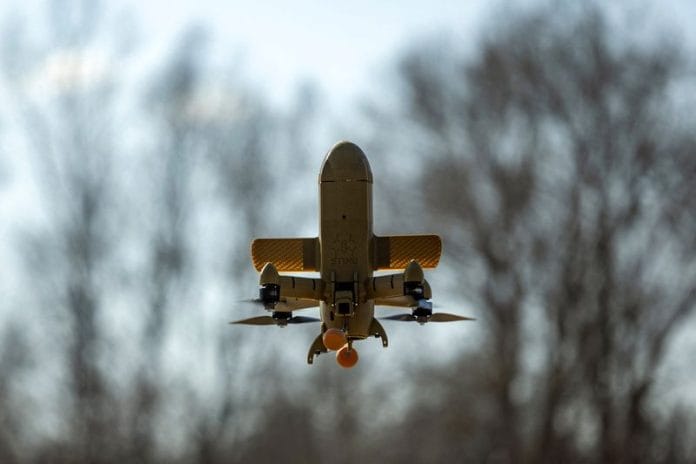
March 17 (Reuters) – Streaking across the sky with a terrifying wail, a Ukrainian-made quadrocopter swerves with unlikely agility for a device resembling a winged lava lamp.
Once a long-shot concept, the interceptor drone developed by private firm Wild Hornets is now key to Ukraine’s defence against Russian drones – and soon, possibly, to combatting Iranian ones in the Gulf.
The government in Kyiv and local drone producers say the U.S. and its allies are seeking their help to repel Iranian Shahed drones that have rained down on targets across the Middle East.
Wild Hornets has said that Middle East clients have expressed interest in its interceptors, but that it is not directly negotiating any export contracts before getting a green light from Ukraine’s government.
Interceptors like the STING are a low-cost alternative to multi-million-dollar U.S. Patriot air-defence missiles, capable of swooping in on lumbering Russian-made versions of the Shahed with overpowering speed.
A Wild Hornets team demonstrated the interceptor for Reuters at an undisclosed location, where masked engineers huddled around a control unit relaying a high-quality feed from the drone’s camera.
“You can’t describe it in words – you need to feel it,” said test pilot “Paskudnyk”, using a call sign that translates to “nasty guy”.
HIGH SPEED AND LOW COST
Russian drones loom over the battlefield and flood Ukraine’s skies, often in mass attacks that knock out power in major cities and target logistics and other infrastructure.
That has pushed cash-strapped but innovative Ukrainian developers to fast-track cheaper solutions.
The STING flies at up to 280 km (174 miles) per hour, supported by a 360-degree antenna and a maximum flight range of around 37 km – a combination allowing it to chase down drones from a distance before crashing into them with explosives.
Controls are easily adaptable for pilots of the first-person-view drones (FPV) that are now commonplace, said Paskudnyk, a former furniture builder who aids Ukrainian pilots in the field.
“If you already know how to fly an FPV drone, then moving to this device is a matter of three or four days,” he said.
The STING has downed more than 3,000 Russian Shaheds since entering regular service in June 2025, the company said. More than 10,000 units roll off the production line monthly.
They cost around $2,000 or less – compared to the Shahed’s $20,000-$50,000 – and are purchased through the government’s defence-tech incubator or prominent private charities.
A second-generation model has already been developed to fly even faster and target the jet-powered Shaheds which Russia is continuously developing, according to a company representative who asked not to be identified for security purposes.
He said it had already been deployed in defensive operations, but that its technical specifications were being kept secret.
CAUTIOUS ABOUT EXPORTS
Since the start of the Iran war on February 28, Gulf Arab states have faced more than 2,000 missile and drone attacks, which have struck U.S. diplomatic missions and military bases as well as oil infrastructure, ports, airports, ships and residential and commercial buildings.
President Volodymyr Zelenskiy said last week Kyiv wants money and technology in return for helping Middle Eastern nations, adding that three teams of air-defence specialists have been sent to the Middle East.
He also criticised some Ukrainian companies and foreign governments that he said had sought to do deals for anti-drone equipment without approval from Kyiv.
The Wild Hornets representative said his company is focused foremost on bolstering Ukraine’s military, and would only export at the government’s call – especially if Kyiv receives more U.S. Patriots to shoot down ballistic missiles.
“We’ve received requests in our inbox,” he said, “but we’re not reacting to them for now.”
(Reporting by Dan Peleschuk; Editing by Daniel Flynn and Ros Russell)
Disclaimer: This report is auto generated from the Reuters news service. ThePrint holds no responsibility for its content.