








Fujitsu Ltd. is one of the world’s largest IT services providers. Now, it’s poised to tackle a new problem: measuring how much carbon dioxide coastal ecosystems absorb.
It’s joining an increasing number of companies developing novel technologies aimed at helping accelerate the growth of blue carbon credits, an underdeveloped corner of the offset market.
Scientists estimate that even under optimal conditions protecting existing habitats and large-scale restoration efforts would likely avoid or remove only a few percent of the world’s global greenhouse gas emission. But the projects can also deliver added environmental benefits and fetch higher prices than other nature-based carbon removal credits, making them attractive to buyers and local developers alike.
Fujitsu uses a microwave-sized underwater drone that can zig-zag across the ocean floor, scanning and identifying plant species that gather CO2 and then store it in sediment as carbon when they die off. Researchers use the data the drones capture to create a digital twin of the habitat and estimate the amount of CO2 absorbed by the living plants. Simulations allow them to forecast how conservation efforts can help ecosystems capture more CO2.
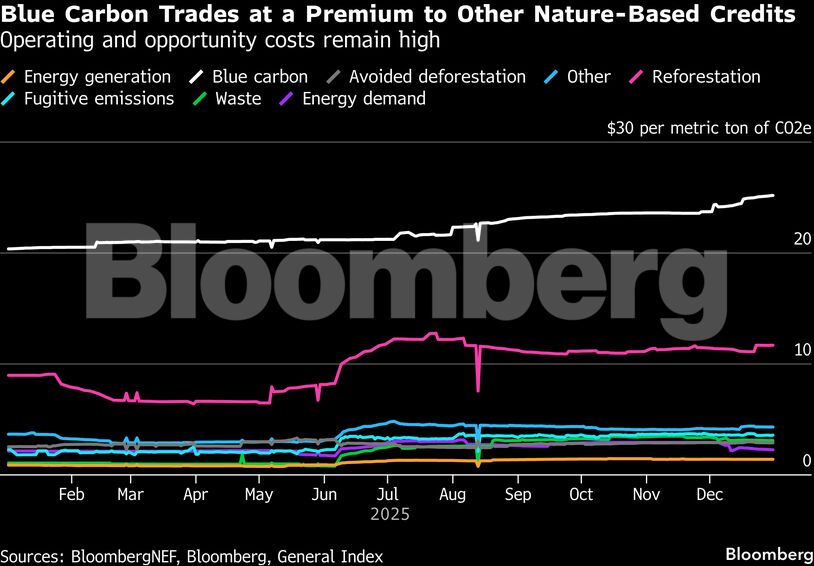
Blue carbon projects are attractive to investors because mangrove and salt marsh ecosystems can store up to five times more carbon per acre than tropical forests and are less vulnerable to fire, droughts and pests than some other nature-based offsets. However, supplies remain limited and the opportunity and operating costs are high, according to BloombergNEF.
“When you think about nature’s ability to sequester carbon, there’s very few systems that actually sequester carbon in the ground over thousands of years,” said Peter Macreadie, a professor and director of the Centre for Nature Positive Solutions at Australia’s RMIT University.
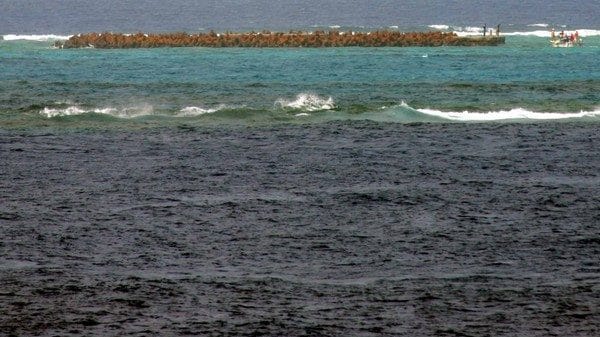
Fujitsu’s drone has already proved useful. The company scanned a habitat restoration project near Uwajima, a port city on the southern Japanese island of Shikoku, which helped generate blue carbon credits from Japan’s certification body last year.
If efforts by Fujitsu and others to cheaply monitor marine projects are successful, they could help grow a small corner of a carbon market that peaked in 2022, with credits equivalent to 3.1 million tons of CO2 issued, to 40.5 million tons by midcentury, according to BNEF’s base case.
But ocean-based projects also come with their own set of risks. Although blue carbon habitats can store large amounts of carbon in waterlogged soils, the ecosystems tend to be fragile and can be impacted by coastal development and dredging. They’re also vulnerable to climate change, from rising sea levels and fiercer storms to warming waters and ocean acidification.
The biggest barrier for blue carbon today, though, is investor confidence, according to May Liew, chief executive officer of Octave Capital Pte, which is focused on making the sector investable at scale. The Singapore-based private equity firm last year launched the Asia Ocean Fund, along with Katapult Ocean, to back companies working on marine issues.
For now, challenges remain. Estimating the amount of carbon stored in marine sediment varies widely due to variability and uncertainty in carbon burial rates. A peer-reviewed report published in 2022 that analyzed results from a mix of studies found a 600-fold difference between the highest and lowest estimates for carbon burial in salt marshes; a 76-fold difference for seagrasses; and a 19-fold difference for mangroves. Mathematical modeling of carbon storage can be highly uncertain, said Phillip Williamson, an associate professor at the University of East Anglia in the UK, who specializes in ocean biogeochemistry.
Some of the new technologies are working to reduce those uncertainties. “There’s strong interest in technologies like hyperspectral satellites, underwater drones and ocean digital twins because they go straight to the biggest investor concern: measurement risk,” said Liew.
In Indonesia, home to roughly a fifth of the world’s mangroves, WWF Indonesia is teaming up with Finnish satellite startup Kuva Space Oy to map ecosystems. The hope is that better quantification will unlock more financing for local communities doing restoration work.
Technology could also help tackle another challenge — proving how much CO2 an ecosystem would’ve absorbed without human intervention, a concept known as additionality. “Only a small proportion of seagrass and mangrove restoration projects have been successful to date,” said Williamson. “If carbon offsets are awarded when not fully justified, then the risk of climate catastrophe is increased not reduced.”
San Francisco-based Ulysses Maritime Technologies Inc. is working to make the restoration process cheaper. The firm’s underwater submersibles plants seeds at precise underwater locations and can cover up to five hectares a day. During a seagrass planting project in Australia, the drone cut costs by 90% compared to human diver-based restoration and was 10 times faster.
“It’s very hard to restore marine ecosystems in a way that’s cost-effective,” said RMIT’s Macreadie. “A diver has a tank of oxygen, some hourly rate, whereas the robot just keeps working until the battery runs out. Then you recharge, redeploy and repeat all over again.”
This report is auto-generated from Bloomberg news service. ThePrint holds no responsibility for its content.