





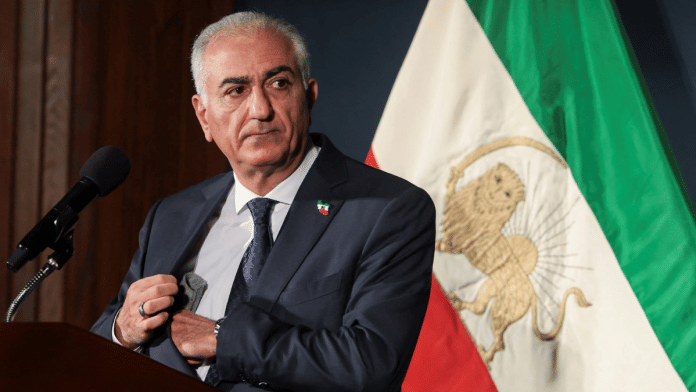



Washington: Last week, surrounded by crowds of cheering protesters, a man in Iran’s western city of Khorramabad shattered a decades-long political taboo and defiantly unfurled the banned monarchist Lion and Sun flag in a public square.
The video circulated on social media a day after Reza Pahlavi, Iran’s exiled former crown prince and the late Shah’s son, called on Iranians to join the protests, spurring thousands more to pour onto the streets. As Iran’s leaders appear to have, for now, brutally suppressed another uprising, Pahlavi has emerged from his home in suburban Washington as an unlikely emblem, finally making inroads in his 40-year campaign to depose the clerical regime.
For decades, Pahlavi has drawn as much ridicule as veneration. For him to become a focal point for the biggest ever popular rebuke of the Islamic Republic underscores just how exasperated Iranians have become.
“There are others who don’t support him but mostly we’ve reached one understanding in Iran: now is not the time to argue about this issue,” an office worker who lives in the northern city of Karaj and took part in protests said via text message, speaking on condition of anonymity fearing government reprisals. “He is the best option for leadership for now, and after the Islamic Republic we will go to the polls and see what happens.”
But Pahlavi and his supporters have already been dealt a blow after US President Donald Trump questioned whether the former prince has enough support in Iran and decided, for now, to shelve plans to strike the Islamic Republic. “He seems very nice, but I don’t know how he’d play within his own country,” Trump told Reuters on Jan. 15, adding “I don’t know whether or not his country would accept his leadership, and certainly if they would, that would be fine with me.”
The lack of endorsement could reflect the fact that Pahlavi has been a polarizing figure for Iranians, often criticized for his inexperience, pro-Israel stance, near half-century absence from the country, and the fact that his most vocal supporters are known for attacking other regime opponents — including Nobel Peace Prize laureate Narges Mohammadi, who’s been detained by Iranian authorities over her campaign for women’s rights and outspoken criticism of the religious political system.
His prominence is “a consequence of Pahlavi nostalgia, the complete ineptitude of the Islamic Republic over 47 years and the real desperation of the people,” said Ali Ansari, professor of modern history at the University of St Andrews.
“Pahlavi is one very recognizable leader and symbol — one of the very few,” said Barbara Leaf, former US assistant secretary of state for the near east. It says more about the “millions of Iranians who are sick to death of the regime and the hard, meager life it has imposed on them than about the qualities Reza Pahlavi has as a potential leader.”
Pahlavi, who didn’t respond to a request for an interview, has been keen to make clear he’s not a king in waiting but wants to lead a transitional government until elections are held. He’s said he wants a democratic system that gives equal billing to all of Iran’s ethnic and religious groups, but hasn’t given any details of the sort of government or constitution he has in mind.
“What I’m trying to make sure is the final element that will prove to the Iranians that are in full control of their own destiny is to return power back to them,” Pahlavi told a press conference in Washington on Friday. “I’m confident that I have the support of my compatriots,”
Now the question is whether he can turn last week’s momentum into a sustained, credible challenge to Supreme Leader Ayatollah Ali Khamenei, whose security forces have already killed at least 3,400 people in a violent crackdown, according to rights groups.
Pahlavi was born in Tehran in 1960 and raised as the heir to the so-called Peacock Throne of what was then Imperial Iran. His father, Mohammad Reza Pahlavi, was both a modernizing and authoritarian ruler — women were encouraged to study and work and had freedom over how they dressed. But politics was heavily controlled as pro-democracy movements, communists and the clergy were targeted by secret police — the Savak — and often imprisoned or tortured.
As opposition to his father grew into what would become the 1979 revolution, Pahlavi was sent to live in the US in 1978. He never returned to Iran, where hundreds of officials of the imperial state and loyalists to the Shah were executed or exiled.
Suddenly, deeply conservative clerics who were persecuted by the Shah were in charge and set about Islamizing political and public life. Women were subject to Sharia law and forced to cover their hair and bodies. Alcohol was banned, businesses and assets were seized, and religious minorities were marginalized or outlawed as Shia Islam became the center of gravity for the state.
By the late 1980s, as Iran was emerging from a war with Iraq that helped galvanize the Islamic Republic, the Pahlavi family had mostly receded into the shadows. The scion, back in the US, studied political science and campaigned against the theocratic system, building a modest following particularly among exiled Iranians.
But over the next decade, the emergence of illegal satellite TV dishes on the rooftops of millions of Iranian homes would breathe new life into the Pahlavi legacy.
Privately-owned, Persian-language stations based abroad like Manoto TV and Iran International emerged as explicitly monarchist, anti-regime and pro-Israel broadcasters, becoming one of the most effective propaganda weapons against the Islamic Republic and a major boon to Pahlavi.
Documentaries about Iran’s pre-revolutionary past, vintage TV shows featuring pop singers and young people at discos fizzed in living rooms at a time when Iranians born after the revolution were coming of age, just as the internet was further eroding the regime’s ability to control their access to the media.
His family’s reign “provided many of the things that many Iranians today are asking for, short of political freedom,” said Arman Mahmoudian, a research fellow at the University of Southern Florida’s Global and National Security Institute.
“The regime shut down every single oppositionist individual or party inside the country,” he added. “Someone has to fill the gap.”
But name recognition will only get Pahlavi so far. After the US overthrew Venezuela’s President Nicolas Maduro, Trump passed over opposition leader Maria Corina Machado — who this week gave him her Nobel Peace Prize medal — and his administration is instead working with the ruling regime.
Even if Pahlavi eventually gains Trump’s blessing, he must also overcome years of criticism from Iranians both at home and abroad. For all his coverage in Western media, it’s impossible to measure his support inside Iran, where political polling on non-regime parties or people doesn’t exist.
The concept of a monarchy — especially one so strongly tied to the US and Israel — is still unacceptable to many Iranians who look back with pride on how former Prime Minister Mohammad Mossadegh stood up to Western efforts to monopolize Iran’s oil industry and challenged the monarchy’s power, before being removed in a 1953 coup backed by the US and Britain that put Pahlavi’s father back in charge.
There is also the question of what, other than his title, qualifies Pahlavi to lead Iran. He has no experience in management or leadership of any organization anywhere near comparable to running a diverse country of 90 million people.
“There are those who dismiss him as frivolous and divisive and say he hasn’t managed anything,” said Abbas Milani, the Hamid and Christina Moghadam Director of the Iranian Studies program at Stanford University. “But to me he’s essentially spent 40 years trying to bring about a coalition — he hasn’t always succeeded, but now is the moment he’s more likely to make it.”
As a symbol of Persian nationalism, Pahlavi is also a problematic figure for many ethnic minorities including Iran’s Kurdish population, many of whom associate the monarchy with efforts to suppress them and crush past attempts to assert autonomy and independence.
Then there is his fervent support base, who are notorious within the diaspora for attacking anyone who doesn’t fully embrace monarchy and Pahlavi as the only alternative to the Islamic Republic.
On Jan. 12, this infighting erupted into violence at solidarity protests by Iranian-Americans in Los Angeles, where pro-monarchist demonstrators started attacking a truck covered in anti-regime slogans that were also anti-monarchy.
But the protester in Karaj said people’s anger at the Islamic Republic and their desire to see it go now transcends any divisions over Pahlavi’s credibility.
“People outside are chanting Pahlavi slogans and supporting him,” he said. “We all have one thing in mind: transition from the Islamic Republic to freedom and voting and democracy.”
Disclaimer: This report is auto generated from the Bloomberg news service. ThePrint holds no responsibility for its content.