








By Michelle Nichols
March 26 (Reuters) – A new United Nations secretary-general will be elected this year for a five-year term starting on January 1, 2027.
Here are the candidates so far, and details on how the successor to current U.N. chief Antonio Guterres will be chosen:
WHEN DOES THE PROCESS START?
The race formally started when Sierra Leone, then-president of the 15-member U.N. Security Council, and Annalena Baerbock, president of the 193-member General Assembly, sent a joint letter soliciting nominations on November 25.
A candidate has to be nominated by a U.N. member state.
The job traditionally rotates among regions, but when Guterres – who is from Portugal – was elected in 2016, it was supposed to be Eastern Europe’s turn. Next on the list is Latin America. However, some diplomats expect candidates from other regions.
Baerbock has asked countries to nominate candidates by April 1 so they are able to take part in so-called interactive dialogues in the week of April 20, which will be broadcast online. Candidates will be able to present their vision statements and U.N. member states will be able to ask questions.
WHO WANTS TO BE THE NEXT SECRETARY-GENERAL?
RAFAEL GROSSI – ARGENTINA: A veteran Argentine diplomat, Grossi is director-general of the International Atomic Energy Agency, a role he has held since 2019. Argentina formally nominated him on November 26, 2025. In his vision statement for the post, Grossi said the United Nations was still relevant but needed “a purposeful, performance-driven renewal.” He said the UN80 reform initiative must be followed by “a wider process of rightsizing, which is sustainable and reconciles mission with available resources.”
MICHELLE BACHELET – CHILE: The former Chilean president was formally nominated for the post by Chile, Brazil and Mexico on February 2, although Chile withdrew its backing on March 24 after a change in leadership and a sharp shift to the right.
Bachelet, Chile’s first female head of state who twice served as president of the South American nation, said she would press ahead with support from Brazil and Mexico.
Bachelet was U.N. high commissioner for human rights from 2018-22 and executive director of U.N. Women from 2010-13.
In her statement for the post, she said she was confident her experience had prepared her “to confront a moment in which the international system faces challenges unprecedented in scale, urgency, and complexity”, and pledged a focus on “rebuilding trust in the United Nations.”
REBECA GRYNSPAN – COSTA RICA: A U.N. spokesperson said in early March that Costa Rica had nominated Grynspan, its former vice president. Grynspan, a politician and economist, currently serves as Secretary-General of the U.N. Conference on Trade and Development. In her vision statement, she said trust in the U.N. was waning and courage was needed to change it to restore belief in its capacity to deliver peace and development.
MACKY SALL – SENEGAL: Sall, the former president of Senegal, was nominated by Burundi. In his vision statement, Sall said the world was going through a deep crisis in which the U.N. faced growing mistrust and an unprecedented risk of weakening. He said the organization needed to be reformed, streamlined, and modernized to address 21st-century challenges.
On March 26, a U.N. spokesperson said the Maldives had withdrawn its nomination for Argentina’s VIRGINIA GAMBA, Guterres’ former special representative for children and armed conflict.
WHAT IS THE PROCESS?
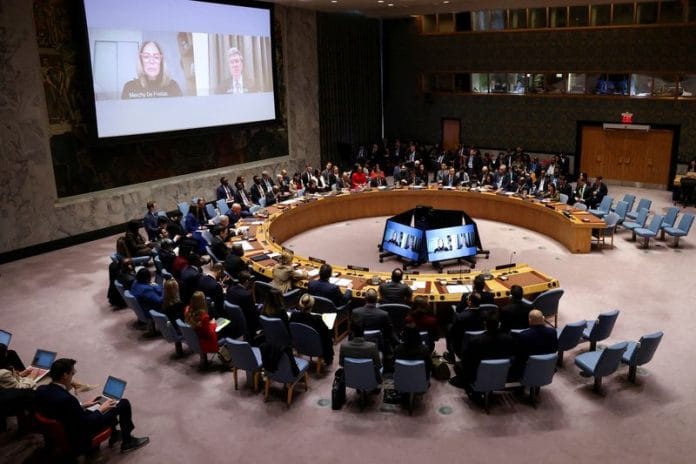
The U.N. Security Council will formally recommend a candidate to the General Assembly for election as the 10th U.N. secretary-general later this year.
The Security Council will hold secret ballots – referred to as straw polls – until a consensus is reached. The choices council members are given for each candidate in the straw poll are: encourage, discourage, or no opinion.
Ultimately, the five permanent veto-wielding council members – the United States, Russia, China, Britain and France – must agree on a candidate. The ballots for the veto powers in the straw poll are traditionally a different color to those of the 10 elected members.
When Guterres was chosen in 2016, it took six straw polls for the Security Council to reach agreement.
The Council then adopts a resolution, traditionally behind closed doors, recommending an appointment to the Assembly. The resolution needs nine votes in favor and no vetoes to pass.
The General Assembly’s approval of the appointment of a secretary-general has long been seen as a rubber stamp.
HOW TRANSPARENT IS THE PROCESS?
The United Nations has been working to improve the transparency of the historically opaque selection process.
In a resolution adopted in September 2025, the General Assembly said each candidate should provide a vision statement when they are formally nominated and be given the opportunity to present it. The statement should also be published on a dedicated United Nations web page.
The Assembly said each candidate should disclose sources of funding and that any candidates who already hold a U.N. position “should consider suspending their work in the United Nations system during the campaign, with a view to avoiding any conflict of interest that may arise from their functions and adjacent advantages”.
WHAT DOES THE SECRETARY-GENERAL DO?
The U.N. Charter calls the secretary-general the “chief administrative officer” of the world body. The U.N. website describes the role as “equal parts diplomat and advocate, civil servant and chief executive officer”.
Guterres oversees thousands of civilian staff and 11 peacekeeping operations. The core annual United Nations budget is $3.45 billion, while the peacekeeping budget is $5.4 billion.
Since the power to authorize military force or sanctions rests with the Security Council, the U.N. chief has little more than a bully pulpit. Many diplomats say the five veto powers prefer a “secretary” rather than a “general.”
HAS A WOMAN EVER BEEN SECRETARY-GENERAL?
No. There is a growing push for the United Nations to choose the first female secretary-general in its 80-year history.
In the resolution adopted in September, the General Assembly noted “with regret that no woman has ever held the position of Secretary-General” and encouraged countries to “strongly consider nominating women.”
(Reporting by Michelle Nichols and David Brunnstrom; editing by Rod Nickel, Nia Williams and Jon Boyle)
Disclaimer: This report is auto generated from the Reuters news service. ThePrint holds no responsibility for its content.