








By Jacob Gronholt-Pedersen
NUUK, Jan 15 (Reuters) – European countries were sending small numbers of military personnel to Greenland on Thursday as Denmark and its allies prepared for exercises to try to assure U.S. President Donald Trump of its security as he pushes to acquire the island.
A meeting of officials from the United States, Denmark and Greenland on Wednesday avoided the type of public humiliation meted out to Ukrainian President Volodymyr Zelenskiy last year, but also produced no quick fix for the dispute.
“The American ambition to take over Greenland is intact,” Danish Prime Minister Mette Frederiksen said in a written comment to Reuters on Thursday, describing a “fundamental disagreement”.
“That is of course serious, and therefore we continue our efforts to prevent this scenario becoming a reality.”
TRUMP CITES RUSSIAN AND CHINESE INTEREST
Trump has said the strategically located and mineral-rich island is vital to U.S. security and the United States must own it to prevent Russia or China occupying it. He has said all options are on the table for securing the territory, which is an autonomous territory of Denmark.
He says Denmark is not capable of warding off Russian and Chinese influence in the Arctic region.
Russia said NATO’s talk of Moscow and Beijing being a threat to Greenland was a myth designed to artificially whip up hysteria and warned of the dangers of escalating confrontation in the region.
Currently there is little evidence that a large number of Chinese and Russian ships sail near Greenland’s coasts.
PROMISE TO BEEF UP ARCTIC DEFENCE
Greenland and Denmark say the island is not for sale, that threats of force are reckless and security concerns should be resolved among allies.
Prominent EU countries have backed Denmark with many leaders warning a U.S. military seizure of the island could in effect spell the end of NATO.
Ahead of the meeting with the U.S., Greenland and Denmark said they had begun to increase their military presence in and around Greenland in close cooperation with NATO allies, as part of their promise to beef up Arctic defence.
European allies including Germany, France, Sweden and Norway have said they are sending military staff to begin preparations for larger drills later this year.
“The Danish Armed Forces, together with a number of Arctic and European allies, will explore in the coming weeks how an increased presence and exercise activity in the Arctic can be implemented in practice,” the Danish Ministry of Defence said.
INITIAL DEPLOYMENT APPEARS SMALL
Danish Foreign Minister Lars Lokke Rasmussen said on Wednesday that about 200 U.S. troops, far fewer than during the Cold War, were currently stationed in Greenland, which has a population of around 57,000.
And so far the scale of the planned European military build up has not been made public, but the initial deployments appeared to be small.
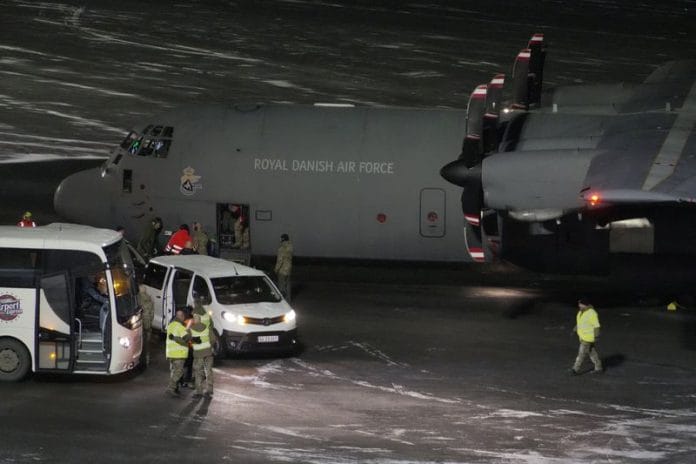
The German Armed Forces were deploying a reconnaissance team of 13 personnel, first to Copenhagen, before heading on to Greenland together with Danish personnel. Late on Wednesday, a Danish Air Force plane also landed at Nuuk airport and personnel in military fatigues disembarked and were met by two buses.
Olivier Poivre d’Arvor, France’s ambassador to the Poles, said France was sending about 15 mountain specialists to Greenland. Sweden was sending three officers and Norway two.
One British officer was also joining the reconnaissance group while the Dutch foreign minister said that it was also willing to send staff and would take a decision before the end of the week. Poland said it would not send soldiers.
TALKS AGREE TO WORKING GROUP
Nonetheless, the European military deployment to Greenland was a message to the U.S. administration, Marc Jacobsen, an associate professor at the Royal Danish Defence College, told Reuters.
“There are two messages … one is to deter, is to show that ‘if you decide to do something militarily, we’re ready to defend Greenland’,” he said.
“And the other purpose is to say: ‘Well, we take your critique seriously, we increase our presence, take care of our sovereignty, and improve surveillance over Greenland’.”
Poivre d’Arvor told France Info radio: “We will show the United States that NATO is there, that Denmark has dramatically increased its surveillance capabilities in Greenland and that the European Union is contributing to ensure the national security of the region as a whole.”
After the talks at the White House with Secretary of State Marco Rubio and Vice President JD Vance, Rasmussen and his Greenlandic counterpart Vivian Motzfeldt said the U.S. and Denmark would form a working group to discuss a broad array of concerns regarding the island.
Greenland’s prime minister reiterated on Thursday that the island did not want to be governed by, or owned by, the United States, and that it would remain part of Denmark and the NATO alliance.
“Now is not the time for internal discussions. Now is the time for unity, calm and responsibility. I’m following the situation closely, and I stand with you to look after Greenland,” Jens-Frederik Nielsen said in a Facebook post.
(Reporting by Jacob Gronholt-Pedersen in Nuuk, Terje Solsvik in Oslo, Tom Little and Soren Jeppesen in Copenhagen, and Andrew Osborn in Moscow; Additional reporting by John Irish in Paris, Kate Holton in London, Bart Meijer in Amsterdam, Madeline Chambers in Berlin, and Gwladys Fouche in Oslo; Writing by Niklas Pollard; Editing by Alison Williams)
Disclaimer: This report is auto generated from the Reuters news service. ThePrint holds no responsibility for its content.