








By Andrew Mills and Timour Azhari
DOHA/RIYADH, March 19 (Reuters) – European countries scrambled to cushion the impact of soaring oil prices on Thursday after tit-for-tat strikes on Gulf energy plants, including the world’s largest gas plant in Qatar – the most economically significant escalation of the U.S.-Israeli war on Iran.
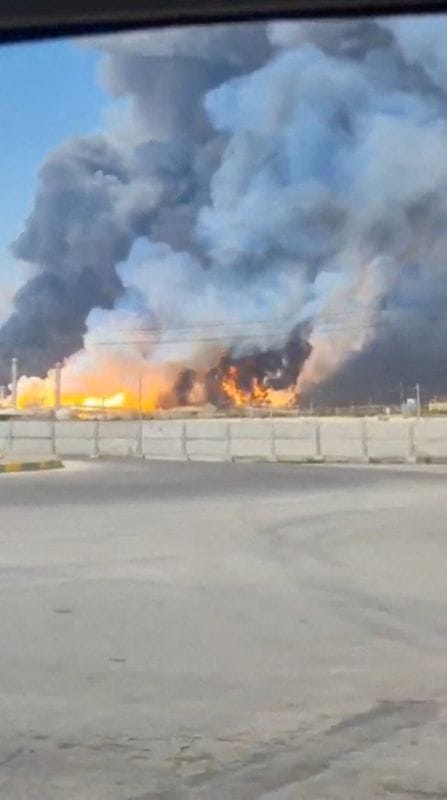
State oil giant QatarEnergy reported “extensive damage” after Iranian missiles hit the Ras Laffan Industrial City, which processes about a fifth of the world’s liquefied natural gas, in response to Israel’s bombing of Iran’s major gas field. Saudi Arabia’s back-up oil port on the Red Sea was also attacked.
The seemingly precise strikes were a dramatic demonstration of Iran’s continuing ability to exact a heavy price for the U.S.-Israeli campaign and the limits of air defences to protect one of the Gulf region’s most valuable and strategic assets.
They also suggested a lack of coordination of strategy and war aims between the two main aggressors almost three weeks into the war.
INTEREST RATES AND ENERGY PRICES WORRY EUROPE
As surging energy prices stoked inflation fears, the likelihood of interest rate hikes increased ahead of Thursday’s European Central Bank and Bank of England meetings.
And European Union leaders were also set to try to offset the jump in energy costs at a summit in Brussels, with few easy options available.
Brent futures were up about 7% to more than $114 a barrel by 1026 GMT. Meanwhile European gas prices have leapt by over 60% since the war began on February 28. [O/R]
Japanese and South Korean stocks fell around 3% while the pan-European index was down 2%. [MKTS/GLOB]
Iranian aerial attacks since Wednesday have also forced the UAE to shut its Habshan gas facility and set off fires at Kuwait’s Mina Al Ahmadi and Abdullah Port oil refineries.
Perhaps just as significantly, Saudi Arabia intercepted a ballistic missile launched towards Yanbu, the port city that serves as the kingdom’s only outlet for crude exports since Iran in effect closed the Strait of Hormuz, through which around a fifth of the world’s crude oil and liquefied natural gas normally passes.
A drone also fell on the Aramco-Exxon refinery, SAMREF, in Yanbu, the Saudi defence ministry said, adding that damage was being assessed.
Saudi Arabia said it had intercepted and destroyed four ballistic missiles launched toward the capital Riyadh on Wednesday as well as an attempted drone attack on a gas facility in the country’s east.
Iran’s armed forces command said strikes on Iran’s energy infrastructure had led to “a new stage in the war” in which it had attacked energy facilities linked to the United States.
“If strikes (on Iran’s energy facilities) happen again, further attacks on your energy infrastructure and that of your allies will not stop until it is completely destroyed,” spokesman Ebrahim Zolfaqari said, according to state media.
TRUMP SAYS ISRAEL ACTED ALONE IN ATTACKING GAS FIELD
Trump said the United States had had no advance knowledge of Israel’s attack on Iran’s gas field and that Qatar – a close partner of Washington and host to the Gulf’s biggest U.S. airbase – had not been involved.
“Israel, out of anger for what has taken place in the Middle East, has violently lashed out at a major facility known as South Pars Gas Field in Iran,” Trump posted on X.
“Unfortunately, Iran did not know this, or any of the pertinent facts pertaining to the South Pars attack, and unjustifiably and unfairly attacked a portion of Qatar’s LNG Gas facility.”
The Wall Street Journal, however, reported that Trump had supported Israel’s plan to attack South Pars, and Israeli media reported widely on Wednesday that it had been carried out with Trump’s consent and in coordination with Washington.
A source briefed on the Israeli campaign said Trump’s remarks were surprising given that Israel was closely coordinating its campaign with the U.S.
Israel has been hoping sustained military pressure on Iran, including the assassinations of senior figures, would weaken the government enough to trigger a popular uprising.
However, Israeli officials have publicly acknowledged that such an outcome is far from certain, and there has been little sign that the Tehran government is losing its grip.
In his post, Trump said that if Iran attacked Qatar again, “the United States of America, with or without the help or consent of Israel, will massively blow up the entirety of the South Pars Gas Field at an amount of strength and power that Iran has never seen or witnessed before”.
South Pars is the Iranian sector of the world’s largest natural gas deposit, shared with Qatar.
Since the start of the conflict, Tehran has targeted not only Israel, but also U.S. diplomatic and military facilities across the Gulf, while warning neighbouring states against hosting attacks on Iran.
SOURCES SAY TRUMP CONSIDERS SENDING MORE TROOPS
A U.S. official and three other people familiar with the planning told Reuters that Trump, politically vulnerable to rising fuel prices among his core voters, was considering sending thousands more U.S. troops to the Middle East.
Those troops could be used to restore the safe passage of oil tankers through the Strait of Hormuz, where Iran has been selectively attacking vessels.
Trump this week asked U.S. allies to help reopen the strait, but his request has so far been rebuffed.
More than 3,000 people have been killed in Iran since the U.S.-Israeli attacks began, the U.S.-based Iran human rights group HRANA estimates, with millions forced to leave their homes.
Authorities in Lebanon say 900 have been killed there and 800,000 displaced. Iranian attacks have killed people in Iraq and across the Gulf states, and at least 13 U.S. service members have died.
(Reporting by Andrew Mills in Doha and Timour Azhari in Riyadh; Additional reporting by Reuters bureaus; Writing by Kevin Liffey; Editing by Ros Russell)
Disclaimer: This report is auto generated from the Reuters news service. ThePrint holds no responsibility for its content.